
WordPress vs Headless CMS: Which CMS Fits Your Situation?
WordPress powers 40% of the web, but headless CMS is growing fast. Which approach delivers better performance, security, and flexibility?
WordPress remains excellent for simple websites, blogs, and teams without a technical background who want to publish content quickly. A headless CMS offers superior performance, security, scalability, and frontend flexibility for modern web projects. The trend is clearly moving toward headless, especially for businesses investing in digital experience and serving multiple channels. The choice depends on your technical capability, performance requirements, and whether you need to publish content across multiple platforms. For existing WordPress sites with large content libraries, migration is not always necessary, but for new projects headless is increasingly the wiser choice.
Background
WordPress still dominates with over 40% market share, but its architectural limitations become more visible as expectations around web performance, security, and Core Web Vitals increase. Google rewards fast websites in search results, which strengthens the business case for headless architectures. Headless CMS platforms are growing rapidly thanks to the separation of content and presentation, giving teams freedom in their frontend technology choice. Payload 3.0 now runs natively on Next.js, blurring the line between CMS and application framework. Sanity introduces Content Lake AI for intelligent content suggestions and automated quality checks.
WordPress
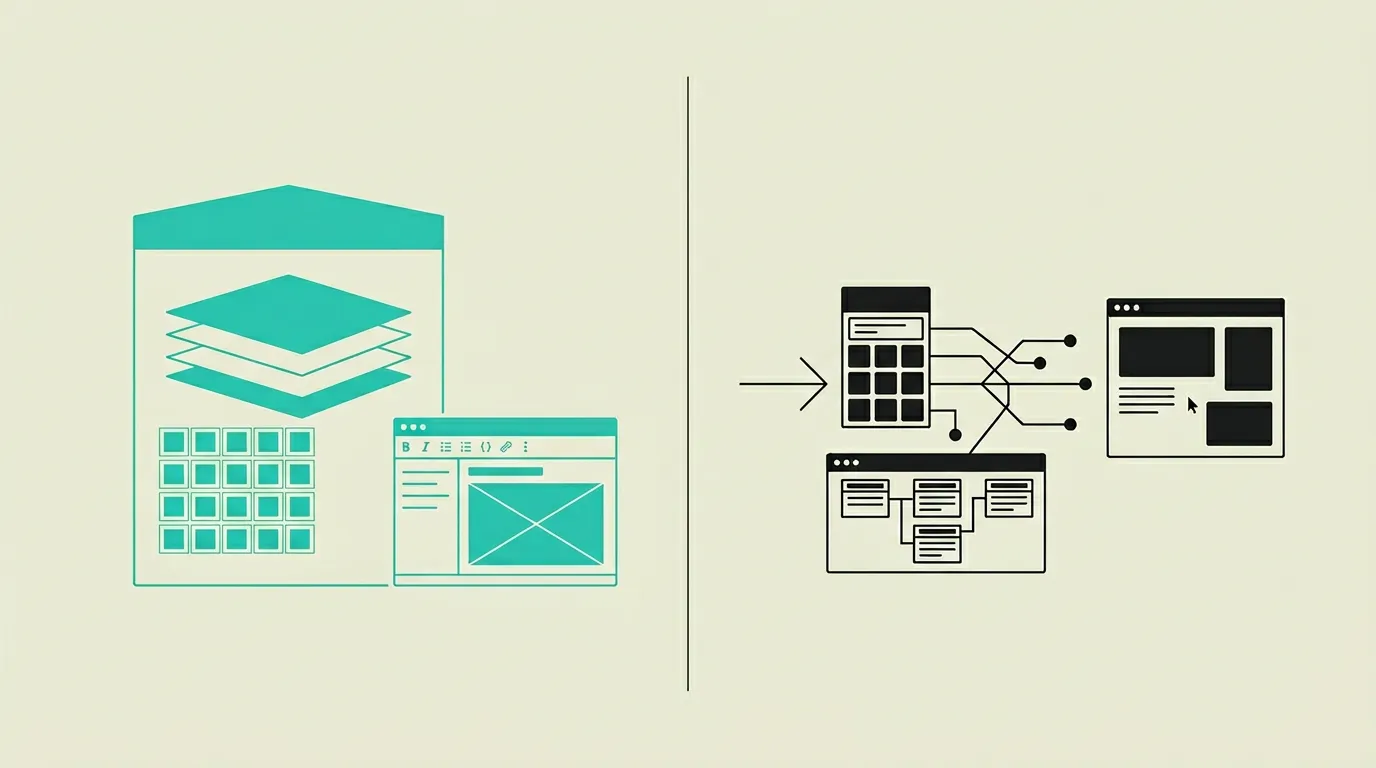
WordPress is the most popular content management system in the world, powering over 40% of all websites. The platform offers a familiar WYSIWYG editor, thousands of themes, and more than 60,000 plugins for virtually every use case. WordPress is built on PHP and MySQL, and is hosted by every hosting provider worldwide. The Gutenberg block editor has modernized the editing experience, but the monolithic architecture limits frontend flexibility and performance for demanding applications.
Headless CMS
A headless CMS delivers content exclusively via an API, completely decoupled from the frontend presentation layer. Popular options include Sanity, Payload, Strapi, and Contentful. This separation gives development teams complete freedom in their frontend technology choice: React, Vue, Svelte, or any other framework. Content can be delivered via the same API to websites, mobile apps, digital signage, and IoT devices. Structured content models ensure consistency and reusability across all channels.
What are the key differences between WordPress and Headless CMS?
| Feature | WordPress | Headless CMS |
|---|---|---|
| Ease of use | Very approachable with a WYSIWYG editor familiar to millions of users and content managers worldwide | Structured editor that is less intuitive initially but produces more consistent content through defined content models |
| Performance | Moderate to poor, PHP-based with database calls per page request and dependent on caching plugins | Excellent, content delivered via API with frontend running as static site or SSR with optimal load times |
| Security | Frequent target for hackers due to massive popularity, third-party plugins, and outdated installations | Smaller attack surface through architectural separation between frontend and backend with fewer attack vectors |
| Frontend flexibility | Tied to the theme system and PHP templates, limited possibilities for modern interactive interfaces | Complete frontend freedom with React, Vue, Svelte, or any other framework for optimal user experience |
| Ecosystem | Massive with over 60,000 plugins, thousands of themes, and an immense community of developers and designers | Growing ecosystem dependent on the chosen platform, but less broad than the WordPress ecosystem overall |
| Multi-channel | Primarily designed for websites, multi-channel requires extra plugins or the WordPress REST API as middleware | Native multi-channel support, the same content API serves web, mobile, digital signage, and IoT devices |
| Content modeling | Limited to posts, pages, and custom post types with meta fields via ACF or similar plugins | Flexible, fully customizable content models with structured fields, validation rules, and relationships |
| Scalability | Limited by PHP architecture, requires aggressive caching and CDN configuration for high traffic volumes | Excellent scalability because the API is stateless and the frontend is served as static assets via CDN |
When to choose which?
Choose WordPress when...
Choose WordPress when your team already has experience with the platform and the budget is limited for both development and hosting. WordPress is ideal for blogs, simple business websites, and projects where thousands of available plugins add immediate value without custom development. It is also the right choice when non-technical staff need to independently manage content via the familiar WYSIWYG editor and when the website does not have high performance requirements.
Choose Headless CMS when...
Choose a headless CMS when performance, security, and frontend flexibility are top priorities, when content needs to be published across multiple channels (web, mobile app, digital signage), or when your development team wants full control over the frontend stack with a modern component-based architecture. Headless is also the better choice for e-commerce platforms, SaaS marketing websites, and projects where Core Web Vitals scores directly impact conversion rates and search rankings.
What is the verdict on WordPress vs Headless CMS?
WordPress remains excellent for simple websites, blogs, and teams without a technical background who want to publish content quickly. A headless CMS offers superior performance, security, scalability, and frontend flexibility for modern web projects. The trend is clearly moving toward headless, especially for businesses investing in digital experience and serving multiple channels. The choice depends on your technical capability, performance requirements, and whether you need to publish content across multiple platforms. For existing WordPress sites with large content libraries, migration is not always necessary, but for new projects headless is increasingly the wiser choice.
Which option does MG Software recommend?
MG Software recommends a headless CMS approach for all new projects. We primarily work with Sanity for content-rich websites and Payload for projects requiring more customization and control. Both integrate seamlessly with Next.js for optimal performance, SEO, and developer experience. Sanity offers a hosted solution with realtime collaboration and the powerful GROQ query language. Payload provides full control as a self-hosted open-source CMS with TypeScript-first architecture. For existing WordPress sites, we offer migration paths to a modern headless architecture while preserving your content.
Migrating: what to consider?
When migrating from WordPress to a headless CMS, export posts, pages, and media via the WordPress REST API or WP-CLI. Restructure content into the new data model using structured fields instead of free-form text. Use tools like wp-to-sanity or custom scripts for data transfer. Plan 4 to 8 weeks including content modeling, data migration, frontend development, and redirect configuration to preserve SEO value of existing URL structures that have accumulated link equity.
Frequently asked questions
Can I use WordPress as a headless CMS?
Yes, WordPress provides a built-in REST API that allows you to use it as a headless CMS with a separate frontend in React, Vue, or Next.js. This combines the familiar WordPress editor with the advantages of a modern frontend. The downside is that you carry the full WordPress backend overhead including PHP execution, database calls, and the security risk of plugins. For new projects we recommend a native headless CMS built from the ground up for API-first content delivery.
Is a headless CMS more expensive than WordPress?
It depends heavily on the chosen platform and your hosting situation. Open-source options like Strapi and Payload are free to self-host on a VPS or cloud service. Hosted solutions like Contentful and Sanity offer free tiers sufficient for small projects. Total costs are often comparable to a well-configured WordPress installation. Keep in mind the higher frontend development costs: headless requires custom development while WordPress themes work out of the box.
Which headless CMS does MG Software recommend?
We primarily work with Sanity for content-rich projects that benefit from realtime collaboration, the powerful GROQ query language, and the hosted content platform. For projects requiring more customization and full control, we choose Payload which is open-source and can be self-hosted. Both offer excellent TypeScript support and integrate seamlessly with Next.js. The choice depends on whether you prefer a hosted or self-hosted solution.
How does content management work in a headless CMS?
Content management in a headless CMS works through a structured editor where content is entered into predefined fields rather than a free-form WYSIWYG page. This feels different from WordPress but produces more consistent content that is reusable across multiple channels. Sanity offers a visually appealing dashboard with realtime collaboration between editors. Most content managers need 1 to 2 weeks to become productive with the new workflow.
What are the SEO benefits of going headless?
A headless CMS combined with Next.js delivers superior SEO performance thanks to server-side rendering that generates complete HTML for search engines, blazing fast load times through static generation and CDN delivery, and excellent Core Web Vitals scores. Google rewards fast websites in search results. Additionally, you have full control over metadata, structured data, and URL structure without depending on SEO plugins that can conflict with theme code.
Can I migrate my existing WordPress content?
Yes, WordPress content can be migrated to any headless CMS. The WordPress REST API and WP-CLI provide access to all posts, pages, media, and custom fields. Tools like wp-to-sanity automate the migration to Sanity specifically. The most important consideration is restructuring free-form text into structured content models. Also plan redirect rules for all existing URLs to preserve SEO value accumulated over time.
Is WordPress secure enough for a business website?
WordPress can be secure with proper configuration, regular updates, a limited number of trusted plugins, and a Web Application Firewall. The reality however is that WordPress is a constant target for automated attacks due to its enormous popularity. Over 90% of hacked CMS websites run on WordPress. A headless CMS fundamentally reduces the attack surface through the separation of frontend and backend. For business websites where security is critical, headless provides an architecturally more secure foundation.
We build production software with this stack
Our developers work with these tools daily for clients across Europe. Price estimate within 24 hours.
 Discuss your project