
Alternatives to Qwik: 5 Frameworks Compared (2026)
The main alternatives to Qwik are Next.js, Astro, SvelteKit, Remix and SolidStart. See what each does better, its trade-offs and which one fits your project.
At MG Software we recommend Next.js for projects where ecosystem breadth and time-to-market are decisive factors. For content-driven sites we choose Astro thanks to its superior loading performance. We suggest SvelteKit when compact bundles and developer experience take priority. The right choice depends on your team competencies, project complexity and the balance between raw performance and ecosystem support.
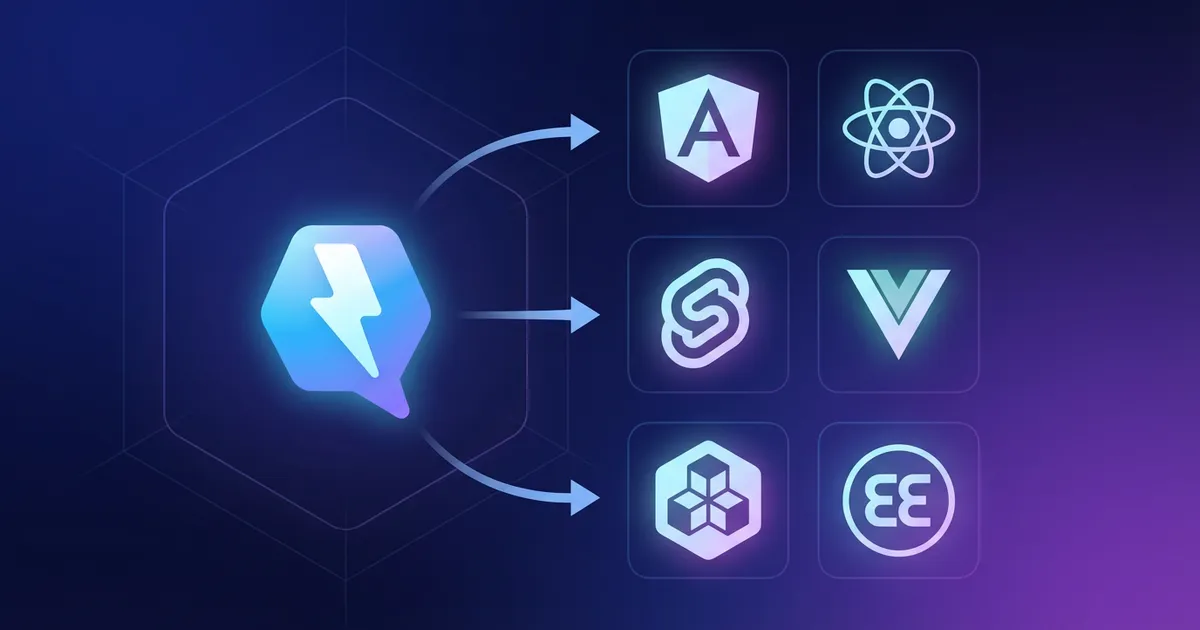
Why do people look for alternatives to Qwik is a JavaScript framework developed by Builder.io under the lead of Miško Hevery, the original creator of Angular. Its core principle is resumability: instead of hydrating the entire application on load, Qwik serializes state into HTML and resumes execution only when a user actually interacts. This results in extremely low Time to Interactive scores regardless of application size. Qwik City serves as the meta-framework providing file-based routing, server-side rendering and data loaders. The framework uses JSX syntax similar to React, lowering the learning curve for developers coming from the React ecosystem.?
Despite its impressive technical architecture, teams in 2026 choose alternatives for several practical reasons. The Qwik ecosystem is considerably smaller than that of Next.js or SvelteKit, with fewer component libraries, plugins and community resources available. Finding experienced Qwik developers is difficult because the framework is still relatively new in the market. Developer tooling is less mature: debugging lazy-loaded chunks requires extra attention and some IDE extensions lack features that are standard for React or Svelte. Additionally, hosting platforms offer fewer optimized deployment adapters for Qwik City compared to Next.js or Astro.
Best alternatives
Next.js
Next.js by Vercel is the most widely adopted React framework for production applications. Version 15 delivers React Server Components, Partial Prerendering, the App Router with nested layouts, and optimized Image and Font components. Its ecosystem is the largest in the frontend landscape with thousands of compatible libraries. Vercel provides optimized hosting, but Next.js runs equally well on platforms like Railway, Fly.io and self-managed servers.
Pros
- +Largest ecosystem of all React frameworks with thousands of compatible libraries and UI components
- +Partial Prerendering combines static and dynamic content without choosing between SSG and SSR
- +Extensive deployment options: optimized on Vercel but fully self-hostable on any Node.js server
- +Active community with over 125,000 GitHub stars and comprehensive documentation and tutorials
Cons
- -Larger JavaScript bundles than Qwik for complex applications due to full React hydration model
- -Vercel-specific features like Edge Middleware and ISR do not work identically on other hosting platforms
- -The App Router has a steeper learning curve due to Server Components, Server Actions and caching layers
Astro
Astro is a content-driven framework that ships zero JavaScript to the browser by default. Its Islands architecture loads interactive components selectively, similar to Qwik's lazy loading but at the component level. Astro supports React, Vue, Svelte, Solid and Preact components in the same project. Content Collections provide type-safe content management with Markdown and MDX. Astro 5 introduced Content Layer API for external data sources and Server Islands for dynamic islands within static pages.
Pros
- +Zero JavaScript by default with selective hydration via Islands that load only when needed
- +Use React, Vue, Svelte or Solid components together in one project without extra configuration
- +Content Collections with full TypeScript validation for Markdown, MDX and external data sources
- +Extremely fast builds and outstanding Lighthouse scores due to minimal client-side JavaScript
Cons
- -Less suitable for complex single-page applications with heavy client-side interactivity and state
- -Islands architecture requires conscious decisions about which components need to be interactive
- -Smaller community than Next.js with fewer available templates, starters and enterprise references
SvelteKit
SvelteKit is the full-stack framework built on top of Svelte that compiles to vanilla JavaScript without virtual DOM overhead. Svelte 5 introduced runes as reactivity primitives enabling fine-grained updates without diffing. SvelteKit provides file-based routing, server-side rendering, form actions and adapters for various hosting platforms. Bundle sizes are consistently smaller than React-based frameworks. The compiler model of Svelte shares Qwik's philosophy of shipping less JavaScript to the browser.
Pros
- +Compiler generates optimized vanilla JavaScript without virtual DOM overhead or runtime library
- +Svelte 5 runes offer granular reactivity comparable to Qwik signals in performance benefit
- +Significantly smaller bundle sizes than React frameworks for equivalent application complexity
- +Intuitive syntax that stays close to standard HTML, CSS and JavaScript with a gentle learning curve
Cons
- -Smaller ecosystem than React: fewer component libraries, fewer job listings and less Stack Overflow coverage
- -Svelte 5 runes require a mindset shift from the original $: reactivity model for existing projects
- -Less enterprise adoption than Next.js making it harder to get approval in larger organisations
Remix
Remix, now part of Shopify, is a full-stack framework that puts web standards at its centre. It uses progressive enhancement as a core principle: forms work without JavaScript and are progressively enhanced when JS is available. Remix offers nested routing with error boundaries per route, loader and action functions for data fetching and mutations, and supports streaming via React Suspense. After the Shopify acquisition, Remix is actively developed with a focus on e-commerce and performance.
Pros
- +Progressive enhancement ensures forms and navigation work even without any client-side JavaScript
- +Nested routing with error boundaries per segment isolates failures without breaking the entire page
- +Loaders and actions follow web standards with Request/Response API for intuitive data management
- +Streaming SSR with React Suspense provides faster perceived load times for slow data sources
Cons
- -Smaller ecosystem and fewer community resources than Next.js despite strong technical foundations
- -No built-in static site generation: all pages are server-rendered per request by default
- -The future direction as React Router framework can be confusing for developers new to the ecosystem
SolidStart
SolidStart is the meta-framework for Solid.js, a reactive framework that uses fine-grained reactivity without a virtual DOM. Solid's reactivity model is conceptually closest to Qwik signals and offers comparable performance advantages. SolidStart provides file-based routing, SSR, API routes and various deployment adapters. Bundle sizes are minimal and runtime performance ranks among the fastest of all JavaScript frameworks. Solid 2.0 is in active development with improved async primitives.
Pros
- +Fine-grained reactivity without virtual DOM delivers benchmark results consistently close to vanilla JS
- +Signals and stores provide a reactivity model that is conceptually similar to Qwik signals
- +Minimal bundle size and extremely fast updates through direct DOM manipulation without diffing
- +JSX syntax makes the transition from React or Qwik easier than switching to Svelte or Vue
Cons
- -Smallest ecosystem of all listed alternatives with limited component libraries and tooling support
- -SolidStart is less mature than Next.js or SvelteKit for production full-stack applications
- -Solid's reactivity rules around destructuring require a mindset shift for React developers
Comparison at a glance
Next.js offers the widest ecosystem and the most deployment options. Astro wins on loading speed for content sites with its zero-JS approach. SvelteKit combines small bundles with an intuitive syntax. Remix excels at progressive enhancement and web standards. SolidStart delivers the highest runtime performance through fine-grained reactivity without a virtual DOM.
What to consider when switching?
- Size of the available ecosystem of libraries, components and community resources for your project
- Availability of developers on the job market with experience in the chosen framework
- Importance of minimal JavaScript bundles versus breadth of features and integration options
- Need for server-side rendering, static generation or a hybrid approach on a per-page basis
- Extent to which progressive enhancement and functioning without JavaScript is a requirement
Which alternative does MG Software recommend?
At MG Software we recommend Next.js for projects where ecosystem breadth and time-to-market are decisive factors. For content-driven sites we choose Astro thanks to its superior loading performance. We suggest SvelteKit when compact bundles and developer experience take priority. The right choice depends on your team competencies, project complexity and the balance between raw performance and ecosystem support.
Frequently asked questions
Why is the Qwik ecosystem smaller than the Next.js ecosystem?
Qwik is a relatively young framework that only reached version 1.0 in 2023, while Next.js has existed since 2016 and has built up an enormous ecosystem over the years. Qwik's unique resumability model requires libraries to be specifically compatible with the lazy-loading architecture. Many existing React libraries do work in Qwik through the qwik-react wrapper, but not all features are fully optimized. The community is growing steadily but remains substantially smaller than that of established frameworks.
Is Qwik faster than Next.js?
Qwik generally delivers a lower Time to Interactive on the initial page load because it skips hydration entirely. The browser does not need to download and execute JavaScript before the page becomes interactive. Next.js with Partial Prerendering in version 15 significantly narrows this gap. For simple pages the difference is minimal. On complex applications with many interactive elements, Qwik's resumability can provide a noticeable advantage, though Next.js offers more optimization paths via Server Components.
Can I use React components inside Qwik?
Yes, Qwik provides an official qwik-react integration package that lets you wrap existing React components as Qwik components. This enables incremental migration without rewriting everything. The wrapped components do lose the benefit of resumability and are hydrated traditionally. For optimal performance you should eventually rewrite components in native Qwik. This hybrid approach is useful during a transition period but not a long-term solution for performance-critical paths.
Which framework produces the smallest bundle size?
SolidStart and SvelteKit consistently produce the smallest JavaScript bundles of the listed alternatives. Solid.js compiles to direct DOM manipulations without virtual DOM runtime, while Svelte compiles to optimized vanilla JavaScript. Astro ships zero JavaScript to the browser by default unless you explicitly define interactive islands. Qwik itself has a minimal initial bundle but loads chunks on demand. Next.js produces the largest bundles but optimizes this through automatic code splitting and tree shaking.
How difficult is it to migrate from Qwik to Next.js?
Migrating from Qwik to Next.js is substantial but achievable. Both frameworks use JSX syntax, which simplifies component conversion. The biggest adjustments involve replacing Qwik signals with React state management, converting loaders to Server Components or API routes, and adapting the routing structure. Plan two to four weeks for a mid-size project. Start with the pages that receive the most traffic and migrate incrementally to manage risk effectively.
Is Astro a complete replacement for Qwik?
Astro is an excellent alternative for content-driven websites and marketing sites where most page content is static. Its Islands model offers similar benefits to Qwik's lazy loading at the component level. For complex single-page applications with heavy client-side state and interactivity, Astro is less suitable. In those cases Next.js, SvelteKit or SolidStart are better options. Astro pairs perfectly with a UI framework of your choice for the interactive parts of your application.
Which Qwik alternative is best for a startup?
For startups we recommend Next.js due to the vast availability of developers, libraries and deployment options. You can build an MVP quickly with the extensive ecosystem and optimize later. SvelteKit is a strong alternative if your team is smaller and performance matters from day one. Astro works exceptionally well for content-driven startups such as blogs, marketplaces or documentation platforms. The decision depends on the type of application and the skills within your team.
Ready to migrate?
We move teams from legacy tools to modern alternatives with zero downtime and full data integrity.
 Plan your migration