
Product updates7 Jul 20269 min read
Mandatory E-Invoicing Is Coming: What SMEs Need to Know About ViDA Now
The Dutch government decides this summer whether e-invoicing becomes mandatory for domestic B2B invoices. What ViDA, Peppol and EN16931 mean for your administration and software, and which steps to take now.

Co-founder

Introduction
A change is coming that will affect virtually every business in the Netherlands, and most owners have never heard of it: mandatory e-invoicing. The European ViDA directive requires electronic invoices and near real-time reporting to the tax authority for cross-border B2B trade from July 1, 2030. And the Dutch government is expected to decide this summer whether that obligation will extend to all domestic business invoices.
We build a lot of invoicing modules, client portals and integrations with accounting packages, so this legislation regularly lands on our drawing board. In this article we lay out what has been decided, which choice the Netherlands is making now, and what you need to arrange at which moment.
What Was Decided in Brussels
ViDA stands for VAT in the Digital Age, a package of revised VAT rules that the European Council formally adopted on March 11, 2025. Its most far-reaching pillar requires all EU member states to introduce e-invoicing and digital reporting for cross-border B2B transactions by July 1, 2030. Invoices must then comply with the European EN16931 standard and be sent in a structured format, and the key invoice data must be reported to the national tax authority in near real time.
The goal is fighting VAT fraud, which costs the EU billions every year, and reducing administrative burdens over time. For the Dutch tax authority it means a fundamentally different information position: instead of periodic returns after the fact, the tax office sees transaction data almost immediately.
The Choice the Netherlands Faces This Summer
The directive only mandates cross-border traffic. For domestic B2B invoices, member states can choose whether to extend the obligation. That is exactly the question now on the table in The Hague. Research firm EY, commissioned by the Ministry of Finance, worked out two scenarios: implementing only the European obligation, or a broad national rollout in which domestic business invoices must be electronic as well.
EY recommends the broad variant, because despite higher introduction costs it is expected to deliver a substantial structural reduction in administrative burdens. In the government response of March 10, 2026, the State Secretary for Finance indicated this advice weighs heavily in the further elaboration. The government is expected to make the call in the summer of 2026, with a public consultation on the draft bill in the fourth quarter of 2026.
What Actually Changes About an Invoice
An e-invoice is not a PDF you email. It is a structured data file, usually XML following the EN16931 standard, that the receiving system can automatically read, validate and book. No retyping, no scan-and-recognize software that turns an 8 into a 3, no invoices stuck in someone's mailbox.
For the infrastructure, the policy study discussed three models: the open Peppol network already widely used in the Netherlands for invoicing the government, a model based on the French approach with certified service providers, and an entirely new national platform. The final choice has not been made, but in practice Peppol is the most likely backbone: the network exists, has a proven track record, and many accounting packages can already work with it.
What This Means for Your Administration and Software
If you use a standard accounting package such as Exact Online, Moneybird or e-Boekhouden, your vendor does the heavy lifting. Most major packages already support sending and receiving via Peppol, or have it on their roadmap. Your main action is checking whether your package participates and adjusting your processes accordingly.
The real work sits with companies that have custom software in the invoicing chain. Think of a webshop that generates its own invoices, a SaaS product with its own billing module, a client portal where invoices are published, or an ERP system with custom invoicing. Everywhere a PDF currently rolls out of a template, a valid EN16931 invoice must come out instead, and everywhere purchase invoices come in, structured data must be received and processed. We build these kinds of API integrations daily and find the adaptation is rarely huge, but it does demand care around validation, error handling and archiving.
The Opportunity Hidden in the Obligation
It is tempting to see this as yet another compliance burden, but there is serious efficiency to be gained. Companies that already exchange invoices in structured form report less manual bookkeeping, faster payments and far fewer disputes about lost or incorrect invoices. A purchase invoice that arrives automatically, gets validated and sits ready for approval quickly saves minutes per invoice.
For companies with high invoice volumes, that is a business case in itself. Run the numbers: one hundred purchase invoices per month times five minutes of manual processing is more than a full working day per month. Automate that through an integration and the investment typically pays for itself within a year. Our calculator gives a first indication of what such an integration costs.
A Realistic Timeline Toward 2030
For most companies, mandatory e-invoicing is not a software replacement but an integration question. If you fold it into regular development, you will barely notice it later.
Jordan Munk, co-founder MG Software
There is no reason to panic, but there is reason to plan. This year and next, the legislation becomes concrete: the decision on the broad mandate this summer, the public consultation in the fourth quarter, and then the bill's journey through parliament. If you trade with other EU countries, your July 1, 2030 deadline is already fixed.
Our rule of thumb: in 2026, map where invoices originate and arrive in your processes and which systems are involved. In 2027, ask your package vendors about their planning and identify which custom software needs adapting. That leaves ample time to include the changes in regular development work instead of an expensive rush job in 2029.
Conclusion
ViDA is coming, and the only real open question for the Netherlands is how broad the mandate will be. Cross-border invoicing becomes electronic on July 1, 2030 regardless, and there is a realistic chance domestic B2B invoices will follow. If you have custom software in your invoicing chain, mapping that chain this year is time well spent.
Do you have custom invoicing, a client portal or integrations that will be affected? Get in touch and we will look at what is needed and when. It is usually less work than feared, as long as you start on time.
Frequently asked questions
When does e-invoicing become mandatory in the Netherlands?
For cross-border B2B transactions within the EU, e-invoicing with digital reporting becomes mandatory on July 1, 2030, based on the European ViDA directive. Whether the obligation will also apply to domestic B2B invoices is a national choice. The Dutch government has announced it will provide clarity in the summer of 2026, with a public consultation on the draft bill planned for the fourth quarter of 2026.
Will a PDF invoice still be valid?
Under ViDA, a PDF does not count as an electronic invoice. An e-invoice is a structured file that follows the European EN16931 standard, usually in XML format, which systems can read and process automatically. To software, a PDF is just a picture, so it does not meet the new requirements for transactions covered by the mandate.
What exactly is Peppol?
Peppol is an open, secured network for exchanging electronic documents such as invoices. You connect through an access point and can then invoice any other connected party, similar to how email providers exchange messages. In the Netherlands, Peppol is already widely used for invoicing the government, and it is one of the infrastructures being considered for the broader B2B mandate.
Do I need to replace my accounting software?
Usually not. Major packages such as Exact Online and Moneybird already support e-invoicing via Peppol or are working on it. The real work is usually in custom software: your own invoicing modules, portals or integrations that currently generate PDF invoices. Those need to be adapted to send and receive structured invoices, and you do not want to still be figuring that out in 2029.
Co-founder
Related posts
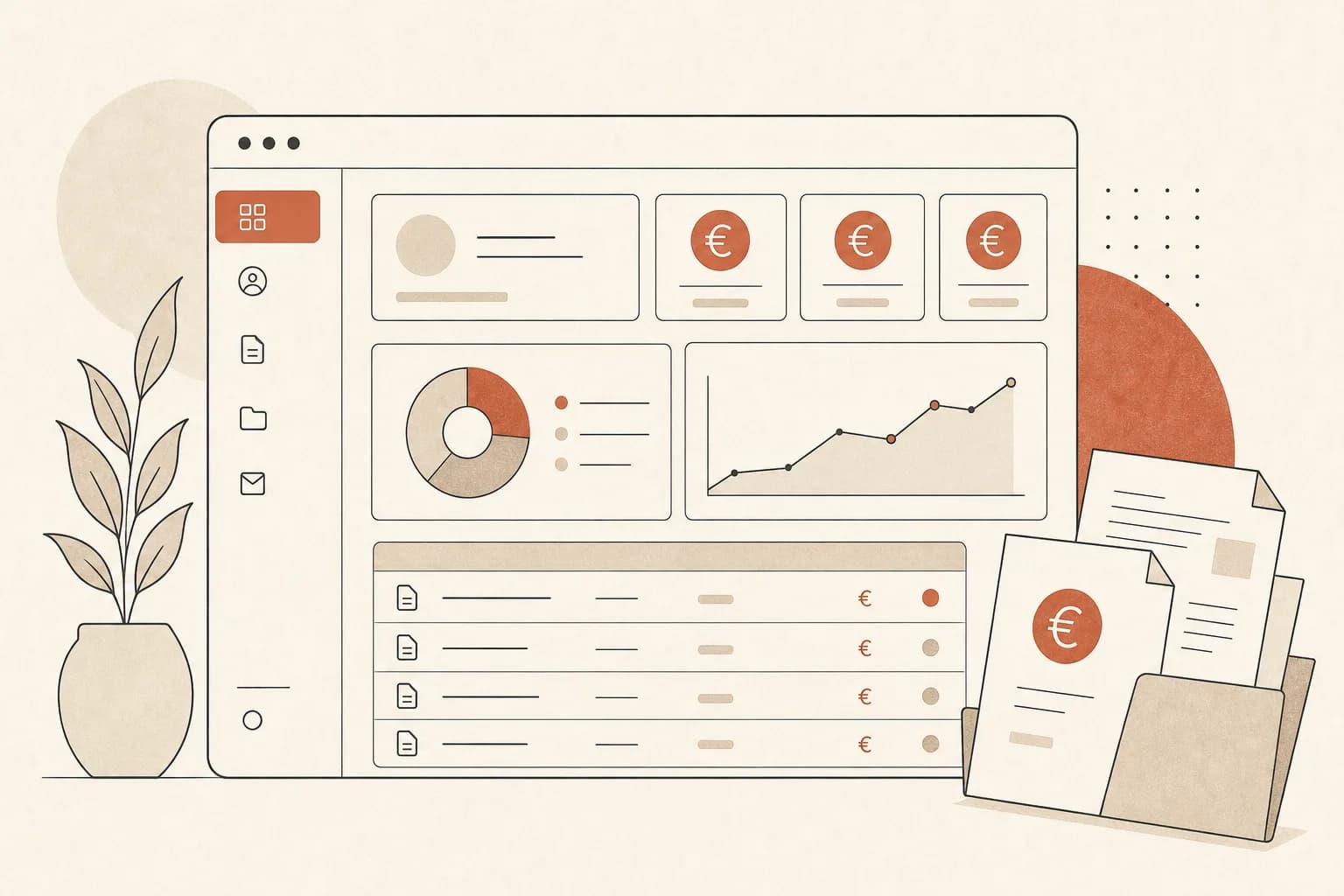 Product updatesWhat does a client portal cost in 2026? Honest price bandsRead article
 Product updatesWhat Does Custom Software Maintenance Cost Per Year?Read article
 Product updatesLegacy Software: 7 Signs It Is Time to Modernize (Before It Costs You Customers)Read article
 Product updatesHow to Choose a Software Development Agency in 2026: 12 Questions That Reveal the TruthRead article