Product updates28 Apr 202613 min read
How to Choose a Software Development Agency in 2026: 12 Questions That Reveal the Truth
Most agencies look identical in the sales pitch. These 12 questions separate the agencies that ship working software from the ones that burn your budget. Use this checklist before signing any contract.

Co-Founder

Introduction
Every software agency website looks the same. Same buzzwords. Same case study photos. Same promises about partnership and innovation. After a thirty-minute sales call, prospects often feel less informed than when they started. Yet the agency choice will shape the next twelve to thirty-six months of business operations. Pick well and the software becomes a competitive asset. Pick poorly and you spend a year fighting fires before realizing the foundation was wrong.
We have seen this from both sides. Clients have hired us after a previous agency delivered something unmaintainable. We have also lost prospects who chose a competitor based on lower price, only to come back twelve months later asking us to rebuild the work that did not survive contact with reality. The pattern is consistent enough that we wrote down the questions that separate the agencies that ship working software from the ones that do not. These are the twelve we recommend asking before signing any contract.
Question 1: Who Specifically Will Work on My Project
Sales teams introduce a senior architect during the pitch. Implementation teams sometimes look very different. The architect signs off the proposal, then your project lands with three juniors and a delivery manager who has been there six weeks. The work suffers and nobody told you the substitution happened.
Ask for names. Ask for LinkedIn profiles of the actual people who will write your code. Ask for their experience with the specific stack your project requires. A reputable agency provides this information without hesitation. An agency that deflects with "we will assign the right team" is signaling that the team you saw in the pitch is not the team you will get.
Question 2: What Is Your Senior to Junior Ratio
Software agencies make money on the ratio between hourly cost and hourly billing rate. The widest margins come from junior developers billed at near-senior rates. This works when seniors actively review junior work. It fails when juniors operate without supervision and ship code that works in development but breaks in production.
A healthy production project has one senior for every two to three medior or junior developers, with the senior spending at least 30 percent of their time reviewing code rather than writing it. Ask the agency directly: how many seniors are on my team and how many hours per week will they spend reviewing the work. Vague answers indicate a model where seniors close deals and juniors do unsupervised work.
Question 3: Show Me Code You Have Recently Written
This question filters out the agencies that buy templates and repaint them. Ask to see actual code samples from a recent project. Not screenshots. Not architecture diagrams. The code itself. A reputable agency can share anonymized excerpts within 24 hours. They can explain why functions are structured the way they are. They can show test coverage. They can walk through their commit history and explain what changed and why.
If an agency cannot show code without breaking client confidentiality, ask for an open-source contribution from any of their developers. Real engineers have github profiles. Real engineering teams contribute back occasionally. An agency where nobody on the team has visible engineering work is an agency where the engineering may not exist at the level the sales team implied.
Question 4: How Do You Handle Scope Changes
Scope changes are the dominant source of project failure. A poorly handled change process either freezes the project in bureaucratic paralysis or turns it into a free-for-all where every meeting adds requirements without adjusting timeline or budget.
A mature agency has a written process. They show you what a change request document looks like. They explain how they estimate the impact on timeline and budget. They describe what happens when you accept versus decline a change. They have examples of clients who declined changes and stayed within original scope. If the answer is "we are flexible, we will figure it out" the agency does not have a process and you are about to learn what scope creep costs.
Question 5: What Happens When Timelines Slip
Software projects miss deadlines. The question is what happens next. Bad agencies absorb the slip silently and bill more. Good agencies surface the slip immediately, explain why, and present options with tradeoffs.
Ask the agency to walk you through a recent project where they missed a deadline. If they claim to never miss deadlines, they are lying or they overpad estimates so badly that you are paying for slip they planned in advance. Honest agencies have stories. Listen for who took responsibility, what they changed afterwards, and how they communicated with the client during the slip.
Question 6: Can I Speak to Three Recent Clients
Every agency has a few showcase clients they happily reference. The pattern that matters is whether they can produce three recent clients, including one whose project did not go perfectly. Ask specifically for a project that had difficulty.
When you talk to references, do not ask whether they were satisfied. Ask whether the agency surfaced problems early or late. Ask what happened when they had a disagreement. Ask whether they would hire the agency again, and listen for hesitation more than the literal words. References are coached. Hesitation is not.
Question 7: How Do You Document What You Build
Software without documentation creates lock-in to the team that built it. When the original developers leave or the relationship ends, you inherit a black box. New developers spend months understanding what the code does. Maintenance becomes risky. Modifications take ten times longer than they should.
A professional agency documents architecture decisions, API contracts, deployment procedures, and known edge cases. They show you sample documentation from a previous project. They include documentation in the deliverables, not as an afterthought but as a contractual milestone. Agencies that promise to document everything but cannot show examples deliver software you will eventually have to rewrite.
Question 8: Who Owns the Code and Infrastructure
Read the contract specifically on intellectual property, source code access, deployment credentials, and domain ownership. Some agencies retain ownership and license usage to clients. Others give clients full ownership but keep deployment infrastructure under agency control. The wrong arrangement traps you.
You should own the source code outright. You should have direct access to the code repository as the primary owner. You should hold the deployment credentials, even if the agency operates them daily. You should own all domains, certificates, and cloud accounts. If any of these are held by the agency in a way that creates leverage, replace those terms in the contract or walk away.
Question 9: How Do You Handle Security
Most agencies treat security as something that gets added at the end if there is budget left. The result is software that ships with credentials in source code, missing input validation, no rate limiting, and authentication that protects nothing meaningful.
Ask the agency how security is integrated into their development process. Do they use automated scanning in CI? Do they run dependency vulnerability checks? How do they handle secrets and configuration? When was the last time they did a security review on a project before launch? In a year where AI tools and supply chain attacks are escalating, agencies that cannot answer these questions concretely are exposing your business to risks they do not understand. Our blog on AI tool security risks covers what serious teams now consider baseline.
Question 10: What Does Maintenance Look Like After Launch
Software needs maintenance. Operating systems update, libraries get security patches, browsers change behavior, regulations evolve. An agency that disappears after launch leaves you with software that decays from working to broken without anyone touching it.
Ask about post-launch support specifically. What is the response time for production issues? Is there a maintenance retainer? How do you handle bugs found after launch? What happens with library updates and security patches? A serious agency has clear answers and standard agreements for ongoing support. An agency that wants to launch and walk away will leave you with software that breaks within twelve months.
Question 11: How Do You Estimate Project Costs
Software estimation is hard. Agencies that promise exact fixed pricing for poorly defined scope are either padding heavily or planning to renegotiate when reality hits. Agencies that refuse to estimate at all are not running a real business.
A mature estimation conversation includes assumptions, risks, and a range. The agency walks you through what would make the project cheaper or more expensive. They explain which features carry uncertainty and propose how to handle that uncertainty. They give you a realistic range with a note about what would push the project to either end of the range. If you want to validate ranges yourself, our project calculator gives a starting point.
Question 12: What Happens When We Disagree
The agency relationship will hit a moment where you and the team disagree on something important. The technical approach. The priority of features. The acceptance of a missed deadline. How the agency handles disagreement reveals more than any case study.
Ask directly: how do you handle a situation where the client wants something different than what your team recommends. Healthy agencies describe a process: they document the disagreement, they explain their reasoning, they propose alternatives, and ultimately they respect the client decision while documenting the risks they flagged. Unhealthy agencies either capitulate immediately to keep the client happy or dig in stubbornly until the client gives up. Either pattern leads to bad outcomes.
How We Approach These Questions Ourselves
We use this checklist when we talk to clients because we want them to evaluate us by the same standards we suggest. The team you meet in the pitch is the team that builds your project. We share code samples and engineering practices openly. We have a written change management process and use it consistently. We document everything in a way that other developers can pick up. Our clients own their code and infrastructure outright.
We also miss deadlines occasionally. We have had disagreements with clients. We have produced software that was not as polished as it should have been on the first iteration. We will tell you about those situations honestly when you ask. The agencies that pretend they never make mistakes are either inexperienced or dishonest. Look for the ones who tell you about their mistakes and show you what they changed afterwards. Reach out if you want to walk through a project together. We will give you a realistic assessment, including telling you when we think we are not the right fit.
Conclusion
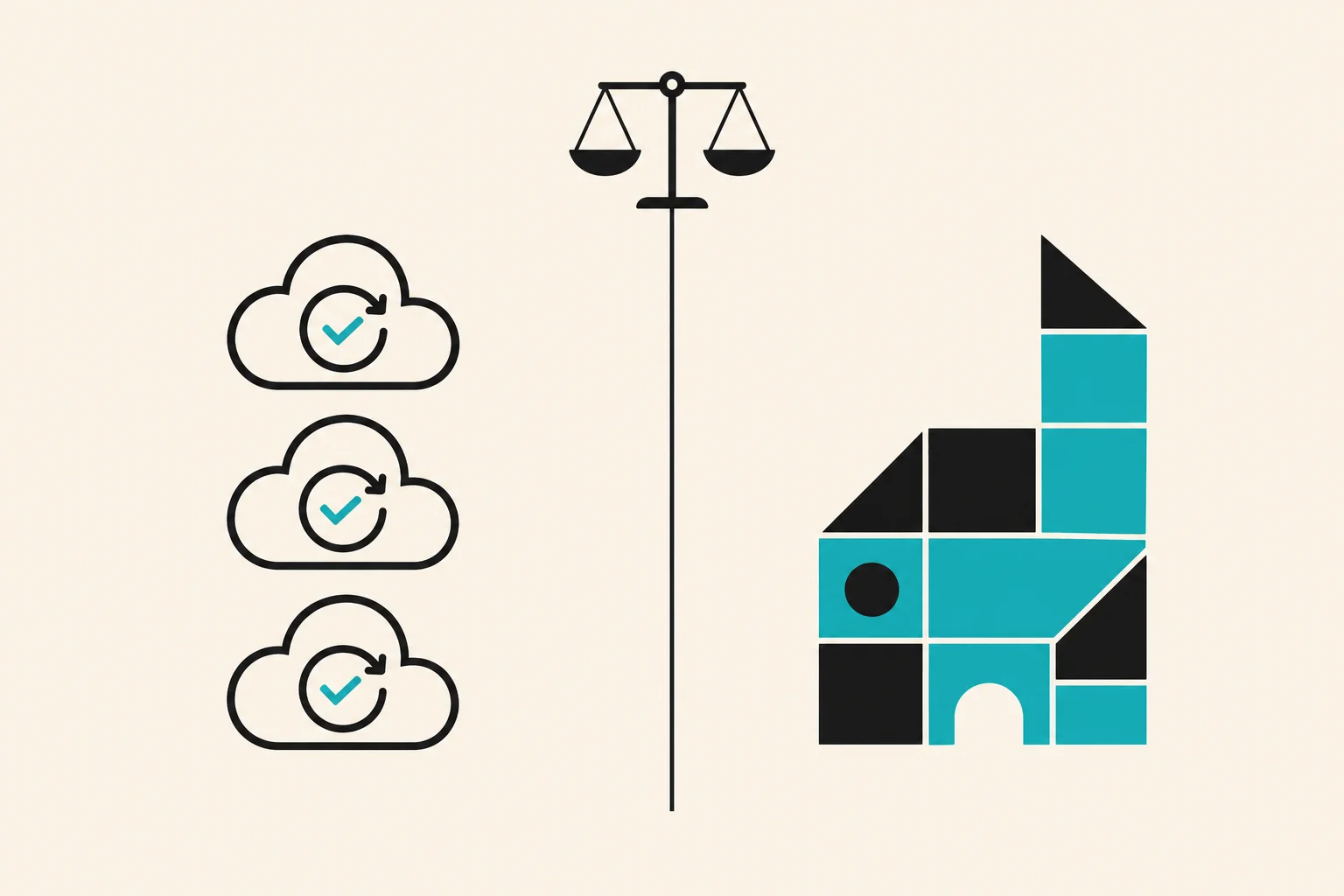
Choosing a software agency is choosing a business partner for the next phase of your operation. The price comparison matters less than the trust comparison. An agency 20 percent more expensive that ships maintainable software on a predictable schedule costs less in total than the agency 30 percent cheaper that delivers something you have to rewrite.
These twelve questions are not magic. They are filters. The agencies that answer them clearly, with specific examples and references, are operating at a level where you have predictable outcomes. The agencies that deflect or generalize are signaling exactly what kind of partner they will be when things get difficult. The signals are usually clear if you ask, and asking takes one meeting. Skipping the questions costs months of regret.
Frequently asked questions
What should I ask a software agency before hiring them?
Ask about their senior to junior ratio, who specifically will work on your project, how they handle scope changes, what happens when timelines slip, and which past projects you can speak to references about. Vague answers to specific questions are the clearest red flag.
How do I know if a software agency is reliable?
Reliable agencies show their work transparently. They share recent client references willing to discuss difficult moments, demonstrate code quality with concrete examples, explain their architecture decisions in plain language, and provide written estimates with assumptions clearly stated. Unreliable agencies talk about awards and deflect specifics.
What are red flags when choosing a software developer?
Red flags include refusing to share team backgrounds, vague pricing without clear assumptions, no written process for change requests, dismissing your existing systems without inspection, promising fixed pricing for undefined scope, and pressure to sign without reviewing the contract carefully.
How much does a good software agency cost in the Netherlands?
Quality Dutch agencies bill between 95 and 145 euros per hour for senior developers, 70 to 100 euros for medior, and 50 to 70 euros for junior. Total project costs depend on complexity. Be cautious of agencies pricing significantly below this range without clear explanation.
Co-Founder