
Product updates28 Apr 202612 min read
Custom Software vs SaaS in 2026: When to Build, When to Buy
Off-the-shelf SaaS gets you running in days but limits your competitive edge. Custom software fits perfectly but takes time and budget. Here is the decision framework we use with every client.

Co-Founder
Introduction
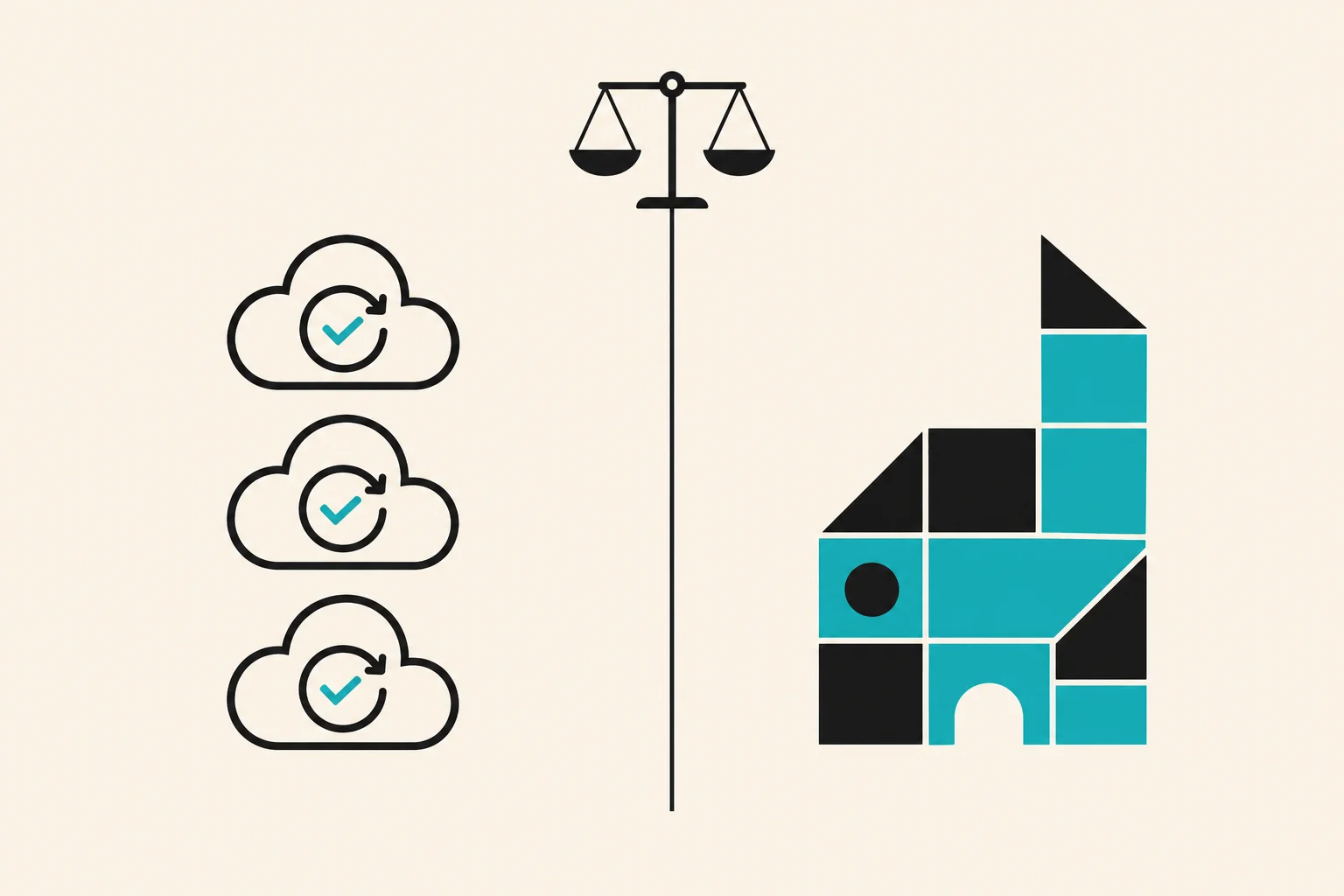
Almost every growing company hits the same wall. The SaaS tools that powered the early years stop fitting. The exports take too long. The reports never quite show what leadership wants to see. Workarounds in spreadsheets pile up next to half-integrated automations. Someone in the operations team asks the question that always comes eventually: should we just build our own?
The honest answer depends on factors most decision-makers underestimate. Custom software is not automatically better. SaaS is not automatically cheaper. The right call depends on where the business is, where it is heading, and what role software plays in the competitive position. We have built custom systems for clients who saved hundreds of thousands of euros switching away from SaaS, and we have advised others to stay on SaaS because building made no economic sense for their stage. This guide covers the decision framework we use with every client who asks the build-or-buy question.
The Hidden Cost of SaaS at Scale
A small team using a CRM at 30 euros per user per month does not think much about subscription cost. The convenience is worth it. Setup takes a day. Updates happen automatically. Support is one click away. This calculation works while the team is small, the workflow is generic, and the volume is modest.
The economics shift at scale. The same CRM at 80 users and an enterprise tier reaches 60 to 100 euros per user per month. That is 60.000 to 96.000 euros per year for one tool. Add project management, billing, support ticketing, marketing automation, and analytics. A mid-sized company easily spends 200.000 to 500.000 euros annually on SaaS subscriptions. Most never run the math, because the costs come in as monthly invoices that never seem urgent enough to question.
The cost that hurts more is the workaround tax. When SaaS does not match your process, your team builds bridges. They export to spreadsheets. They run manual reconciliations. They paste the same data into three different tools. Every workaround is hours of skilled work spent moving data instead of creating value. We have audited operations teams where 30 to 40 percent of working hours went into SaaS workarounds nobody had bothered to measure.
When Custom Software Pays for Itself
Custom software is the right call when your business process is a competitive advantage. If your operation runs on workflows nobody else can replicate, generic SaaS forces you to operate like generic competitors. The thing that makes you valuable disappears into menus designed for somebody else.
A logistics client of ours runs route planning that combines vehicle constraints, driver certifications, customer preferences, and traffic forecasts in ways no off-the-shelf tool supported. They tried five SaaS solutions over four years. Each one solved 70 percent of the problem and forced manual work for the remaining 30 percent. We built a custom system that automated the full process. The first-year ROI was 380 percent. They are still running it five years later with maintenance costs lower than the original SaaS subscription.
Custom also wins when integration density gets high. A growing company often connects 8 to 15 different systems: CRM, ERP, accounting, warehouse, e-commerce, marketing tools, support tools, BI. SaaS integrations work for a while, then break under your specific edge cases. A custom layer that orchestrates the systems you already use, in the way your business actually operates, removes a class of problems entirely. Our software integration services and web application development exist exactly for this scenario.
Compliance is a third strong driver. Industries with specific regulatory requirements, healthcare, legal, financial services, public sector, often find that SaaS providers cannot accommodate the audit trails, data residency, or workflow restrictions the law demands. A custom system can be designed for compliance from day one rather than retrofitted with workarounds.
When SaaS Is the Smarter Choice
Building custom software when SaaS works is a recipe for wasted budget. There are three signals that staying on SaaS is the right call.
The first signal: your process is genuinely standard. Email marketing is email marketing. Generic CRM functions are generic. Standard accounting follows the same patterns everywhere. If a workflow is not different from what every other company does, the SaaS provider has invested millions in features you would have to rebuild. You will lose that arms race.
The second signal: your scale is too small for the math to work. Custom software has a minimum viable cost. A simple internal tool starts around 15.000 to 25.000 euros. If you would replace SaaS that costs 5.000 euros per year, the payback period is too long to justify. Wait until your SaaS spend or workaround cost makes the equation real.
The third signal: you do not have organizational capacity to specify, validate, and govern a custom build. Software development requires sustained input from the people who will use it. If your team is already stretched thin, adding a build project makes things worse. SaaS at least removes that internal cost. Build when your organization has the maturity to invest beyond the development hours.
The Build vs Buy Decision Framework
These are the seven questions we walk through with every client considering custom development. Honest answers usually make the decision obvious.
Question one: which workflows give you competitive advantage. List them. If SaaS forces you to operate like a generic competitor on advantage workflows, build. If SaaS does the job adequately on those workflows, stay.
Question two: what does SaaS force you to do differently than you want. If the gap is cosmetic, ignore it. If the gap costs measurable hours per week or distorts your customer experience, that is real money worth solving.
Question three: what is the actual cost of working around SaaS today. Audit your team. Count the hours spent on exports, manual reconciliations, copy-paste workflows, and integration patches. Multiply by the hourly cost of the people doing the work. Most companies are shocked by the number.
Question four: how will your process change over the next three years. If your process is stabilizing into something specific to your business, custom protects that investment. If your process is still evolving rapidly, SaaS flexibility may be more valuable than custom precision.
Question five: what is the long-term cost of SaaS at your projected scale. Project your growth. Calculate SaaS subscription costs three and five years out. Compare to custom development plus maintenance over the same period. The crossover point usually surprises people.
Question six: who will own this decision long-term. Custom software needs an internal owner. Without one, even good systems atrophy. SaaS shifts that ownership to the vendor. Both are valid. Pick the one your organization can sustain.
Question seven: what happens if you do nothing. The status quo has a cost. Quantify it. If staying on SaaS while accumulating workarounds is genuinely cheaper than building, that is the answer. If the workaround cost is rising faster than the build cost, the timing for custom is now.
The Hybrid Model Most Companies Should Use
For most companies, the right answer is not one or the other. It is both, deployed strategically. Use SaaS for the standard 70 percent of operations where commoditization makes sense. Build custom for the 30 percent that defines your competitive position.
A typical hybrid setup looks like this: SaaS for accounting, payroll, email marketing, generic CRM functions, and standard productivity tools. Custom for the workflow that is unique to your business, the integration layer that ties everything together, and the customer-facing experience that distinguishes you from competitors. This pattern delivers SaaS efficiency where it matters and custom advantage where it matters more.
The hybrid model also makes vendor lock-in less dangerous. When your custom layer owns the orchestration logic, individual SaaS tools become replaceable. We have helped clients swap CRMs, billing systems, and analytics tools without operational disruption because the custom integration layer absorbed the switch. SaaS-only operations rarely have that flexibility.
Gartner frames this as Buy/Build/Blend rather than a binary choice: buy commodity workflows, build where you differentiate, blend where both apply. That matches what we see in practice. Most mid-sized companies we advise end up in a hybrid stack, not a pure custom or pure SaaS answer.
What Research Says About Total Cost of Ownership
Industry research consistently shows that initial SaaS quotes understate long-term cost. Integration work, admin time, per-seat growth and exit fees rarely appear in the first-year spreadsheet. Gartner notes that enterprises often miss 50 to 70 percent of true TCO in early calculations, especially on integration and migration.
That does not mean custom is always cheaper. It means you should model five years, not twelve months. Include workaround hours, consultant fees to bend SaaS toward your process, and the cost of staying when the tool no longer fits. When the crossover point arrives between year three and five, custom development through a partner like MG Software often wins on both fit and total cost.
If you are building a product company rather than buying internal tools, the calculus shifts again. A SaaS you resell or embed in your own offering may need a custom core underneath. See our web application development page if that is your path, or software integrations if you need internal systems that match how you actually operate.
Common Mistakes When Choosing
The most expensive mistake is over-customizing SaaS. Companies pay for SaaS, then spend tens of thousands on integrations, custom fields, and consultants to bend the tool toward their actual process. After two years, total spend rivals what custom development would have cost, and the result is a fragile Frankenstein that nobody fully understands. If you find yourself paying consultants to make SaaS behave like custom software, you should have built custom.
The opposite mistake is over-building. Some teams want custom because they like the idea of owning their stack. They build CRMs that compete with Salesforce, billing systems that compete with Stripe, project tools that compete with Asana. These are categories where SaaS providers have outspent every internal team a thousand times over. You will not win that competition. Stick to building what genuinely differentiates you.
A third mistake is buying SaaS based on features in the demo. Demos show the happy path. Real operations live in the unhappy path: edge cases, exceptions, exports, integrations, support escalations. Before signing a SaaS contract, run the actual workflows your team will use, with realistic data volumes, including the integrations you actually need. The gap between demo and production is where most regret lives.
Finally, treating the decision as permanent. Build versus buy is rarely a final answer. Companies migrate from SaaS to custom as they grow into specificity. They migrate from custom to SaaS when categories commoditize. They run hybrid models that shift over time. The right question is not what to do forever. It is what to do for the next two to three years.
How We Help Clients Make This Decision
At MG Software, the build-or-buy question is the first conversation we have with every prospective client. Not because we want to sell custom development, but because building when SaaS works is bad for everyone. We have turned away projects where SaaS was clearly the right answer, and we have built custom systems that paid for themselves inside the first year because the math was overwhelming.
Our process starts with a free consultation that maps your current SaaS spend, your operational workarounds, and your competitive workflows. We benchmark against similar companies we have worked with. We give you a recommendation that includes the option we think is wrong, so you can stress-test our thinking. About half the time the answer is custom. The other half is SaaS, sometimes a better-fit SaaS than the one currently in use, sometimes the same one with smarter integration.
When custom is the right call, we work backward from your competitive advantage, not from a feature list. The system we build solves the problems SaaS could not solve, and integrates with the SaaS that handles the parts where custom adds no value. Explore web application development, or reach out if you want to walk through this analysis for your business. The conversation is genuinely free, and the recommendation does not always lead to an engagement with us.
Conclusion
The build-or-buy question gets confused with technology when it is really a strategy question. Custom software is right when your operation has unique value that generic tools cannot capture. SaaS is right when your operation runs on standard processes the entire industry has converged on. Neither is universally better. Both are tools, and the skill is matching the tool to the job.
The companies that handle this well share three habits. They measure SaaS workaround costs honestly. They identify which workflows are actual competitive advantages versus which feel important but are not. And they revisit the decision every two to three years as the business evolves. Not sure where you sit today? Use our project calculator or book a free build-or-buy review.
Frequently asked questions
When should I choose custom software over SaaS?
Choose custom software when your process is a competitive advantage, when SaaS workarounds are slowing your team down, when you have unique data or compliance requirements, or when long-term subscription costs exceed development costs. The break-even point typically arrives between year 3 and 5.
How much does custom software actually cost compared to SaaS?
A typical custom application ranges from 25,000 to 150,000 euros to build, with annual maintenance around 15 to 20 percent of the build cost. Compare that to SaaS subscriptions: a 50-user CRM at 60 euros per month equals 36,000 euros per year. After three years, custom often costs less in total ownership while delivering exact-fit features.
Can I start with SaaS and migrate to custom later?
Yes, this is a common and often smart path. Use SaaS to validate your process and understand your real requirements. Migrate to custom when SaaS limitations actively cost you revenue, productivity, or competitive positioning. Plan for data export from day one to keep migration realistic.
What questions should I ask before building custom software?
Ask: which workflows define our competitive advantage; what does SaaS force us to do differently than we want; what is the cost of working around SaaS limits today; how will our process change in three years; do we have internal capacity to specify and validate the build. Honest answers point clearly to build or buy.
Co-Founder
Related posts
 Product updates5 Signs Your Business Needs Custom SoftwareRead article
 Product updatesWhat does a client portal cost in 2026? Honest price bandsRead article
 Product updatesWhat Does Custom Software Maintenance Cost Per Year?Read article
 Product updatesHow to Choose a Software Development Agency in 2026: 12 Questions That Reveal the TruthRead article