
Custom Software vs SaaS: What Is the Best Choice for Your Business?
Every growing organization faces this choice: custom software or SaaS? An honest analysis of cost, flexibility, ownership, and long-term scalability.
SaaS is ideal for getting started quickly and supporting validated standard processes without upfront development investment. Custom software offers unmatched flexibility and ownership when off-the-shelf solutions limit your business or when software must be your competitive differentiator. In practice, many successful organizations combine both approaches: SaaS for supporting functions like email, accounting, and project management, and custom software for the processes that make their business unique. The deciding factor is not technical but strategic: determine which processes can be standard and which ones need to provide competitive advantage.
Background
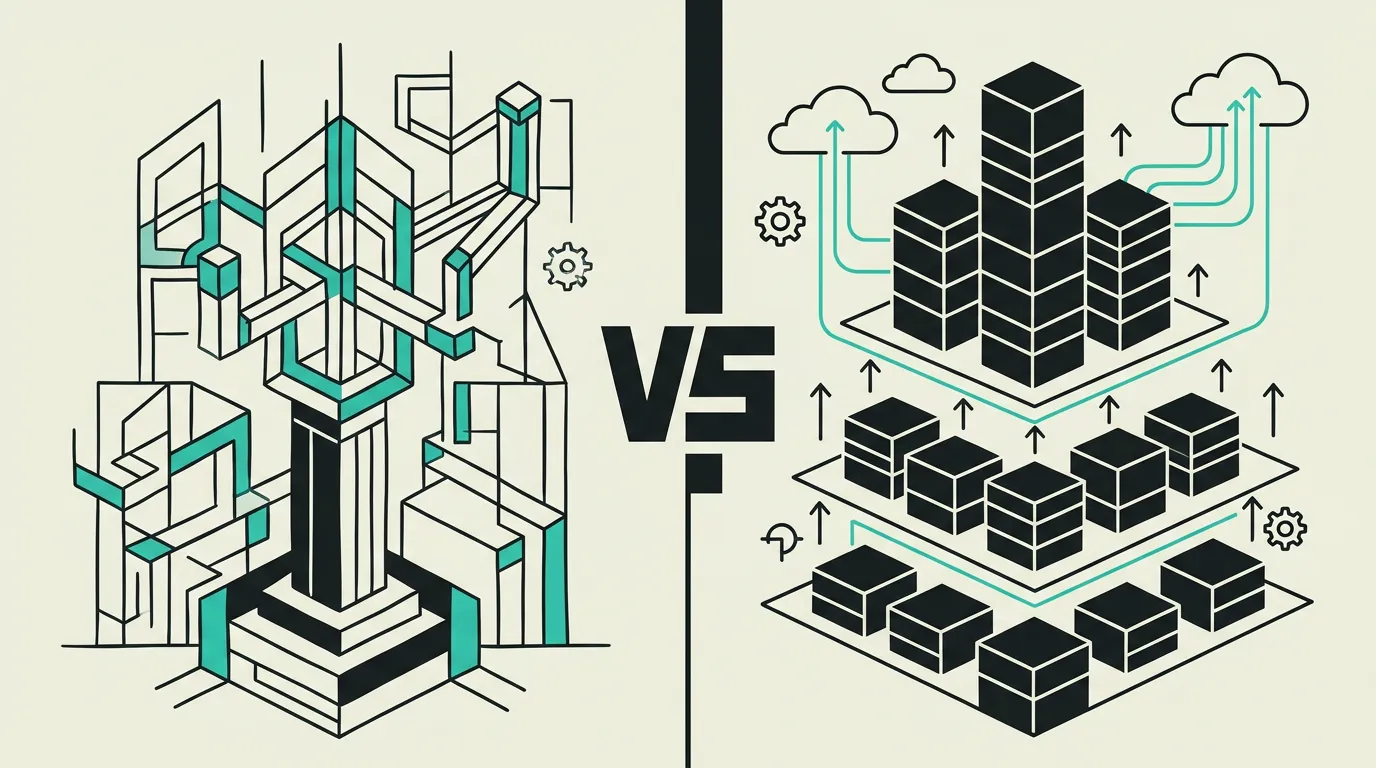
The boundary between custom and SaaS is blurring in 2026. Modern SaaS platforms offer extensive API integrations, webhooks, and no-code customizations that give organizations more flexibility than ever before. Meanwhile, building custom solutions has become faster and more affordable thanks to open-source frameworks, AI-powered development tools, and managed cloud services. Low-code platforms like Retool and Appsmith fill the gap between full SaaS and full custom development. The choice increasingly revolves around business strategy and growth plans rather than technical limitations, specifically around which processes constitute your competitive edge.
Custom Software
Custom software is bespoke software designed and built entirely around the unique processes, workflows, and needs of your organization. Unlike off-the-shelf solutions, every component is tailored to how your business operates, giving you full control over functionality and user experience. You own the source code and all data, which means complete autonomy over future development, hosting decisions, and integrations with other systems in your technology stack without vendor restrictions.
SaaS (Software as a Service)
SaaS is off-the-shelf cloud software available via a monthly or annual subscription, fully maintained, updated, and hosted by the vendor. Well-known examples include Salesforce, HubSpot, Slack, and Asana. SaaS solutions provide standard functionality that is immediately operational without development costs. The vendor handles updates, security patches, and infrastructure management, allowing you to focus on using the software rather than managing it.
What are the key differences between Custom Software and SaaS (Software as a Service)?
| Feature | Custom Software | SaaS (Software as a Service) |
|---|---|---|
| Initial cost | Higher, because upfront investment is needed for design, development, testing, and deployment | Lower, with a monthly subscription providing immediate access without significant upfront investment |
| Flexibility | Fully customizable to your unique processes, workflows, and integration requirements without compromises | Limited to available configuration options and customization capabilities provided by the vendor |
| Time-to-market | Weeks to months of development time depending on complexity, but the result fits your needs exactly | Immediately available after purchase, allowing you to be operational within days using standard functionality |
| Ownership and control | Full ownership of source code, data, and intellectual property without any vendor dependency | Data and functionality depend on the vendor, including the risk of price increases or service discontinuation |
| Scalability | Unlimited scalability on your own terms without per-user license costs that grow exponentially | Scalable within platform boundaries, but costs increase linearly with the number of users and features |
| Maintenance | Your responsibility or your development partner handles updates, security patches, and hosting management | Fully managed by the vendor, including updates, patches, and complete infrastructure management |
| Integrations | Unlimited integration possibilities via custom API connections with any system in your technology stack | Limited to available connectors and API capabilities that the SaaS vendor offers for third-party tools |
| Total Cost of Ownership | Higher initial investment but lower costs long-term as user counts and feature needs grow | Lower starting costs but cumulatively more expensive over 3 to 5 years with growing user numbers |
When to choose which?
Choose Custom Software when...
Choose custom software when your business processes are a direct competitive differentiator and standard solutions force compromises on your workflow. Custom development is the right path when you need full data ownership due to compliance or privacy regulations, when you require complex integrations between multiple systems, or when per-user SaaS pricing becomes prohibitively expensive at scale. Also consider custom when existing SaaS tools force your team to build workarounds for core processes that should be streamlined.
Choose SaaS (Software as a Service) when...
Choose SaaS when your business processes are largely standard and you want to be operational quickly without development costs. SaaS is ideal for supporting functions like CRM, accounting, email marketing, and project management where proven solutions exist. It is also the right choice when you have a limited IT budget, cannot justify building an internal development team, or when the frequency of customization needs is low enough that a predictable monthly cost model makes the most financial sense.
What is the verdict on Custom Software vs SaaS (Software as a Service)?
SaaS is ideal for getting started quickly and supporting validated standard processes without upfront development investment. Custom software offers unmatched flexibility and ownership when off-the-shelf solutions limit your business or when software must be your competitive differentiator. In practice, many successful organizations combine both approaches: SaaS for supporting functions like email, accounting, and project management, and custom software for the processes that make their business unique. The deciding factor is not technical but strategic: determine which processes can be standard and which ones need to provide competitive advantage.
Which option does MG Software recommend?
MG Software helps you find the right balance between custom and SaaS. We recommend SaaS where it fits and build custom where it matters. Our experience across dozens of projects shows the greatest value comes from bespoke solutions that seamlessly integrate with existing SaaS tools in your stack. We start every engagement with a thorough analysis of your business processes to determine which parts can be standard and which require custom development. This hybrid approach maximizes your investment: you only pay for custom development where it genuinely makes a difference to your business outcomes.
Migrating: what to consider?
When transitioning from SaaS to custom software, data export is the biggest concern. Inventory which data you can export, in what format, and through which channel (API, CSV, manual extraction). Plan a transition period of at least 4 to 8 weeks during which both systems run in parallel and ensure all integrations with other tools are reconfigured. The reverse migration from custom to SaaS requires mapping which custom functionality the SaaS solution already covers and which workflows need to be adapted to fit the standard feature set.
Frequently asked questions
When is custom software better than SaaS?
Custom software is better when your business processes are unique and do not fit standard software, when you need full control over data due to compliance or privacy legislation, or when the software must provide a direct competitive advantage. For growing organizations where per-user SaaS licenses become prohibitively expensive, custom development can be more cost-effective long-term. Always analyze the Total Cost of Ownership over a 3 to 5 year period before making a decision.
Is custom software always more expensive than SaaS?
In the short term, custom software is nearly always more expensive due to the initial development investment. Long-term the picture is more nuanced. SaaS costs grow linearly with the number of users and features, while custom software is a one-time investment with lower ongoing hosting and maintenance costs. For organizations with more than 50 users or specific integration requirements, custom can be cheaper after 2 to 3 years than cumulative SaaS subscriptions.
Can I combine SaaS and custom software?
Absolutely, and this is actually the approach we recommend most often. Many successful businesses use SaaS for standard functions like email, accounting, CRM, and project management, and build custom software for the processes that make their business unique. The custom solution then integrates via API connections with the SaaS tools. This hybrid strategy maximizes your investment: you only pay for custom development where it genuinely adds value to your operations.
How long does it take to build custom software?
The timeline varies significantly depending on complexity. An MVP or first version is typically ready within 6 to 12 weeks. A full enterprise application with complex integrations can take 3 to 6 months. At MG Software we work in iterative 2-week sprints so you see working software early and can provide feedback throughout the process. This prevents surprises at the end of the project and keeps costs manageable and predictable.
What happens if my SaaS vendor shuts down?
This is a real risk with SaaS dependency. If your vendor shuts down or gets acquired, you may face data loss, functionality loss, or forced migration under time pressure. Protect yourself by having a data export strategy in place beforehand, making regular backups of your data, and including exit clauses in your contract that give you the right to export data in a usable format at any time.
Is custom software more secure than SaaS?
Not by definition. SaaS vendors often invest heavily in security because it is their core competency and reputation is on the line. Custom software requires you to be responsible for security patches, penetration tests, and compliance yourself. The advantage of custom software is that you have exact control over where data is stored and who has access to it, which is crucial for organizations with strict privacy requirements or compliance obligations like GDPR and NIS2.
How do I choose the right partner for custom software?
Look for demonstrable experience with comparable projects, a clear development process with regular demos and transparent communication, and source code ownership that stays with you from day one. Ask for references and critically review the portfolio. A good partner thinks along about architecture and also advises when SaaS is the better choice. At MG Software we always offer a no-obligation consultation to determine the best approach for your specific situation together.
We build production software with this stack
Our developers work with these tools daily for clients across Europe. Price estimate within 24 hours.
 Discuss your project