
AWS vs Google Cloud 2026: Which Should You Pick?
AWS owns enterprise workloads; GCP wins on data, AI and BigQuery. Which cloud fits your team, budget and use case? Honest comparison on pricing, services and lock-in for 2026.
AWS and Google Cloud are both tier-1 cloud platforms serving millions of businesses, but they optimize for fundamentally different priorities. AWS delivers the broadest service portfolio with over 200 fully managed services and the largest partner ecosystem in the world. If a cloud service exists, AWS likely launched it first. Google Cloud excels in data analytics with BigQuery, AI/ML with Vertex AI and Gemini, and container orchestration with GKE. For enterprise workloads where compliance, vendor support, and service breadth are decisive factors, AWS is the proven and safe choice. For data- and AI-driven projects where analytical power, machine learning capabilities, and cost efficiency take center stage, GCP provides a technically superior experience. The best choice ultimately depends on your primary workload, your team's expertise, and your long-term cloud strategy.
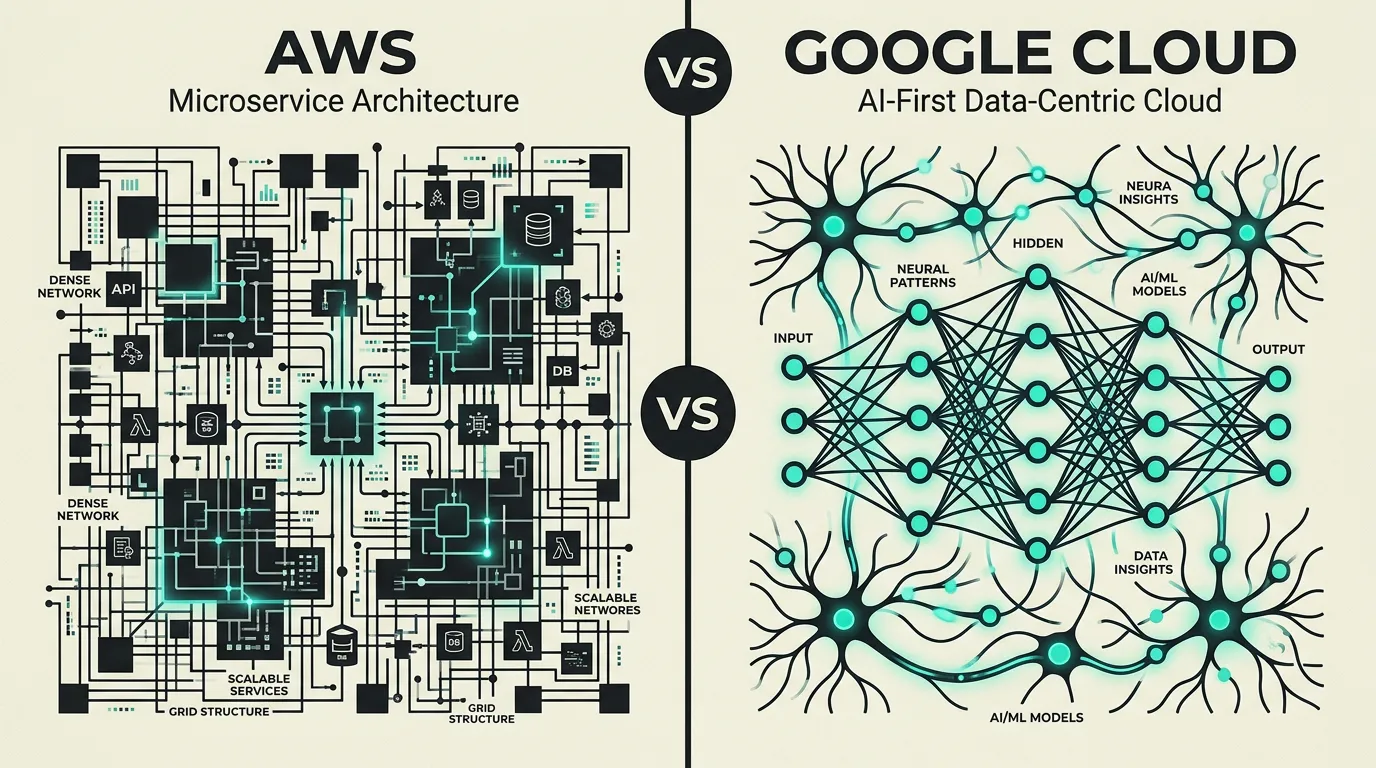
Background
The choice between AWS and Google Cloud is one of the most strategic decisions for any business migrating to the cloud or reassessing its existing cloud strategy. With a combined market share exceeding 44%, these two providers together shape the direction of cloud computing worldwide. AWS has dominated since 2006 with the broadest service portfolio, while Google Cloud strengthens its position through market-leading innovations in AI and data analytics. The right choice depends on your primary workload, the technical expertise within your team, your compliance requirements, and your long-term vision for areas like artificial intelligence and data-driven decision making.
AWS
Amazon Web Services is the undisputed market leader in cloud computing with approximately 32% market share in 2026. AWS offers over 200 fully managed services, ranging from foundational compute (EC2) and object storage (S3) to advanced AI services (Bedrock, SageMaker), IoT platforms, and even satellite communication via AWS Ground Station. The platform holds the most compliance certifications in the world, including SOC 2, HIPAA, PCI DSS, and ISO 27001, and maintains the largest partner ecosystem with over 100,000 certified partners. For enterprise organizations that require maximum choice and vendor support, AWS remains the industry standard.
Google Cloud
Google Cloud Platform (GCP) is Google's public cloud solution, built on the same infrastructure that internally powers Search, YouTube, and Gmail. In 2026, GCP serves approximately 12% of the cloud market and is growing faster than AWS in AI and data segments. GCP is renowned for its industry-leading AI/ML services including Vertex AI and Gemini, the powerful serverless data analytics engine BigQuery, and its Kubernetes-native approach via Google Kubernetes Engine. As the inventor of Kubernetes, Google delivers the most refined managed container service, making GCP the preferred choice for data-driven and AI-intensive organizations.
What are the key differences between AWS and Google Cloud?
| Feature | AWS | Google Cloud |
|---|---|---|
| Market share | Market leader at ~32% in 2026, with the largest ecosystem and over 100,000 certified partners worldwide | Third position at ~12%, but fastest growing in AI and data segments driven by Gemini and BigQuery adoption |
| Number of services | 200+ fully managed services with the broadest coverage in the industry, from compute to satellite communication | 100+ services with a strategic focus on quality over quantity, optimized for data and AI workloads specifically |
| AI & Machine Learning | SageMaker, Bedrock, and Rekognition provide a mature AI stack with broad model support but more complex configuration | Vertex AI, Gemini models, and TPU v5 hardware form a deeply integrated AI stack with native Google support |
| Data analytics | Redshift, Athena, and EMR are powerful but require multiple separate services for a complete data pipeline | BigQuery serverless data warehouse is market-leading in analytics and processes petabytes without cluster management |
| Kubernetes | EKS offers managed Kubernetes with deep AWS integrations but requires more manual configuration for upgrades | GKE is Kubernetes-native, invented and managed by Google, with the best auto-scaling and Autopilot mode |
| Pricing model | On-demand, Reserved Instances (1-3 year) and flexible Savings Plans for long-term discounts up to 72% | On-demand with automatic Sustained Use Discounts and Committed Use Discounts for predictable workloads |
| Networking & CDN | CloudFront CDN with 450+ edge locations globally, Direct Connect for dedicated on-premises connections | Premium tier networking over Google's own fiber backbone, Cloud CDN, and Interconnect for hybrid architectures |
| Compliance & security | Most certifications in the industry, AWS GovCloud for government workloads, and extensive audit trail integrations | Strong EU datacenter presence, Assured Workloads for compliance, and transparent encryption enabled by default |
When to choose which?
Choose AWS when...
Choose AWS when your organization needs the broadest range of cloud services and maximum choice between providers and tools. AWS is the best fit for companies with strict compliance requirements such as SOC 2, HIPAA, or PCI DSS that benefit from AWS GovCloud and the extensive audit framework. Also choose AWS when your team already holds AWS certifications, when you want to leverage an extensive partner ecosystem for consulting and implementation, or when you are migrating legacy workloads that depend on specific AWS services. Enterprise organizations with dedicated platform engineers will find the most mature tooling for large-scale cloud operations in AWS.
Choose Google Cloud when...
Choose Google Cloud when your primary workload revolves around data analytics, machine learning, or Kubernetes-native architectures. GCP is the better choice if your team wants to use BigQuery as a serverless data warehouse without cluster management, if you train or serve AI models via Vertex AI and Gemini, or if you need the most powerful managed Kubernetes service (GKE). Google Cloud also suits organizations that value transparent pricing with automatic Sustained Use Discounts and teams looking to extend their Google Workspace environment with cloud-native applications and analytics.
What is the verdict on AWS vs Google Cloud?
AWS and Google Cloud are both tier-1 cloud platforms serving millions of businesses, but they optimize for fundamentally different priorities. AWS delivers the broadest service portfolio with over 200 fully managed services and the largest partner ecosystem in the world. If a cloud service exists, AWS likely launched it first. Google Cloud excels in data analytics with BigQuery, AI/ML with Vertex AI and Gemini, and container orchestration with GKE. For enterprise workloads where compliance, vendor support, and service breadth are decisive factors, AWS is the proven and safe choice. For data- and AI-driven projects where analytical power, machine learning capabilities, and cost efficiency take center stage, GCP provides a technically superior experience. The best choice ultimately depends on your primary workload, your team's expertise, and your long-term cloud strategy.
Which option does MG Software recommend?
At MG Software, we work with both platforms and make deliberate choices for each project based on specific requirements. For clients with complex enterprise architectures, extensive compliance needs, and demand for the broadest service catalog, we recommend AWS for its unmatched ecosystem and depth of service. For data-driven applications, AI integrations, and projects where BigQuery, Vertex AI, or GKE form the core, we recommend Google Cloud. Our own production stack runs primarily on Vercel and Supabase, but for clients with heavy infrastructure needs, we design architectures across both platforms. We always use Infrastructure as Code via Terraform or Pulumi, ensuring clients can scale flexibly and are not locked into a single provider.
Migrating: what to consider?
Migrating between AWS and Google Cloud requires careful planning around identity management, network configuration, and data transfer costs. Key steps include mapping service equivalents such as S3 to Cloud Storage, RDS to Cloud SQL, and Lambda to Cloud Functions. IAM policies must be completely rewritten since the authorization models differ fundamentally. Be aware of egress charges that can add up substantially at large data volumes. Use Terraform or Pulumi to define your infrastructure as code, making the migration repeatable and testable. Plan a phased approach per workload and conduct thorough load tests before switching production traffic to the new platform.
Frequently asked questions
Is AWS more expensive than Google Cloud?
Costs depend heavily on the specific services you use and how you configure them. AWS generally has slightly higher list prices for compute instances but offers extensive discount mechanisms via Reserved Instances (up to 72% off with a 3-year commitment) and flexible Savings Plans. Google Cloud automatically applies Sustained Use Discounts without upfront commitments. For comparable compute workloads, GCP is on average 10-20% more affordable. Storage and networking prices are closer together. Actual costs are determined by your usage patterns, commitment willingness, and your team's expertise in cost optimization.
Can I use both cloud platforms simultaneously?
Yes, a multi-cloud strategy is increasingly common among mid-sized and large organizations. You could use AWS for your primary application infrastructure and deploy Google Cloud for data analytics with BigQuery or AI workloads via Vertex AI. Tools like Terraform and Kubernetes make managing multi-cloud architectures technically feasible. Keep in mind that multi-cloud introduces additional operational complexity including dual IAM configurations, cross-cloud networking, and higher egress costs. Ensure the benefits outweigh the extra overhead before committing.
Which platform is better for startups?
Both platforms offer startup programs with free credits to get started. Google Cloud provides higher credit amounts through the Google for Startups program (up to $200,000) compared to AWS Activate. GCP is generally simpler to get started with thanks to Firebase for rapid prototyping and BigQuery for analytics without cluster management. AWS offers more scaling options and service breadth as your startup grows toward enterprise scale. Choose based on your primary use case: data and AI point to GCP, a broad and proven service catalog points to AWS.
How do AWS and Google Cloud AI services compare?
AWS offers AI services through SageMaker (ML platform), Bedrock (foundation models), and Rekognition (image recognition). The AWS AI stack is broad but requires more configuration to connect the right services together. Google Cloud integrates AI deeper into the platform through Vertex AI as a central ML platform, Gemini as a foundation model, and TPU hardware for training. GCP has the advantage that Google's own research team develops the models, resulting in faster iterations on cutting-edge AI capabilities. For most organizations, GCP delivers the most streamlined AI experience.
Which platform has better Kubernetes support?
Google Kubernetes Engine (GKE) is widely regarded as the best managed Kubernetes service available, which makes sense given that Google invented Kubernetes. GKE offers automatic node provisioning, release channels for controlled upgrades, and an Autopilot mode for fully managed clusters. AWS EKS is a solid alternative with deep integration into the AWS ecosystem but requires more manual configuration for comparable functionality. If Kubernetes is your primary orchestration tool, GKE objectively provides the best out-of-the-box experience.
What about data sovereignty and GDPR compliance?
Both platforms offer EU datacenters (including regions in the Netherlands and surrounding countries) allowing you to keep data within the EU. Google Cloud provides additional tooling for European compliance requirements through Assured Workloads and EU Sovereign Cloud. AWS offers comparable capabilities via regional deployments in Frankfurt, Ireland, and Stockholm. Both platforms provide contractual data processing agreements for organizations where GDPR compliance is critical. Google Cloud scores slightly higher on transparency with default encryption at rest and in transit without additional configuration.
Can MG Software help choose and implement a cloud platform?
Yes, at MG Software we advise clients on cloud strategy based on their specific workloads, budget, and team expertise. We design architectures on both AWS and Google Cloud using Infrastructure as Code via Terraform, ensuring implementations are repeatable and transferable. For data-driven projects we set up BigQuery pipelines, and for enterprise clients we build scalable AWS architectures. Contact us through our contact form for a no-obligation consultation about your cloud strategy.
We build production software with this stack
Our developers work with these tools daily for clients across Europe. Price estimate within 24 hours.
 Discuss your project