
AWS vs Azure: Which Cloud Platform Should You Choose?
Already on Microsoft licenses? Azure pulls ahead. Purely technical? AWS offers the most. A comparison on services, pricing, and scalability.
AWS offers the broadest service range and the most flexibility for cloud-native architectures and innovative workloads. Azure is the logical choice for organizations already invested in the Microsoft ecosystem that value hybrid cloud, enterprise governance, and AI integration through Azure OpenAI Service. Both are enterprise-grade platforms with data centers worldwide, excellent SLAs, and comparable technical capabilities. The choice primarily depends on your existing technology stack, license agreements, and team expertise. For most organizations, strategic fit is more important than technical feature comparisons when selecting a cloud provider.
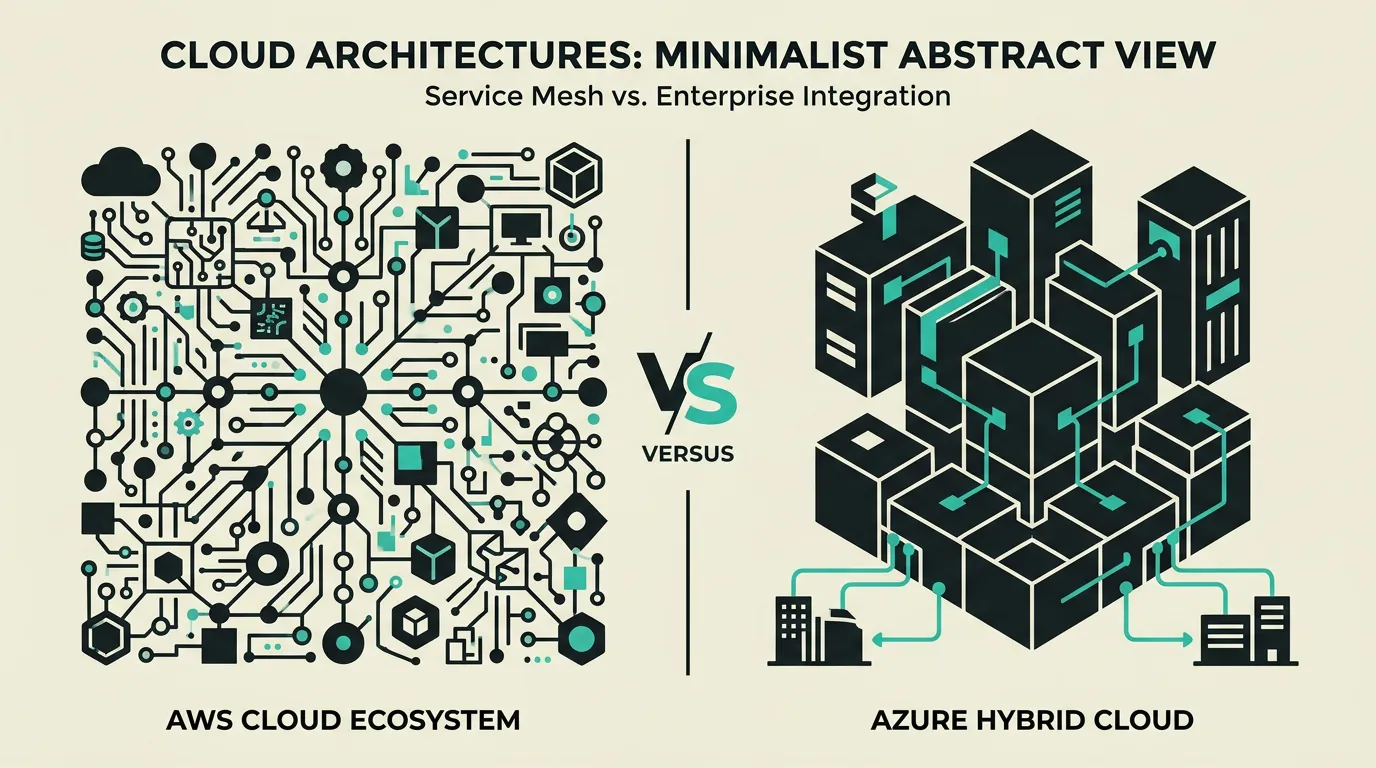
Background
AWS and Azure together dominate over 60% of the global cloud market, with Google Cloud Platform as a growing third player. The choice is increasingly less purely technical and more strategically driven. Existing license agreements, compliance requirements (such as GDPR and NIS2), the expertise present in your organization, and relationships with IT vendors often weigh more heavily than technical feature comparisons. The rise of AI workloads makes Azure more attractive thanks to the Azure OpenAI Service partnership, while AWS with Bedrock offers a broader range of foundation models from multiple providers.
AWS (Amazon Web Services)
AWS is the largest cloud platform in the world with over 200 fully managed services spanning compute, storage, AI, machine learning, and IoT. Amazon launched AWS in 2006 and the platform has been the market leader with the broadest offering and most innovation since. AWS operates data centers in more than 30 regions worldwide, including the EU regions Frankfurt, Ireland, and Stockholm. The Activate program offers startups free credits to rapidly experiment with cloud services and build their initial infrastructure.
Microsoft Azure
Microsoft Azure is the cloud platform from Microsoft with deep integration into the Microsoft ecosystem, strongly positioned in enterprise, hybrid cloud, and AI services. Azure offers over 200 services and operates data centers in more than 60 regions worldwide. The unique strength of Azure lies in seamless integration with Active Directory, Microsoft 365, Teams, and Dynamics 365. Azure OpenAI Service provides direct access to GPT-4 and other OpenAI models for enterprise applications with compliance guarantees and data residency options.
What are the key differences between AWS (Amazon Web Services) and Microsoft Azure?
| Feature | AWS (Amazon Web Services) | Microsoft Azure |
|---|---|---|
| Service offering | Broadest range with over 200 services and the most innovation in cloud-native architectures and serverless | Extensive with over 200 services, strong focus on enterprise, hybrid cloud, and Microsoft ecosystem integration |
| Pricing model | Pay-as-you-go with a complex pricing structure, Savings Plans, and Reserved Instances for cost optimization | Pay-as-you-go with attractive discounts for existing Microsoft Enterprise Agreement licenses and hybrid benefits |
| Serverless | Lambda is the most mature serverless platform with broad integration into the AWS ecosystem and Step Functions | Azure Functions provides solid serverless capabilities with strong integration with .NET, Visual Studio, and Logic Apps |
| AI and ML | SageMaker for ML workflows, Bedrock for foundation models, and a broad range of pre-trained AI services | Azure OpenAI Service with direct GPT-4 access, Cognitive Services, and strong enterprise AI governance tools |
| Enterprise integration | Good enterprise offering but less integrated with office environments and identity management systems | Excellent with seamless integration with Active Directory, Microsoft 365, Teams, SharePoint, and Dynamics 365 |
| Hybrid cloud | AWS Outposts offers on-premises extension but hybrid cloud is not a core focus of the platform | Azure Arc and Azure Stack are market leaders in hybrid cloud with strong on-premises and multi-cloud governance |
| Container orchestration | ECS, EKS, and Fargate provide mature container options with deep integration into the AWS networking ecosystem | AKS provides managed Kubernetes with good integration into Azure DevOps and the broader Azure platform |
| Database services | RDS, DynamoDB, Aurora, and more than 15 database services for every workload and scaling requirement | Azure SQL, Cosmos DB, and managed database services with strong integration into the Microsoft data platform |
When to choose which?
Choose AWS (Amazon Web Services) when...
Choose AWS when you need the broadest range of cloud services and your team values the flexibility to pick best-of-breed solutions for each requirement. AWS is ideal for startups leveraging the Activate program with free credits, for projects requiring specific services like DynamoDB, CloudFront, or SageMaker, and for organizations prioritizing cloud-native architectures. The largest range of third-party integrations and community support makes AWS the safest choice for technical teams building innovative applications.
Choose Microsoft Azure when...
Choose Azure when your organization is already invested in Microsoft 365, Teams, and Active Directory. The deep integration with the Microsoft ecosystem simplifies identity management, governance, and compliance significantly. Azure is the stronger choice for hybrid cloud scenarios combining on-premises and cloud infrastructure via Azure Arc. Teams with existing .NET or C# expertise can leverage their skills directly. Azure OpenAI Service provides enterprise-grade AI with data residency guarantees in the EU.
What is the verdict on AWS (Amazon Web Services) vs Microsoft Azure?
AWS offers the broadest service range and the most flexibility for cloud-native architectures and innovative workloads. Azure is the logical choice for organizations already invested in the Microsoft ecosystem that value hybrid cloud, enterprise governance, and AI integration through Azure OpenAI Service. Both are enterprise-grade platforms with data centers worldwide, excellent SLAs, and comparable technical capabilities. The choice primarily depends on your existing technology stack, license agreements, and team expertise. For most organizations, strategic fit is more important than technical feature comparisons when selecting a cloud provider.
Which option does MG Software recommend?
MG Software works platform-agnostically, but our preference leans toward managed services that reduce complexity: Vercel for frontend hosting, Supabase for databases and authentication. When dedicated cloud infrastructure is required for specific workloads, we help choose between AWS and Azure based on your existing licenses, team expertise, and compliance requirements. For AI applications we recommend Azure OpenAI Service for its enterprise-grade governance and EU data residency options. For cloud-native microservice architectures, AWS often has an advantage through its broader ecosystem and more mature serverless platform.
Migrating: what to consider?
When migrating between AWS and Azure, mapping equivalent services is the first step since naming conventions differ significantly between platforms. Use tools like Azure Migrate or AWS Migration Hub for initial assessments. Plan for reconfiguring networking, IAM policies, monitoring, and alerting systems. Budget 3 to 9 months depending on infrastructure complexity. Containerized workloads on Kubernetes are the easiest to migrate, while services with strong platform binding like Lambda or Azure Functions require a rewrite.
Frequently asked questions
Is AWS cheaper than Azure?
It depends heavily on specific usage and the services you consume. AWS is often cheaper for compute-intensive workloads thanks to the broad range of instance types and Savings Plans. Azure can be significantly cheaper if you already have Microsoft Enterprise Agreement licenses, thanks to hybrid benefits and license discounts. Both platforms offer a free tier and comprehensive pricing calculators that let you calculate upfront what your specific workload would cost on each platform.
Can I use AWS and Azure simultaneously?
Yes, a multi-cloud strategy is possible and increasingly adopted by large organizations for vendor diversification and specific service selection. It does however add significant complexity to operational management, monitoring, security, and team expertise requirements. Only consider multi-cloud if you need specific services from both platforms that are not interchangeable, or when compliance requirements mandate vendor diversification. For most organizations a single-cloud strategy with an exit plan is more practical.
Which platform is better for a startup?
AWS is more popular among startups thanks to the broader service offering, larger community, and the AWS Activate program that provides up to $100,000 in free credits. Azure is attractive via the Microsoft for Startups program with comparable benefits. However, also consider alternatives like Vercel for frontend hosting and Supabase for databases: these platforms offer less operational overhead and allow you to focus on building your product rather than managing infrastructure.
What about compliance and data residency in the EU?
Both platforms offer EU data centers and support GDPR compliance. AWS has regions in Frankfurt, Ireland, and Stockholm. Azure has data centers in the Netherlands (Amsterdam) plus other EU locations. Both provide encryption at rest and in transit, audit logging, and compliance certifications (ISO 27001, SOC 2, BSI C5). Azure has an advantage for organizations using Microsoft 365 Compliance Center for unified governance across cloud and office environments.
Which platform is better for AI and machine learning?
Azure currently has an edge for enterprise AI thanks to the exclusive Azure OpenAI Service with direct access to GPT-4, DALL-E, and Whisper with enterprise governance and EU data residency. AWS offers through Bedrock a broader range of foundation models from Anthropic, Cohere, Meta, and Amazon itself, plus SageMaker as the most mature ML platform. The choice depends on whether you specifically want OpenAI models (Azure) or prefer a broader selection of models (AWS).
How do the free tiers compare?
Both platforms offer a free tier for new customers with 12 months of free access to popular services. AWS provides 750 hours of EC2 t2.micro, 5 GB S3 storage, and 25 GB DynamoDB. Azure offers comparable resources plus 750 hours of B1s VM and 5 GB Blob Storage. Both platforms also provide always-free services like Lambda (1 million invocations per month) and Azure Functions. The free tiers are sufficient for experimentation but not suitable for production workloads with significant traffic.
Can I migrate from AWS to Azure later or vice versa?
Yes, but the effort varies significantly per workload type. Containerized applications on Kubernetes are the easiest to migrate since EKS and AKS both run standard Kubernetes. Serverless functions (Lambda versus Azure Functions) require a rewrite due to platform-specific APIs and triggers. Managed databases can be migrated via export-import or dedicated migration tools. Budget 3 to 9 months depending on complexity and start with an assessment using Azure Migrate or AWS Migration Hub to understand the full scope.
We build production software with this stack
Our developers work with these tools daily for clients across Europe. Price estimate within 24 hours.
 Discuss your project