
In-house vs Outsourcing: Build Internally or Partner Externally?
Build your own development team or outsource? The right strategy depends on budget, time-to-market, and how central software is to your business.
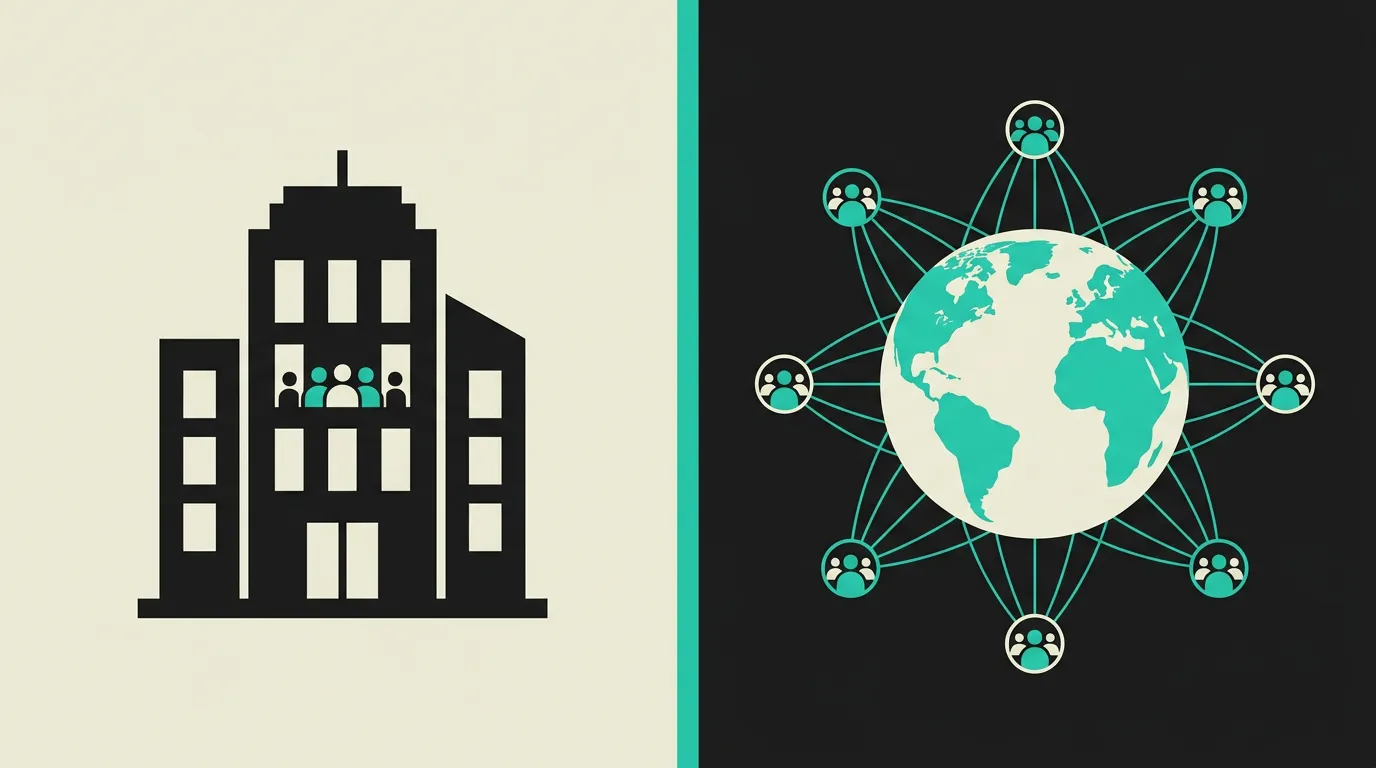
In-house is ideal when software is your core product and you need continuous development with deep domain knowledge that accumulates over years. Outsourcing offers speed, flexibility, and access to specialized expertise without the fixed costs of a permanent team. The reality is that many successful companies combine both strategies: a small core team that guards the architecture and product direction, supplemented with strategic outsourcing for capacity and specialist expertise. The choice depends on how central software is to your business model, your budget, desired speed to market, and the availability of talent in the job market.
Background
The tight IT job market in Europe makes the choice between in-house and outsourcing more urgent than ever in 2026. Senior full-stack developers are scarce and recruitment costs are high, with salaries increasing annually. Meanwhile, the quality of outsourcing partners has grown significantly thanks to remote-first work practices, improved collaboration platforms, and higher industry standards. AI tools are accelerating the development process for both in-house and external teams. The question is no longer whether outsourcing is qualitatively good enough, but which mix of in-house and external best fits your specific situation.
In-house Development
In-house development means having software built by an internal team of developers employed by your organization, working full-time on your products. This team builds deep domain knowledge, is directly manageable, and shares the company culture. Costs include salaries, recruitment, onboarding, office space, tools, licenses, and continuous training. In the tight European tech job market of 2026, recruiting senior developers can take 3 to 6 months with recruitment costs of 15 to 25% of the annual salary.
Outsourcing
Outsourcing means delegating software development to an external partner, agency, or freelancer that provides expertise without the overhead of an internal team. Modern outsourcing partners operate as an extension of your organization with shared project tools, transparent communication, and iterative sprints. Costs are variable: you pay per project, per sprint, or per hour, and can flexibly scale the team up or down as needed. The quality of development agencies has risen significantly thanks to remote-first practices and established collaboration processes.
What are the key differences between In-house Development and Outsourcing?
| Feature | In-house Development | Outsourcing |
|---|---|---|
| Cost | High and fixed: salary, recruitment, office, tools, licenses, and continuous training for the entire team | Variable and predictable: pay per project or per sprint without overhead of recruitment and personnel management |
| Control | Maximum with direct management, priority setting, and daily interaction with the development team | Indirect through clear agreements, sprint demos, and shared project tools with regular communication |
| Speed to start | Slow because recruitment in the tech job market takes 3 to 6 months for senior profiles | Fast because the team is immediately available and can be operational within 1 to 2 weeks |
| Knowledge retention | Knowledge stays fully in-house and grows with the product and organization over time | Knowledge transfer requires active attention, documentation, and structured handover procedures |
| Scalability | Limited because scaling up requires new recruitment and scaling down has employment law consequences | Highly flexible, scale the team up or down per sprint based on the current needs of the project |
| Expertise breadth | Limited to the skills of the current team, new expertise requires recruitment or training | Broad because agencies have diverse specialists in-house for frontend, backend, DevOps, and design |
| Continuity | Risk of knowledge loss when a developer leaves, dependent on documentation and team size | Secured by the agency which is responsible for knowledge transfer and team composition |
| Recruitment costs | High: 15 to 25% of annual salary per hire, plus hours from internal recruiters and managers | No recruitment costs, the partner handles team composition and replacement in case of attrition |
When to choose which?
Choose In-house Development when...
Choose in-house development when software is your core product and continuous iteration is essential for your competitive position. An internal team is the better choice when you work with sensitive data that cannot leave the organization, when compliance requirements demand direct control over the development environment, or when your product roadmap requires multi-year commitment and deep domain knowledge that is difficult to transfer to an external party.
Choose Outsourcing when...
Choose outsourcing when you want to start quickly with an MVP or prototype without spending months on recruitment and team building. Outsourcing is also ideal when you temporarily need specific expertise that is not available internally, such as mobile development, DevOps, or AI integration. It is the smart choice when development frequency is too low to justify a full-time internal team, or when you want to scale up and down flexibly without employment law complications.
What is the verdict on In-house Development vs Outsourcing?
In-house is ideal when software is your core product and you need continuous development with deep domain knowledge that accumulates over years. Outsourcing offers speed, flexibility, and access to specialized expertise without the fixed costs of a permanent team. The reality is that many successful companies combine both strategies: a small core team that guards the architecture and product direction, supplemented with strategic outsourcing for capacity and specialist expertise. The choice depends on how central software is to your business model, your budget, desired speed to market, and the availability of talent in the job market.
Which option does MG Software recommend?
MG Software operates as an extension of your organization, not as an external vendor. We offer the flexibility and expertise of outsourcing combined with the commitment, transparency, and dedication of an in-house team. Our approach ensures proactive knowledge transfer through shared repositories, comprehensive documentation, and regular architecture reviews. We work in 2-week sprints with demos and retrospectives. This long-term partnership goes beyond a single project and grows with your organization and its evolving needs over time.
Migrating: what to consider?
Transitioning from outsourcing to an in-house team requires thorough knowledge transfer planning. Ensure your outsourcing partner documents all architecture decisions, deployment procedures, and technical debt comprehensively. Plan a 2 to 4 month overlap period where internal hires work alongside the external team before full handover takes place. The reverse transition from in-house to outsourcing requires finding a partner who understands your existing codebase and can take over development without rebuilding everything from scratch.
Frequently asked questions
When is outsourcing better than an in-house team?
Outsourcing is better when you want to start quickly without spending months on recruitment, when you need specific expertise temporarily that is not available internally, or when the cost of a full internal team does not justify the development frequency. It is also ideal for building an MVP, validating a product idea, or adding a specific feature for which you lack internal capacity or knowledge.
How do I maintain control when outsourcing?
Through clear agreements on communication, sprint cadence, deliverables, and quality standards from the very beginning. Choose a partner that works transparently with regular demos after each sprint, full access to source code in a shared repository, and shared project tools for task management and communication. At MG Software we always work with complete transparency: you have realtime visibility into progress, can adjust priorities, and participate in retrospectives.
Can I switch from outsourcing to in-house later?
Yes, this is a very common and smart strategy. Start with outsourcing to build quickly and bring a working product to market, then invest in an internal team once the business case is proven. A good outsourcing partner actively facilitates the handover through comprehensive documentation, pair programming sessions with your new team members, and a gradual reduction of their involvement over a period of 2 to 3 months.
What does an internal development team cost?
A mid-level full-stack developer costs between 50,000 and 80,000 euros gross annual salary in Western Europe in 2026. Add employer costs (approximately 30%), office expenses, tools and licenses, recruitment costs (15-25% of annual salary), and training on top. Total costs per developer are between 80,000 and 120,000 euros per year. For a minimally effective team of 2 to 3 developers, this amounts to 180,000 to 360,000 euros per year excluding management overhead.
How do I choose a good outsourcing partner?
Look for demonstrable experience with comparable projects and technologies, a clear and proven development process with transparent communication, and references from previous clients. Ask about code ownership (should always stay with you), documentation standards, and their approach to knowledge transfer. A good partner asks critical questions about your project and advises when a simpler solution would suffice. Avoid partners who agree to everything without providing feedback.
What are the risks of outsourcing?
The main risks are communication issues due to timezone differences or language barriers, quality differences that only become visible late in the project, and dependency on a partner for knowledge and continuity. These risks are manageable by choosing a partner in the same timezone, agreeing on clear quality standards, conducting regular code reviews, and investing in documentation and knowledge sharing from day one of the engagement.
Can I combine in-house and outsourcing?
Absolutely, and this is a strategy we frequently recommend. A small core team of 1 to 2 senior developers guards the architecture, product vision, and domain knowledge internally, while an outsourcing partner provides development capacity for feature development, testing, and deployment. This gives you the best of both worlds: the control and knowledge retention of in-house with the flexibility and expertise breadth of outsourcing.
We build production software with this stack
Our developers work with these tools daily for clients across Europe. Price estimate within 24 hours.
 Discuss your project