
Agile vs Waterfall: How Your Process Shapes What You Build
Iterative or sequential? Choosing between Agile and Waterfall determines how your team plans, builds, and responds to change. A practical guide.
Agile and Waterfall represent fundamentally different approaches to building software, and the right choice depends on project context rather than personal preference. Agile is superior for projects with evolving requirements where rapid feedback and iteration lead to a better end result. The vast majority of modern software teams, from startups to enterprises, work successfully with Agile methods. Waterfall remains valuable in clearly scoped contexts with fixed requirements, strict compliance demands, or when a detailed upfront plan is contractually required. In practice, many organizations adopt a hybrid approach: upfront architecture planning combined with Agile sprints for implementation. The best methodology is the one that fits your team, the type of product, and your organizational culture. In our experience, Agile is the better choice for roughly 90 percent of web and software projects.
Background
The Agile versus Waterfall debate is more nuanced than most articles suggest. Waterfall earned its negative reputation through rigid implementations in IT, but structured planning and documentation remain valuable. Modern teams often combine Agile sprints with upfront architecture planning, an initial discovery phase, and thorough documentation where needed. The Standish Group CHAOS Report has shown for years that Agile projects have a significantly higher success rate than traditional Waterfall projects. Yet the nuance matters: a poorly executed Agile process (without a real product owner, without retrospectives, without working software each sprint) often performs worse than a well-structured Waterfall project. The methodology is just a framework; execution determines success.
Agile
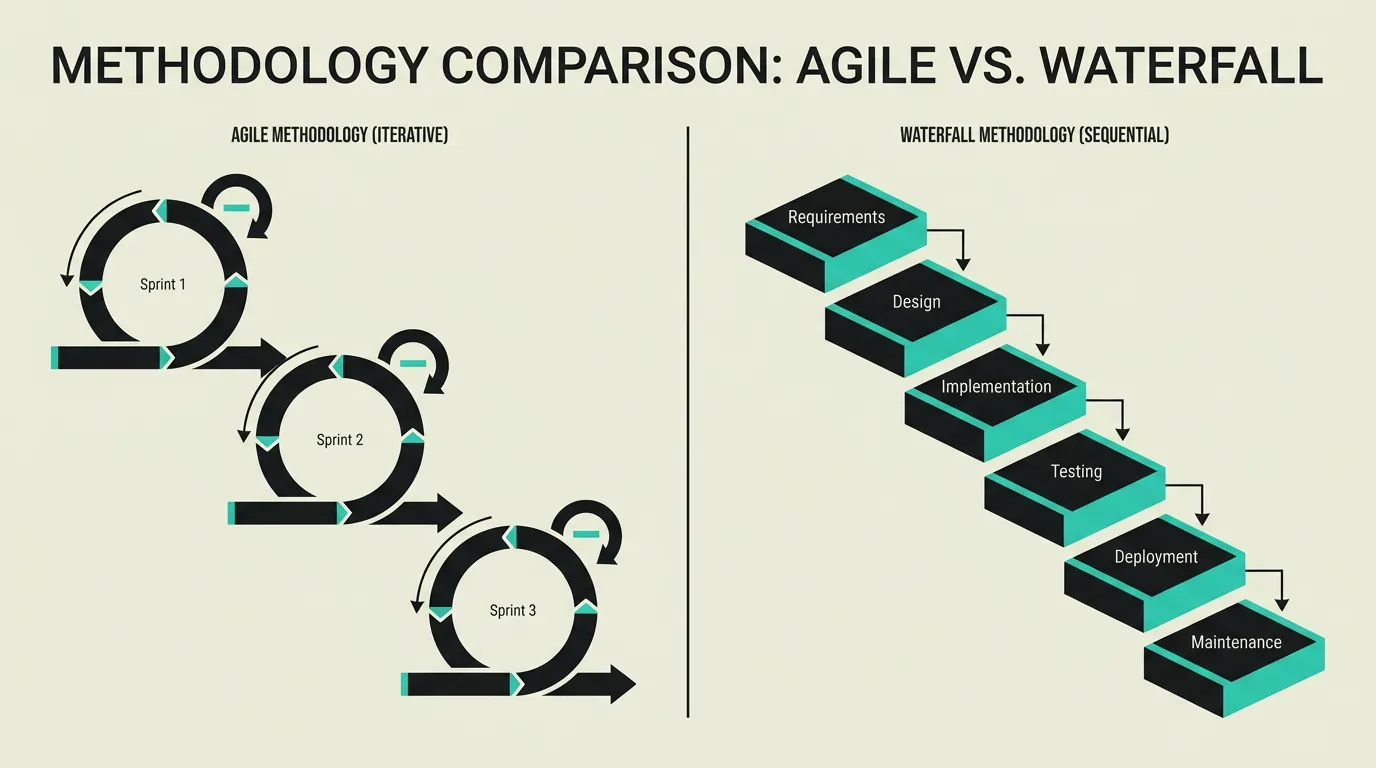
An iterative software development methodology that prioritizes flexibility, collaboration, and continuous delivery of working software. Agile typically operates in two-week sprints where cross-functional teams plan, build, test, and deliver increments based on direct stakeholder feedback. Scrum (with sprints, daily standups, and retrospectives) and Kanban (with continuous flow and WIP limits) are the most widely adopted frameworks. Originating from the Agile Manifesto in 2001, modern implementations like SAFe and LeSS scale Agile to enterprise organizations. As of 2026, over 70 percent of software teams worldwide use some form of Agile methodology.
Waterfall
A linear, sequential project methodology where each phase is fully completed before the next begins. Waterfall follows a fixed path of requirements analysis, system design, implementation, integration testing, acceptance testing, and deployment. Originally described by Winston Royce in 1970, it is predictable and produces comprehensive documentation at every stage. Waterfall works best when requirements are locked down and the end result is clearly defined upfront. In sectors like defense, aviation, and medical devices, Waterfall remains the dominant approach due to strict certification requirements and full traceability from requirement to test case.
What are the key differences between Agile and Waterfall?
| Feature | Agile | Waterfall |
|---|---|---|
| Flexibility to change | High, changes are welcomed and incorporated into the next sprint through backlog refinement sessions | Low, changes after the planning phase require a formal change request with impact analysis and re-approval |
| Planning horizon | Adaptive with a high-level product roadmap and detailed sprint planning every two weeks | Fully defined upfront with a comprehensive project plan, Gantt charts, and fixed milestones throughout |
| Feedback moments | Continuous, stakeholders evaluate working software every sprint during a dedicated sprint review session | Only after delivery of the complete application does the client see the final result for the first time |
| Risk management | Lower risk because problems surface early through short iterations and regular demos with stakeholders | Higher risk because problems typically only become visible during the testing phase, late in the project |
| Documentation | Minimal but sufficient, focusing on working software supplemented with living documentation where valuable | Extensive and formal, each phase produces detailed documents as a required deliverable for the next phase |
| Team structure | Cross-functional self-organizing teams with a product owner setting priorities and a scrum master facilitating | Specialized roles per phase, with business analysts, architects, developers, and testers working separately |
| Value delivery | Incremental, every sprint delivers a potentially shippable product increment with immediate business value | At the end of the project, after completion of all phases and the final acceptance test by the client |
| Remote team suitability | Effective when daily standups and digital boards like Jira or Linear maintain team communication and visibility | Less dependent on synchronous communication as comprehensive documentation serves as the primary knowledge transfer |
When to choose which?
Choose Agile when...
Choose Agile when requirements are not fully defined and you want to iteratively discover what works best. Agile is ideal for product development where user feedback drives direction, for teams that want to deliver and adapt quickly, and for projects where market conditions or technology shift rapidly. It works particularly well when the product owner is actively involved and provides feedback every sprint. Also choose Agile when building a long-lived product under continuous development, where priorities shift based on user data and market dynamics. At MG Software, we see the best results when clients actively participate in sprint reviews.
Choose Waterfall when...
Choose Waterfall when requirements are fixed, well-documented, and unlikely to change during development. Waterfall fits projects with strict compliance requirements such as medical devices (IEC 62304), aviation software (DO-178C), or defense systems where every requirement must be traceable to test cases. It is also appropriate for public tenders with fixed budgets and scopes where every change requires a formal change request. When the project involves a one-time delivery with a clearly defined end result, Waterfall can be the most efficient approach.
What is the verdict on Agile vs Waterfall?
Agile and Waterfall represent fundamentally different approaches to building software, and the right choice depends on project context rather than personal preference. Agile is superior for projects with evolving requirements where rapid feedback and iteration lead to a better end result. The vast majority of modern software teams, from startups to enterprises, work successfully with Agile methods. Waterfall remains valuable in clearly scoped contexts with fixed requirements, strict compliance demands, or when a detailed upfront plan is contractually required. In practice, many organizations adopt a hybrid approach: upfront architecture planning combined with Agile sprints for implementation. The best methodology is the one that fits your team, the type of product, and your organizational culture. In our experience, Agile is the better choice for roughly 90 percent of web and software projects.
Which option does MG Software recommend?
MG Software works exclusively with Agile methods, specifically a lightweight Scrum approach with two-week sprints. We believe iterative development with regular client feedback leads to better end products and significantly less waste. Every sprint delivers a working product increment the client can directly evaluate and steer. Our sprint reviews are not presentations but hands-on work sessions where the client interacts with real, working software. For clients accustomed to Waterfall, we guide the transition to Agile and demonstrate the benefits with a successful first sprint. We complement our Agile workflow with solid technical documentation where it adds value, such as API documentation and architecture decision records in ADR format. Our experience shows that after the first three sprints, clients never want to go back to Waterfall.
Migrating: what to consider?
Transitioning from Waterfall to Agile is primarily a cultural shift, not just a process change. Start with a pilot team on a non-critical project and introduce Scrum ceremonies gradually: daily standups, sprint planning, sprint reviews, and retrospectives. Expect three to six months before the team reaches a productive Agile cadence with measurable velocity. Train the product owner so they can effectively prioritize the backlog. Invest in tooling like Jira or Linear for backlog management. The biggest pitfall is doing "Agile in name only," where ceremonies are followed but the mindset remains Waterfall.
Frequently asked questions
We build production software with this stack
Our developers work with these tools daily for clients across Europe. Price estimate within 24 hours.
Discuss your project