
Custom CRM System Examples for Businesses
Three detailed examples of custom-built CRM systems: from real estate agencies to B2B sales teams and customer service departments. Discover the approach, technical choices, and measurable results of each project, including the integrations and workflows that made the difference.
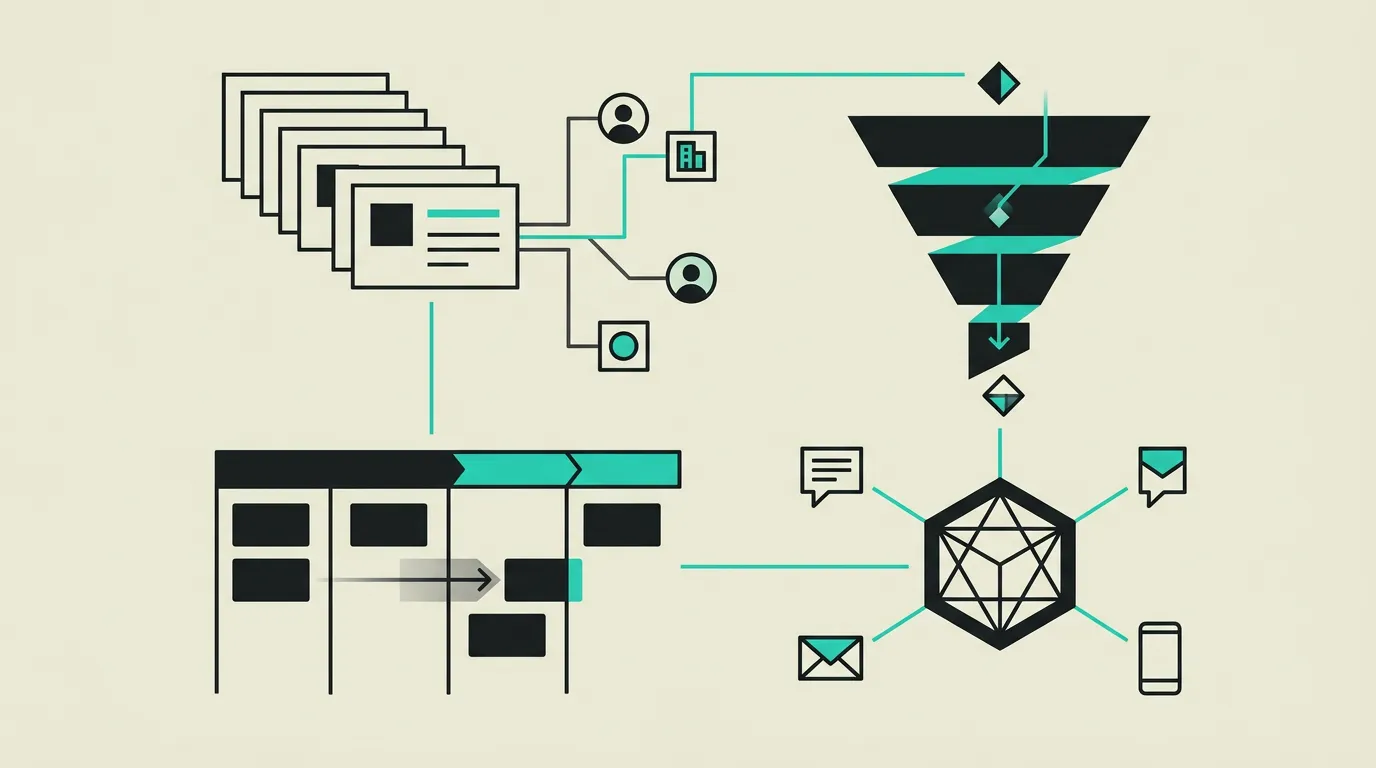
Client relationship management forms the backbone of every successful commercial organisation. Yet many businesses struggle with CRM systems that do not align with their specific work processes. Off-the-shelf CRM packages such as Salesforce, HubSpot, and Pipedrive offer a broad range of features, but force companies to adapt their processes to the software rather than the other way around. Sales processes, customer data structures, and reporting needs vary enormously per industry: a real estate agency has completely different requirements than a technical wholesaler, and a SaaS company demands an entirely different approach to client management than a retail business. On top of that, monthly per-user licence costs for standard CRM platforms add up quickly as your team grows, while you simultaneously pay for modules that nobody uses. A custom CRM system is built around your existing workflow. It integrates seamlessly with internal tools such as your ERP system, email platform, and calendar, and scales with your organisation without forcing compromises on functionality. MG Software has built CRM systems for diverse industries, from real estate and technical trade to SaaS companies. For every project, we start with a thorough analysis of the sales process and customer touchpoints, then build a system your team enjoys using daily. Below we share three concrete examples from our practice, each from a different industry, with unique challenges and measurable results that demonstrate what a custom CRM delivers compared to standard solutions.
Real estate agency CRM with pipeline management
A real estate office in the Randstad region with 12 agents and a portfolio of approximately 400 properties per year needed a CRM that could track their specific sales stages: from first viewing to notary appointment. The office was working with a combination of Excel sheets and a generic CRM that offered no support for the unique workflow of the real estate sector, where properties, buyers, and sellers each have their own timeline and document set. The main challenge was the lack of oversight: agents missed follow-up moments, status updates got lost in email chains, and handovers between colleagues during illness or holidays were messy. We built a custom CRM with a visual pipeline board per agent in which every phase of the sales process is mapped, from first contact and viewing to offer, purchase agreement, and notary appointment. The system processes automatic status updates upon document uploads and synchronises property data with listing platforms via API connections. When a property's status changes, interested buyers automatically receive an update via email. An integrated appointment system links viewings to agent calendars via Google Calendar and Outlook. All client communication is logged in a central client file, ensuring smooth handovers between agents and preventing any touchpoint from being lost. The implementation took ten weeks and the system was rolled out in phases per branch.
- Visual pipeline board with real estate specific stages such as viewing, offer, purchase agreement, and notary
- Automatic synchronisation of property data with external listing platforms via REST API
- Integrated appointment system with calendar sync to Google Calendar and Outlook
- Client communication log with complete history per property and per client
- Result: 35% faster throughput from first viewing to completed sale
- Built with Next.js frontend, Node.js backend, and PostgreSQL database
B2B sales team CRM with quote automation
A technical trading company with 25 representatives generated over 300 quotes monthly, all manually formatted in Word and sent via email. Tracking quote status, follow-up moments, and client history happened in separate spreadsheets that were not connected. When a representative was ill or left the company, valuable client knowledge was lost. Management had no real-time insight into the sales pipeline and could only assess which quotes were won or lost after the fact. We developed a CRM with a built-in quote generator that pulls product data from the ERP system, automatically calculates margins based on customer category and volume, and generates professional PDF quotes in the company's corporate style. Representatives can send quotes directly from the CRM, and the system records when the recipient opens the document. For quotes that remain unanswered for more than five business days, the CRM automatically schedules a follow-up task. Complete sales history per client is available in a clear timeline format showing all touchpoints, quotes, orders, and notes chronologically. Management has real-time dashboard insight into the total pipeline, expected revenue, and conversion rate per representative.
- Automated quote generation with product data from the ERP system and dynamic margin calculation
- Quote view tracking so the sales team knows when prospects review their proposal
- Automatic follow-up tasks for unanswered quotes after a configurable number of business days
- Client timeline with complete sales history, notes, and touchpoints
- Result: 40% more quotes per month and 22% higher conversion rate
- Integration with ERP system for product data and invoicing
Customer service CRM with ticketing system
A SaaS company with 800 business clients and a support team of 8 used a shared Gmail inbox for all customer queries. Prioritisation, escalation, and knowledge sharing were chaotic: urgent questions were sometimes not picked up for hours because they disappeared among less pressing messages. Customers regularly had to re-explain their issue when they reached a different agent, causing frustration on both sides. Moreover, management had no insight into actual response times and could not assess whether SLA commitments were being met. We built a CRM with an integrated ticketing system that automatically converts incoming emails into tickets, categorises them based on keywords and message content, and assigns them to the agent with the most expertise on that topic. The system takes into account the current workload per agent to ensure fair distribution. An internal knowledge base is directly accessible from the ticket screen and suggests relevant solutions based on the problem type. Customers receive automatic status updates whenever their ticket changes status and a satisfaction survey upon resolution. When SLA thresholds are at risk of being breached, the system automatically escalates to a senior agent and sends a notification to the team lead.
- Automatic ticket creation from incoming emails with content-based categorisation
- Smart assignment to agents based on expertise, availability, and workload
- Internal knowledge base with searchable solutions and suggestions during ticket handling
- SLA monitoring with automatic escalation when response time thresholds are at risk
- Result: average response time dropped from 4 hours to 45 minutes
- Customer satisfaction score rose from 7.2 to 8.8 within three months of launch
Key takeaways
- A custom CRM eliminates the compromises that off-the-shelf software forces and adapts precisely to your sales process.
- Automating repetitive tasks such as quote generation and follow-up reminders significantly increases sales team productivity.
- Integration with existing systems like ERP and email platforms prevents double data entry.
- Visual pipelines provide immediate insight into deal status and client journeys.
- A built-in knowledge base speeds up support query resolution and reduces dependency on individual team members.
- SLA monitoring and automatic escalation ensure no customer request goes unanswered.
How MG Software can help
MG Software designs and builds CRM systems that align precisely with your client processes and sales workflows. We start every project with a thorough analysis of your current way of working: how does the sales process flow from first contact to closed deal, what information does your team need at each stage, and where are the bottlenecks costing productivity. Based on this analysis, we design a system your team enjoys using daily and that measurably contributes to your commercial objectives. From visual pipeline management and quote automation to ticketing systems, reporting, and client portals: every component is built based on your specific needs. We integrate with your existing tools such as ERP systems, email platforms, and calendar applications, so data flows automatically and double entry becomes a thing of the past. All systems are delivered with comprehensive documentation and training for your team. The average timeline for a custom CRM project ranges from six to twelve weeks, depending on the number of modules and integrations. After delivery, we offer maintenance contracts for continued development, technical maintenance, and support.
Frequently asked questions
What does a custom CRM system cost?
Costs for a custom CRM depend on complexity, the number of desired modules, and the integrations required with external systems. A basic CRM with contact management and pipeline functionality starts from approximately 10,000 euros. More extensive systems with quote automation, ERP integration, reporting, and a client portal typically range between 15,000 and 40,000 euros. We always provide a no-obligation quote based on a concrete scope analysis, so you know the investment upfront.
How long does it take to build a custom CRM?
A basic CRM with the most essential modules can be delivered in six to eight weeks. More complex projects with multiple integrations, extensive reporting, mobile access, and a client portal typically take ten to fourteen weeks. We work in two-week sprints and deliver working versions along the way, so you can provide feedback from the start and the final result aligns precisely with your expectations.
Can a custom CRM integrate with our existing ERP system?
Yes, integration with ERP systems such as Exact Online, SAP Business One, and Microsoft Dynamics is a standard part of our CRM projects. We build connections via available REST or SOAP APIs, or develop custom middleware when the ERP system does not offer a modern API. Product data, client records, and invoicing are automatically synchronised, preventing double data entry and keeping both systems up to date at all times.
Why choose a custom CRM instead of Salesforce or HubSpot?
Standard CRM platforms offer extensive functionality but force you to adapt your processes to the software. A custom CRM is built precisely around your workflow and contains only the features your team actually uses. Additionally, you avoid escalating monthly per-user licence costs that add up quickly as your team grows. In the long run, a custom solution is often more cost-effective than years of SaaS subscriptions for a large team.
Is a custom CRM also usable on mobile devices?
All CRM systems we build are fully responsive and work on tablets and smartphones via the browser. For teams that are frequently on the road, such as field sales representatives or estate agents, we can develop a Progressive Web App that offers basic offline functionality. Data is stored locally and automatically synchronised as soon as an internet connection becomes available.
How is data secured in a custom CRM?
We implement multiple security layers: role-based access control so employees only see data relevant to their role, encrypted data storage, and communication via TLS. All client data is stored in a secured cloud environment within the EU, fully compliant with GDPR. Additionally, we set up daily automatic backups and implement audit logging so every data change is traceable for compliance purposes.
Can we extend the CRM ourselves later?
Yes, we deliver fully documented code and a modular architecture that your own development team can maintain and extend. The codebase follows proven design patterns and includes tests that safeguard quality when making changes. We also offer a maintenance contract for continued development, bug fixes, and technical maintenance after delivery, so you can always fall back on our team when needed.
Want to build something like this?
From concept to launch. We deliver custom software that works for your customers and team.
 Discuss your project