

Product updates28 Apr 202612 min read
Legacy Software: 7 Signs It Is Time to Modernize (Before It Costs You Customers)
Old systems do not break loudly. They bleed slowly through outages, manual workarounds, and lost deals. Here are seven signals that your legacy software is costing more than replacement, and what to do about each one.

Co-Founder
Introduction
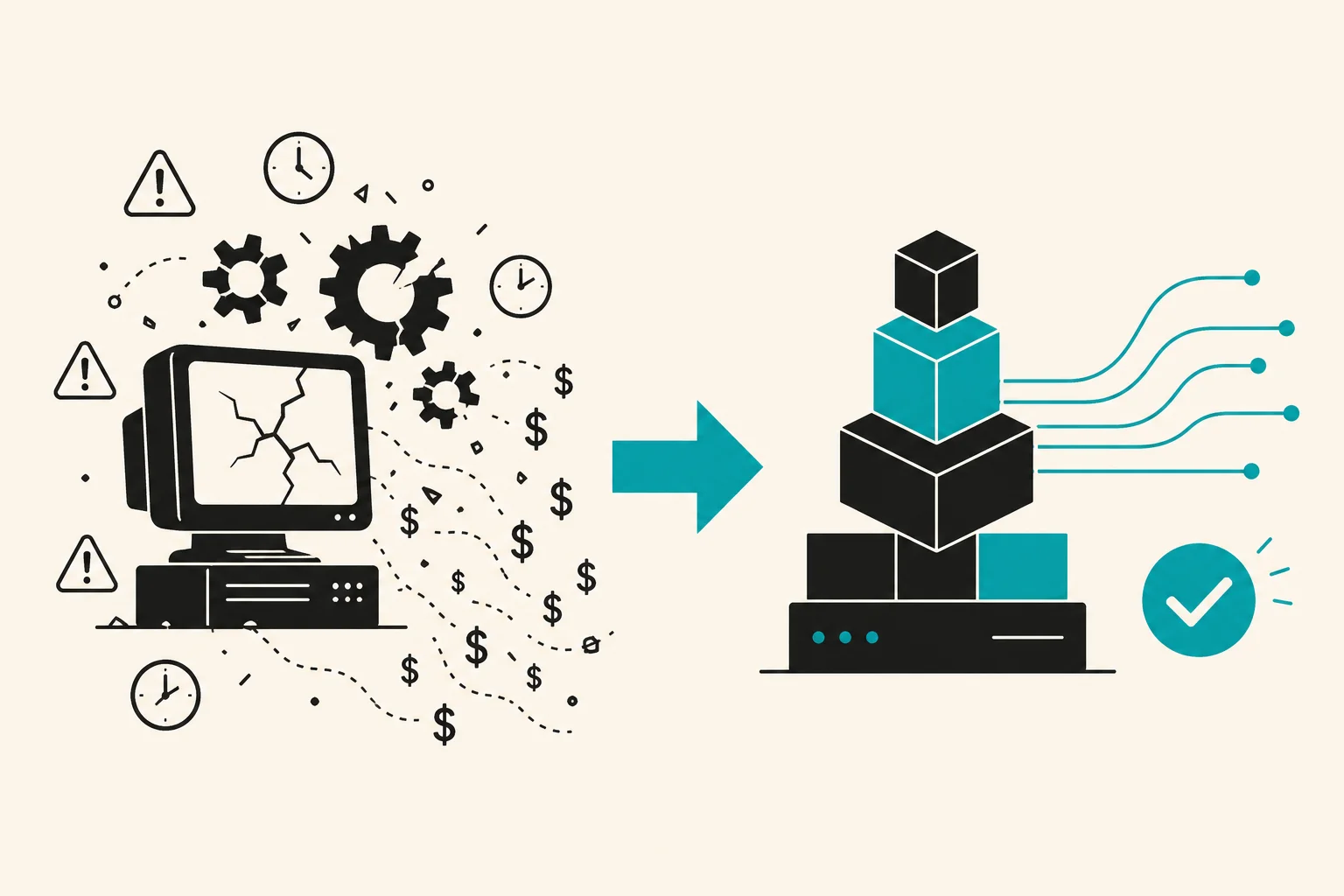
Legacy software rarely fails dramatically. There is no fire, no crash, no headline incident that forces a decision. Instead it slowly bleeds the business through small daily costs that nobody adds up. An hour here on a manual workaround. A deal there that fell through because the system could not provide a quote fast enough. A developer who quits because the tooling makes their work harder than it should be. By the time the cost is undeniable, the system is so embedded that replacing it feels impossible.
We get called into legacy modernization projects every month. The pattern is consistent enough that we recognized seven distinct signals that appear before the business pain becomes acute. Each signal is solvable on its own. Two or more appearing together typically means modernization is overdue. All seven appearing at once means the system is actively destroying value and continuing to operate it costs more than replacement. This is the framework we use to assess whether software has crossed from useful to liability.
Signal 1: Your Team Has Built a Spreadsheet Layer Around the System
Look at how your operations team actually works. If the official system is the source of truth on paper but the real work happens in spreadsheets that get updated manually, you are looking at the most reliable indicator of legacy software pain. The spreadsheet layer exists because the system cannot do something the business needs. Every spreadsheet is a workaround that consumes hours per week that should be productive work.
A logistics client we worked with had built 14 separate spreadsheets that operations checked daily. Order status from the ERP. Driver availability tracked by hand. Customer preferences in a shared document. Vehicle maintenance schedules in a fourth file. They had effectively rebuilt the parts of their ERP that did not work, in spreadsheets nobody was responsible for maintaining. The workaround cost was 18 hours per week across the team. After modernization, the spreadsheets were gone and operations recovered nearly half a full-time equivalent.
Signal 2: Adding Features Takes Months Instead of Weeks
New features in healthy software take days to weeks. The team understands the codebase. Tests catch regressions. Deployments are routine. New features in legacy software take months because every change risks breaking something nobody understands. Developers tread carefully. Testing is manual because automated tests do not exist or are abandoned. Deployments are stressful events that happen rarely.
When you ask for a feature and your team estimates three months for what feels like a small change, the codebase is telling you something. The estimate is honest. The cost is not in the feature itself. The cost is in navigating the accumulated technical debt that surrounds the change. This is the moment where modernization becomes cheaper than continuing to feed the legacy system. Our blog on technical debt as hidden cost covers the math in detail.
Signal 3: Developers Refuse to Work on the System
Talented engineers have options. When a system uses obsolete frameworks, lacks modern tooling, or runs on infrastructure that no longer ships security patches, working on it becomes a career liability. Engineers who care about their long-term marketability avoid it. The team you can hire becomes the team that cannot find work elsewhere.
This signal compounds quietly. Your senior developers leave first because they have the most options. Their replacements are less experienced and produce more bugs. The bug rate increases the maintenance burden, which makes the system worse, which drives more good engineers away. Within two to three years, the system is being maintained by people who were not capable enough to maintain anything else. The business does not see the cause. They just see escalating problems with no clear explanation.
Signal 4: Your System Cannot Integrate With Modern Tools
Modern business runs on connected tools. Customer data flows from marketing automation to CRM to support to billing. Inventory updates from suppliers to warehouse to e-commerce to accounting. When your core system cannot expose modern APIs, every integration becomes a custom batch job, a nightly export, or a screen-scraping hack.
These integrations break frequently because the legacy system was not designed to be integrated with. Every change to a connected modern system risks breaking the bridge. The business ends up unable to adopt new tools because the existing system cannot accept them. You watch competitors deploy capabilities you cannot match because their foundation supports modern integration patterns. We discussed this dynamic in detail in our custom software vs SaaS analysis.
Signal 5: Security Updates Stop Arriving
Software stacks have lifecycles. Frameworks, libraries, runtimes, and operating systems eventually reach end-of-life. The vendor stops shipping security patches. Vulnerabilities discovered after end-of-life remain unpatched forever. Running unpatched software in production is increasingly a compliance violation in regulated industries and an unacceptable risk in any industry.
The technology choices made when your system was new have a shelf life. PHP 5 reached end-of-life in 2019. .NET Framework reached end-of-life with no further updates. Older Java runtimes, older Windows Server versions, older database engines: all eventually stop receiving security updates. If your core business system runs on technology that the vendor no longer maintains, you are operating on borrowed time. The breach has not happened yet. The conditions for it are accumulating.
Signal 6: Onboarding New Employees Takes Weeks Just for the System
Healthy systems have intuitive interfaces, clear workflows, and documented processes. New employees become productive within a few days. Legacy systems require dedicated training, mentorship from existing users, and weeks of supervised practice before someone can operate independently.
When the cost of onboarding becomes a meaningful fraction of an employee's first months, the system has crossed from tool to obstacle. The onboarding cost compounds in growing teams. A company hiring 20 people per year spends a measurable percentage of its operations capacity onboarding people on a system that should be teaching itself through good design. This is hidden cost that nobody includes in the system's total cost of ownership but appears clearly when you tally the time.
Signal 7: You Lose Deals Because of System Limitations
The most expensive legacy signal is the one that shows up in revenue. A prospect asks for a feature competitors offer. The sales team explains the limitation, watches the prospect walk away. A customer asks for a custom integration their other vendors support. The answer is no. A regulatory requirement changes and your system cannot accommodate it. The contract goes to a competitor whose system can.
These losses do not show up in monitoring dashboards. They show up in lost pipeline, churned customers, and delayed expansions. By the time the pattern becomes visible to leadership, the business has been bleeding deals for quarters or years. We have seen modernization projects justified entirely by the deals the existing system was preventing the company from closing. The replacement cost was real. The cost of not replacing was larger.
How to Decide What to Do About It
Identifying the signals is the easy part. Deciding what to do is harder because legacy modernization rarely fits a clean playbook. Three approaches cover most situations.
The first approach is targeted modernization. Pick the single workflow causing the most pain and replace just that part. This works when the legacy system is mostly functional but has a few specific gaps. The replacement integrates with the existing system through APIs or data exports. Risk is low, payback is fast, and you preserve the parts of the legacy system that still work. Most of our modernization projects start here.
The second approach is a phased rewrite. Plan a complete replacement but execute it in pieces over 12 to 24 months. Each phase replaces one functional area while the legacy system continues to operate the rest. This works when the legacy system has structural problems that cannot be patched but the business cannot tolerate a long migration window. The risk is higher than targeted modernization but lower than a single big-bang rewrite.
The third approach is a full rewrite with parallel operation. Build the new system completely, run it alongside the legacy in production, validate equivalence over weeks or months, then cut over. This is the highest-risk approach and only makes sense when the legacy system is so broken that piecemeal approaches are impractical, or when the new system represents a fundamentally different architecture. Most projects we recommend against. Some genuinely require it.
How We Handle Legacy Modernization at MG Software
Our approach starts with diagnosis, not architecture. We spend the first weeks understanding what the legacy system actually does, where the pain lives, what the team has built around it, and what business value the modernization needs to deliver. Half of our modernization engagements end up smaller than the client expected because we find that targeted modernization solves the real problem.
When the project is bigger, we structure it for risk reduction. We write tests against the legacy behavior before we replace it, so we have an objective measure of feature parity. We migrate data in stages with rollback plans. We run the new system in parallel with the legacy until business stakeholders confirm equivalence. We document the architecture and onboard your team progressively so you own the system fully when the engagement ends.
If you recognize three or more of the seven signals in your own operation, the modernization conversation is overdue. Reach out for an assessment. We will be honest about whether modernization is the right move for your situation and which approach fits your constraints. The conversation costs nothing and you walk away with a clearer view of what you are actually paying for the system you have today.
Conclusion
Legacy software does not announce itself. It accumulates costs in places that nobody is responsible for measuring. The spreadsheet workarounds, the months instead of weeks, the lost deals, the security risk, the developer turnover. Each one looks manageable in isolation. Together they consume capacity the business needs to compete.
The companies that handle legacy well do not wait for a crisis. They watch for the signals, they tally the real costs honestly, and they invest in modernization while it is still a strategic choice rather than a forced response. The companies that wait until the system fails dramatically discover that legacy modernization done in panic costs three times what it costs done deliberately. The signals are usually visible long before the dramatic moment. The discipline is acting on them.
Frequently asked questions
How do I know if my software is legacy?
Software becomes legacy when it actively limits the business rather than enabling it. Common signs include developers refusing to work on it, users building spreadsheet workarounds, security patches that no longer arrive, and integrations that break with every update from connected systems. Age alone does not make software legacy. Limitation does.
What does it cost to modernize legacy software?
Modernization costs vary widely based on scope and approach. A targeted modernization of a single critical workflow ranges from 25,000 to 75,000 euros. A full system replacement typically costs between 80,000 and 300,000 euros depending on data complexity and integration requirements. Most projects pay back within 18 to 36 months through reduced maintenance and reclaimed productivity.
Should I rewrite or refactor legacy software?
Refactor when the architecture is sound but the implementation has aged. Rewrite when the architecture itself blocks the business or when the technology stack has no future. Refactoring is faster and cheaper but only works on systems that were built reasonably well. Rewriting takes longer but gives you fundamentally better software when the original was structurally limited.
How long does legacy software modernization take?
A focused modernization project typically takes 3 to 9 months from kickoff to launch. Full system replacements can take 6 to 18 months. The duration depends mostly on data migration complexity, integration count, and the testing required to ensure feature parity with the existing system.
Co-Founder
Related posts
 Product updatesWhat does a client portal cost in 2026? Honest price bandsRead article
 Product updatesMandatory E-Invoicing Is Coming: What SMEs Need to Know About ViDA NowRead article
 Product updatesWhat Does Custom Software Maintenance Cost Per Year?Read article
 Product updatesHow to Choose a Software Development Agency in 2026: 12 Questions That Reveal the TruthRead article