
infrastructure
What is a Message Queue? - Definition & Meaning
Message queues decouple system components through async communication, often using RabbitMQ and Kafka for reliable, scalable data processing.
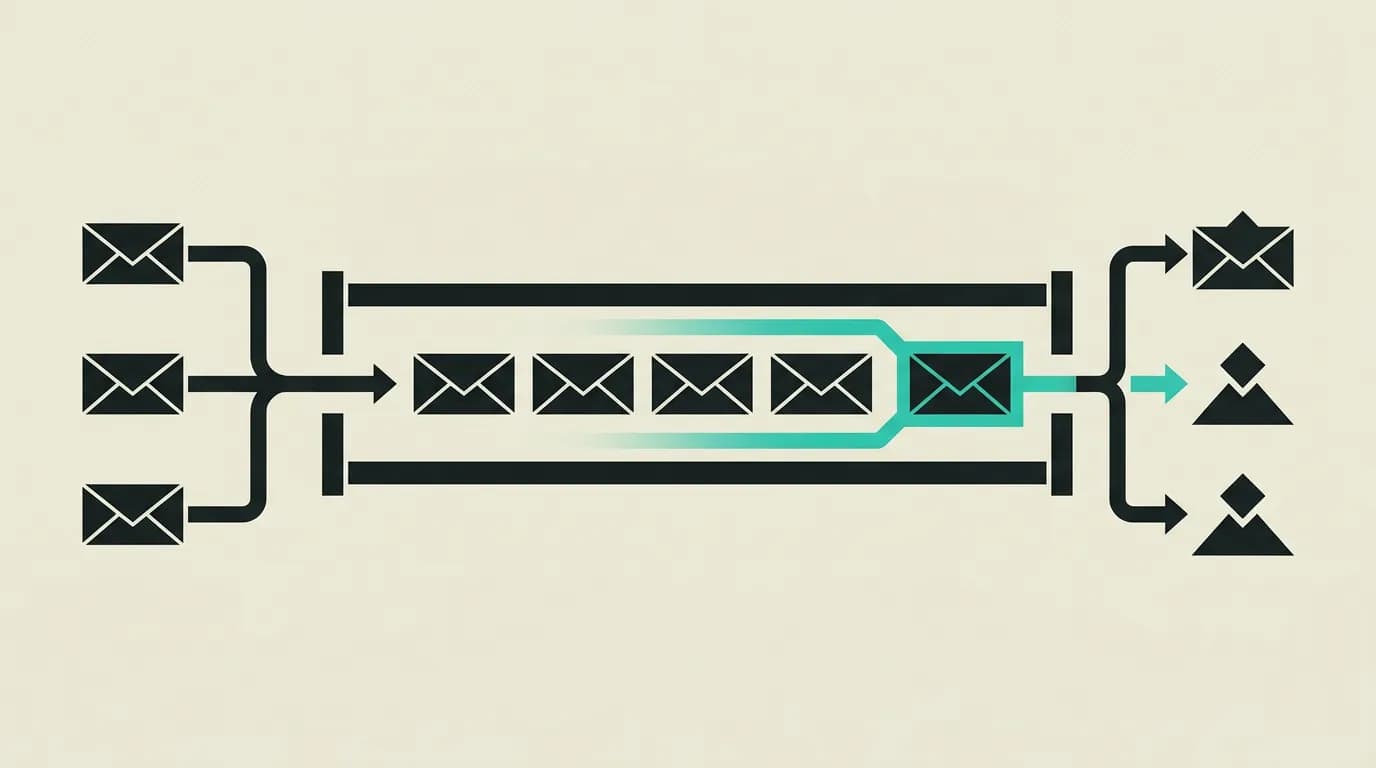
What is Message Queue?
A message queue is a communication mechanism where messages are temporarily stored in a durable queue until the receiver can process them. This decouples the sender (producer) from the receiver (consumer) and enables asynchronous processing where both parties can operate at their own pace. Message queues are a core building block of distributed systems and event-driven architectures, providing reliable, guaranteed communication between loosely coupled application components without requiring both parties to be available at the same time.
How does Message Queue work technically?
Message queues implement the producer-consumer pattern: producers send messages to a queue, and consumers retrieve and process them independently. RabbitMQ is a widely used AMQP broker supporting exchanges, bindings, and routing keys for complex routing patterns including direct, topic, fanout, and headers exchange. RabbitMQ provides acknowledgment mechanisms where consumers confirm successful processing before a message is removed from the queue, preventing data loss during crashes. Apache Kafka is a distributed streaming platform that stores messages in ordered, immutable logs (partitions). Kafka provides high throughput (millions of messages per second), persistence, and replay capabilities, making it ideal for event sourcing and audit trails. Consumer groups in Kafka automatically distribute processing across multiple consumers for horizontal scalability. Dead letter queues (DLQ) capture messages that cannot be successfully processed after a configurable number of attempts. Idempotency patterns, such as including a unique message ID, prevent duplicate processing during retries. Backpressure mechanisms protect consumers from overload by regulating production speed. Cloud-native alternatives like AWS SQS, Google Cloud Pub/Sub, and Azure Service Bus offer managed queueing without operational overhead. Event-driven architectures use message queues to decouple services: each service publishes events and reacts to events from other services, resulting in loose coupling, improved scalability, and independent deployment cycles. Message serialization using Avro or Protocol Buffers combined with a Schema Registry (such as Confluent Schema Registry for Kafka) ensures backward and forward compatibility as message formats evolve, allowing producers and consumers to be updated independently. Kafka supports exactly-once delivery semantics since version 0.11 through idempotent producers and transactional consumers, eliminating duplicate processing at the broker level. Message ordering is guaranteed within a single Kafka partition; global ordering requires a single-partition topic, which caps throughput. RabbitMQ supports priority queues that process higher-urgency messages first, and quorum queues that provide Raft-consensus-based replication for stronger durability guarantees during cluster failures. Message TTL at both the queue and individual message level prevents stale messages from consuming resources indefinitely.
How does MG Software apply Message Queue in practice?
At MG Software, we use message queues for decoupling time-consuming tasks like email delivery via Resend, PDF generation, and payment processing. In microservice architectures, we deploy RabbitMQ or cloud-native alternatives like AWS SQS so services can scale independently. Every queue consumer is designed to be idempotent and includes retry logic with exponential backoff. We monitor queue depth and consumer lag through dashboards and alerts, so issues are flagged before they impact end users. This guarantees that client applications remain responsive even during peak load while background tasks are processed reliably. Each message carries a correlation ID so we can trace the full processing chain end-to-end through our observability stack. Dead letter queues have dedicated alerting configured, and we build admin tooling that lets our team inspect failed messages, identify root causes, and replay them back into the original queue with a single action once the underlying issue is resolved.
Why does Message Queue matter?
Without message queues, application components are tightly coupled: if a downstream service is slow or fails, the user feels it immediately. A queue absorbs spikes, guarantees that no message is lost, and makes it possible to deploy and scale services independently. For businesses, this means higher availability, a better user experience during peak load, and the flexibility to build new features without disrupting existing systems. On the cost side, queues reduce infrastructure spending because workloads are spread over time rather than requiring servers provisioned for peak capacity that sit idle most of the day. Development teams ship faster because services are released independently of one another, shortening time-to-market for new features and reducing the blast radius of each deployment.
Common mistakes with Message Queue
Messages are acknowledged before processing completes, so a crash silently loses the data with no dead letter or retry. Teams treat the broker as a database and discover too late that messages expire or are not searchable. Without idempotent consumers, retries produce duplicate orders or charges. Monitoring on consumer lag is absent, so outages look like silence until customers complain. Backpressure is not configured and producers flood the queue until memory is exhausted. Message schemas are changed without versioning, causing existing consumers to crash on payloads they can no longer deserialize. Poison messages, payloads that are structurally unprocessable, block the entire queue when there is no mechanism to move them to a DLQ after repeated failures.
What are some examples of Message Queue?
- An online store that instantly confirms orders to the customer in the browser while inventory checks, payment processing, and email confirmations happen asynchronously through a message queue, eliminating user-facing wait times and ensuring checkout conversion does not drop due to slow downstream services.
- A notification service receiving events from various microservices via Kafka and batching them into push notifications, emails, and in-app messages for mobile users, with deduplication to prevent duplicate alerts and priority sorting that delivers urgent messages first.
- A data pipeline distributing raw log files via RabbitMQ to multiple workers that transform, validate, and store the data in a data warehouse in parallel, where each worker can independently fail and restart without impacting the rest of the pipeline.
- A video platform placing uploaded material into a queue for transcoding into multiple resolutions, where each transcoding task is independently processed by workers that scale horizontally with upload volume.
- An IoT system streaming sensor data from thousands of devices via MQTT to a Kafka cluster, where real-time analytics run while raw data is simultaneously archived for historical reporting.
Related terms
Further reading
Frequently asked questions
What is the difference between RabbitMQ and Apache Kafka?
RabbitMQ is a traditional message broker that removes messages after successful consumption, ideal for task processing and request-reply patterns. It offers complex routing through exchanges and bindings with fine-grained control over message delivery. Kafka is a distributed streaming platform that persistently stores messages in immutable logs, suited for event sourcing, analytics, and high throughput of millions of messages per second. Kafka retains messages after consumption, enabling replay and reprocessing. Choose RabbitMQ for complex routing and task queues, Kafka for high volumes, event replay, and audit trails.
When do I need a message queue?
You need a message queue when you want to decouple time-consuming tasks from user interactions (such as sending emails after registration or generating PDF reports), allow services to scale independently, or need a reliable communication layer between microservices that is resilient to temporary outages. A queue is also essential when your application experiences traffic spikes that would otherwise overwhelm the backend, requires guaranteed message delivery, or you want to distribute workloads across multiple workers for parallel processing.
How do I handle failed messages in a queue?
Implement a dead letter queue (DLQ) where messages are sent after a configurable number of failed processing attempts, typically three to five retries. Add retry logic with exponential backoff and a maximum retry count to automatically recover from transient failures. Actively monitor the DLQ through dashboards and alerts that notify the team as soon as messages arrive. Build tooling to inspect failed messages and re-queue them after resolving the underlying issue. Log every failed attempt with context, including the error message and payload, so debugging is possible.
What is the difference between synchronous and asynchronous communication?
In synchronous communication, the caller waits for a response before continuing, as with a REST API call. In asynchronous communication via a message queue, the producer sends a message and continues immediately without waiting for processing. Synchronous is simpler but creates coupling: if the receiver is slow, the sender becomes slow too. Asynchronous decouples pace and availability but adds complexity around message delivery and error handling. Most production systems combine both patterns: synchronous calls for direct queries and asynchronous messages for background tasks like email sending.
How do I scale a message queue horizontally?
With RabbitMQ, you can have multiple consumers listen on the same queue; messages are automatically distributed round-robin. With Kafka, you scale by adding partitions to a topic and adding consumers to the consumer group, up to a maximum of one consumer per partition. Cloud-managed queues like AWS SQS scale automatically. Monitor consumer lag to determine when you need additional consumers, and ensure each consumer processes idempotently.
What is the difference between a message queue and an event bus?
A message queue typically delivers each message to exactly one consumer (point-to-point), ideal for task processing. An event bus or publish-subscribe system delivers each event to all subscribed consumers (fan-out), ideal when multiple services need to react to the same event. RabbitMQ supports both patterns through different exchange types. Kafka is inherently publish-subscribe but simulates point-to-point through consumer groups.
What cloud-managed alternatives exist for self-hosted queues?
AWS offers SQS (simple queue) and SNS (pub/sub). Google Cloud has Pub/Sub with automatic scaling and guaranteed delivery. Azure offers Service Bus for enterprise messaging. These managed services eliminate operational overhead like patching, scaling, and failover. They are well suited for teams without dedicated infrastructure engineers, though they offer less configuration flexibility than self-hosted solutions like RabbitMQ or Kafka. Evaluate your exit strategy beforehand, since migrating between managed queue services can be complex due to vendor-specific features and message formats.
From the blog
This concept in your system?
We work with this every day. In a one-hour conversation you know whether it is a portal, an integration or a rebuild.