
Astro vs Next.js: Content Sites or Full-Stack Applications?
Astro ships zero JavaScript by default, Next.js offers full app capabilities. Your choice depends on whether the site is content-driven or interactive.
Astro and Next.js serve fundamentally different needs and the choice is clear in most cases. Astro is unmatched for content-driven websites where speed and SEO are crucial. The zero-JavaScript approach delivers perfect Lighthouse scores and excellent Core Web Vitals without compromises. Next.js is the better framework when your project requires rich interactivity, authentication, complex server-side logic, or a full-stack platform. It is a complete framework for any type of web project. Choose Astro for content-driven sites where every kilobyte counts, choose Next.js for interactive applications that leverage the full React ecosystem.
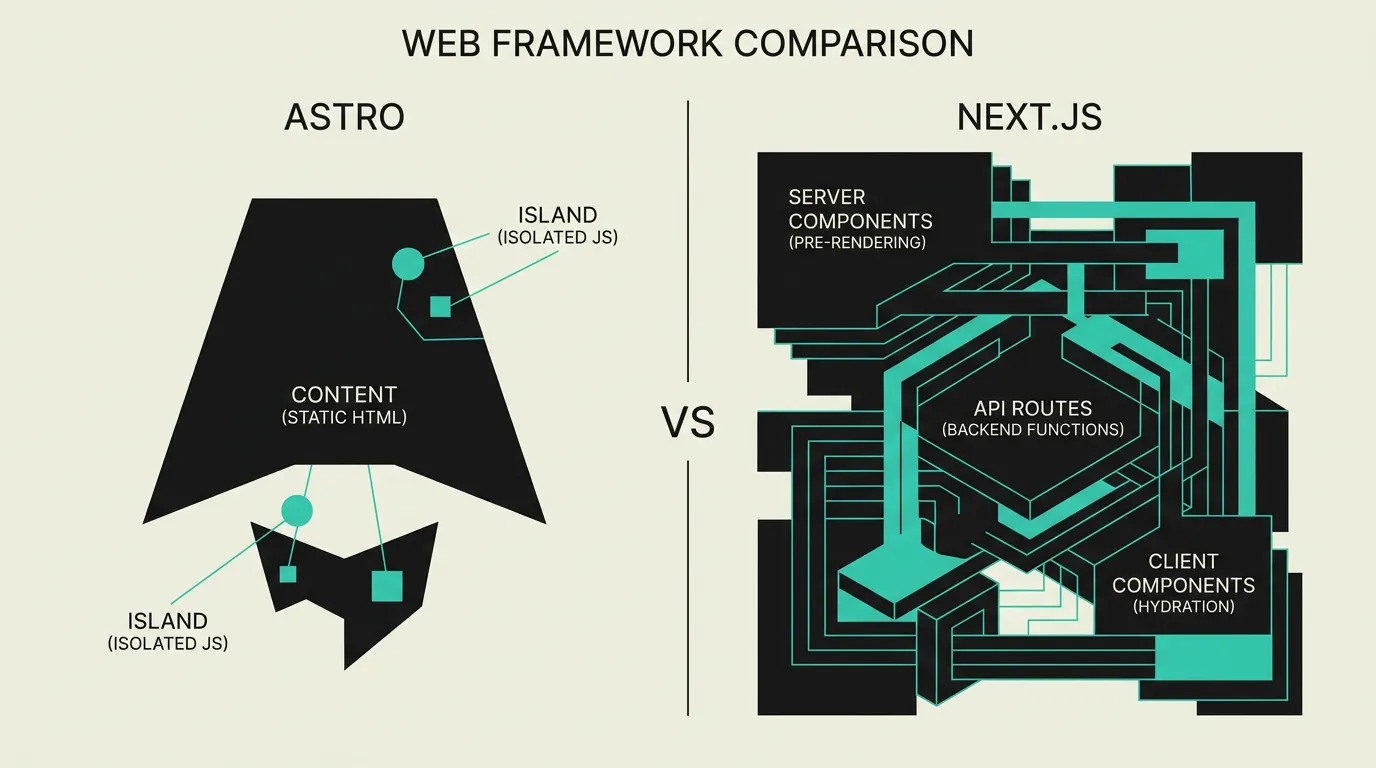
Background
Astro and Next.js serve two clearly different segments of web development in 2026. Astro has established itself as the go-to framework for content-driven websites thanks to its zero-JavaScript architecture and excellent build performance. Next.js dominates the market for interactive React applications with the broadest ecosystem and most rendering options. The choice depends primarily on how much client-side interactivity your project requires. A purely content website benefits enormously from Astro's minimal bundles, while an interactive application needs the full-stack capabilities of Next.js.
Astro
A modern web framework that ships zero JavaScript to the browser by default, resulting in extremely fast load times and perfect Lighthouse scores. Astro is designed for content-driven websites and uses a unique island architecture where interactive components are selectively hydrated. It supports React, Vue, Svelte, Preact, and Lit as UI frameworks, allowing you to reuse existing components. Astro's Content Collections provide type-safe Markdown and MDX processing for structured content. The framework is built on Vite and offers fast development and build times.
Next.js
The leading React framework for building both static websites and dynamic web applications. Next.js 16 offers server-side rendering, static site generation, incremental static regeneration, and React Server Components via the App Router. The framework has the most extensive ecosystem in the React landscape with strong support from Vercel and the community. Next.js provides built-in image optimization, internationalization, middleware, API routes, and advanced caching strategies that make it suitable for any type of web project.
What are the key differences between Astro and Next.js?
| Feature | Astro | Next.js |
|---|---|---|
| JavaScript output | Zero JS by default, only loaded where needed via selective island hydration | React runtime always present in the client bundle, optimized via Server Components |
| Rendering | Primarily static via SSG with optional SSR mode and on-demand rendering | Full flexibility with SSR, SSG, ISR, and hybrid rendering per route |
| UI framework | Framework-agnostic, supports React, Vue, Svelte, Preact, and Lit side by side | Exclusively React-based with the full React 19 ecosystem available |
| Performance | Exceptionally fast for content sites due to minimal JavaScript and small bundles | Highly optimized but with higher baseline from the required React runtime |
| Content integration | Built-in Content Collections with type-safe Markdown, MDX, and Zod validation | MDX support via plugins, no built-in content layer for structured data |
| Build speed | Very fast builds thanks to Vite, ideal for large content sites with thousands of pages | Good build speed with Turbopack, but slower for very large static sites |
| Ecosystem | Growing ecosystem with active community and many integrations for CMS platforms | Very large ecosystem with thousands of plugins, templates, tutorials, and broad talent |
| Full-stack capabilities | Basic SSR and API endpoints, but limited for complex server-side logic | Fully full-stack with Server Components, Server Actions, middleware, and API routes |
When to choose which?
Choose Astro when...
Choose Astro when your website is primarily content-driven and maximum load speed is priority. Astro ships zero kilobytes of JavaScript to the browser by default and only hydrates components that need interactivity via the island architecture. It is ideal for blogs, documentation sites, marketing websites, portfolios, and knowledge bases where every millisecond counts. Content Collections make it easy to manage large amounts of structured content with type safety.
Choose Next.js when...
Choose Next.js when your project requires rich client-side interactivity, complex state management, authentication, or server-side rendering with React Server Components. Next.js is the better choice for SaaS applications, dashboards, e-commerce platforms, and any project where the full React ecosystem and dynamic functionality are essential. Built-in image optimization, ISR, and middleware also make it suitable for content sites that need dynamic elements.
What is the verdict on Astro vs Next.js?
Astro and Next.js serve fundamentally different needs and the choice is clear in most cases. Astro is unmatched for content-driven websites where speed and SEO are crucial. The zero-JavaScript approach delivers perfect Lighthouse scores and excellent Core Web Vitals without compromises. Next.js is the better framework when your project requires rich interactivity, authentication, complex server-side logic, or a full-stack platform. It is a complete framework for any type of web project. Choose Astro for content-driven sites where every kilobyte counts, choose Next.js for interactive applications that leverage the full React ecosystem.
Which option does MG Software recommend?
At MG Software, we use Astro for client projects that are primarily content-driven, such as marketing websites, blogs, and documentation portals where every kilobyte of JavaScript matters and perfect Lighthouse scores are a requirement. For our own website mgsoftware.nl and for client projects with dynamic functionality, we choose Next.js for its flexibility, the React ecosystem, and seamless Vercel integration. Our ideal approach for larger projects is to use Astro for the public content pages and Next.js for the application portion, combining the best performance with the richest functionality.
Migrating: what to consider?
Migrating from Next.js to Astro involves converting React pages to Astro components while keeping interactive React islands where needed. Astro supports React components natively through its island architecture. Restructure routing from Next.js conventions to Astro's file-based routing. Budget two to five weeks depending on the complexity of interactivity. Server-side logic must be rewritten or moved to external APIs.
Frequently asked questions
Is Astro faster than Next.js?
For static content websites, Astro is typically significantly faster because it ships no JavaScript to the browser by default. This results in perfect Lighthouse scores and superior Core Web Vitals. Next.js can achieve comparable speed with SSG, but always requires a React runtime that enlarges the bundle. For dynamic applications with lots of interactivity, the comparison is less relevant because Astro is not designed for that use case.
Can I use React components in Astro?
Yes, Astro fully supports React components via its island architecture. You can import existing React components and selectively hydrate them with directives like client:load, client:visible, or client:idle. This makes migration from a React project easier and allows you to add interactive elements where needed. You can even use React, Vue, and Svelte components side by side on the same page.
Is Astro suitable for web applications?
Astro is primarily designed for content websites and excels there. While it supports SSR mode and API endpoints, it lacks built-in features for authentication, complex middleware, and advanced server-side logic that Next.js provides. For full web applications with dashboards, user management, and real-time features, Next.js is a better choice. Astro is ideal as a content layer alongside a separate application backend.
What are Astro Content Collections?
Content Collections are Astro's built-in system for managing structured content like blog posts, documentation pages, and product descriptions. They provide type-safe Markdown and MDX processing with Zod schema validation. This prevents errors and provides autocomplete in your editor. Next.js has no comparable built-in system and requires external libraries or CMS integrations for similar functionality.
Can I deploy Astro on Vercel?
Yes, Astro works excellently on Vercel and other hosting providers including Netlify, Cloudflare Pages, and AWS. Vercel provides native support for Astro with automatic optimization. The difference from Next.js is that Astro has no vendor-specific features, so it performs equally well on any platform. For SSR mode, you need a serverless or edge runtime.
How much JavaScript does Astro save compared to Next.js?
For a typical content website, the difference can be enormous. Astro ships zero kilobytes of JavaScript by default, while Next.js sends at least 80 to 100 kilobytes of React runtime. For a page with only text and images, Astro can literally load zero JavaScript while Next.js always needs the React hydration layer. This difference translates directly into better Core Web Vitals and faster Time to Interactive.
What is the island architecture in Astro?
The island architecture means Astro renders pages as static HTML and only selectively hydrates specific interactive components, the so-called "islands," with JavaScript. You determine per component when it gets hydrated: immediately on load, when visible in the viewport, or when the browser is idle. This minimizes JavaScript and maximizes performance while still allowing you to add interactivity where needed.
We build production software with this stack
Our developers work with these tools daily for clients across Europe. Price estimate within 24 hours.
 Discuss your project