
MongoDB vs PostgreSQL: Flexible Documents or Relational Strength?
Documents or tables? MongoDB offers schema flexibility, PostgreSQL offers ACID guarantees plus JSONB. Which database matches your data model?
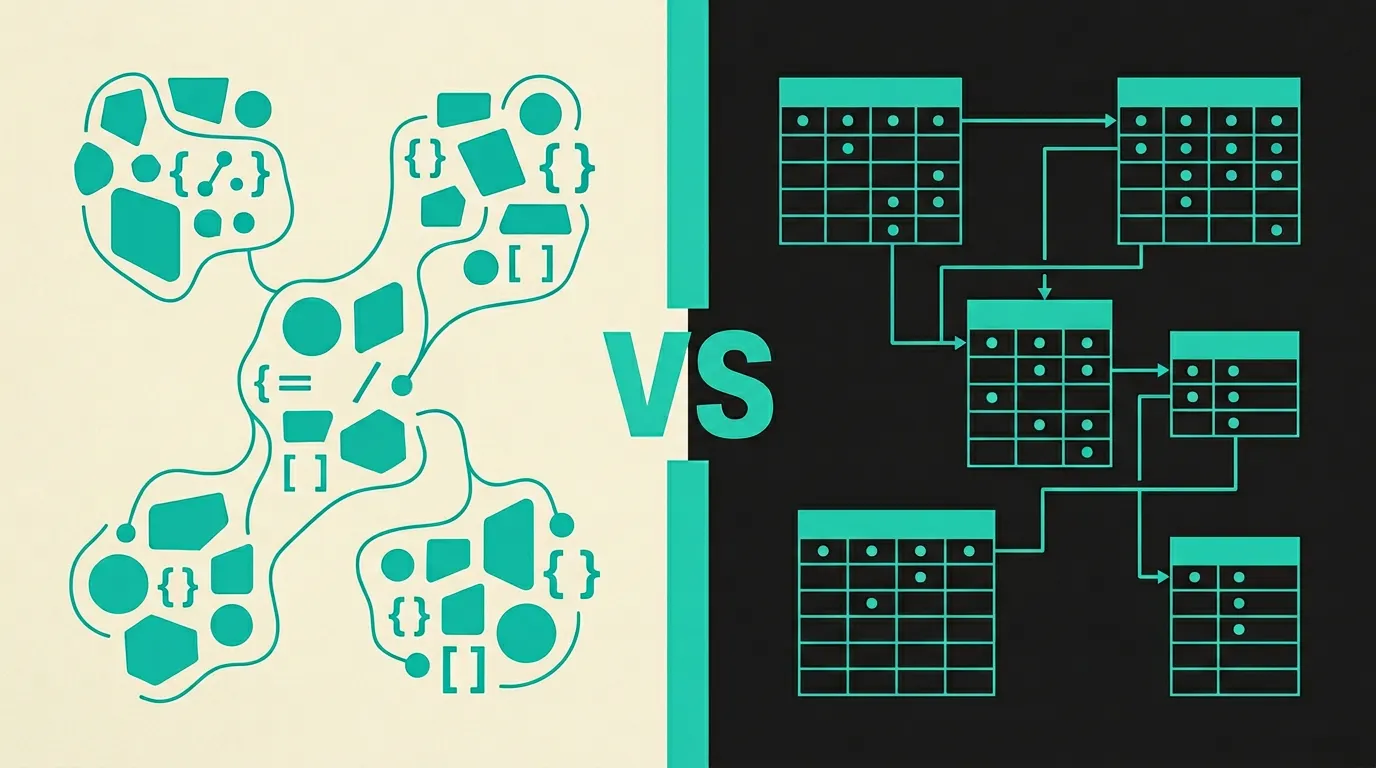
MongoDB and PostgreSQL are both excellent databases operating on fundamentally different data models. MongoDB excels when horizontal scalability, schema flexibility, and high write throughput are priorities. It is the logical choice for applications with unstructured data, IoT workloads, and systems that need to scale across multiple geographic regions. PostgreSQL is the better choice when data integrity, complex relationships, ACID transactions, and advanced SQL functionality are crucial. With JSONB support, PostgreSQL can also handle many document-based workloads that traditionally belonged to MongoDB, making the boundary between both databases increasingly thin. For most web applications, PostgreSQL offers the best combination of flexibility and reliability. MongoDB is specifically recommended for workloads that genuinely require horizontal scaling across multiple nodes or where the data model is inherently document-oriented.
Background
The choice between PostgreSQL and MongoDB is one of the most common architecture decisions when starting a new project. PostgreSQL has gained significant popularity in recent years thanks to platforms like Supabase and Neon, which make the database more accessible for modern web development. MongoDB remains dominant in specific niches like IoT, gaming, and content management where schema flexibility and horizontal scaling are essential. A key development is that PostgreSQL with JSONB and extensions like pgvector is increasingly taking over territory that traditionally belonged to NoSQL databases. Meanwhile, MongoDB has added features like ACID transactions and Atlas Search that traditionally belonged to relational databases. The boundaries are blurring, but the fundamental architecture differences remain.
MongoDB
MongoDB (version 8.0+) is a document-oriented NoSQL database that stores data in flexible JSON-like documents using the BSON format. The database excels at horizontal scalability through built-in sharding and is ideal for applications with rapidly changing data schemas. MongoDB Atlas provides a fully managed cloud platform with built-in search via Atlas Search, real-time sync for mobile apps, and automatic scaling. Since version 4.0, MongoDB supports multi-document ACID transactions, and version 8.0 added queryable encryption and improved time series collections. The platform processes billions of documents daily for companies like eBay, Forbes, and Toyota.
PostgreSQL
PostgreSQL (version 17+) is a powerful open-source relational database with over 35 years of active development and a reputation for reliability and data integrity. The database combines full SQL compliance with advanced features including JSONB for flexible document storage, full-text search, geospatial queries via PostGIS, and vector embeddings via pgvector for AI applications. Row Level Security enables fine-grained access control at the database level. The extension ecosystem offers hundreds of add-ons for specific workloads. Combined with Supabase, PostgreSQL becomes a complete backend-as-a-service platform with real-time subscriptions, authentication, and automatic API generation.
What are the key differences between MongoDB and PostgreSQL?
| Feature | MongoDB | PostgreSQL |
|---|---|---|
| Data model | Document-based with flexible JSON structures and no fixed schema, ideal for polymorphic data | Relational with structured tables, strict schema validation, and powerful JOIN operations for complex relations |
| Query language | MongoDB Query Language with JSON-like syntax, aggregation pipelines, and Atlas Search integration | Standard SQL with extensive JOIN support, window functions, CTEs, and stored procedures |
| Scalability | Built-in horizontal scaling via automatic sharding across multiple nodes in a cluster | Primarily vertical scaling, horizontal possible via Citus, read replicas, or Supabase architecture |
| ACID transactions | Multi-document transactions since version 4.0, improved but less battle-tested than relational databases | Full ACID compliance with decades of proven reliability in production environments worldwide |
| JSON support | Native document storage in BSON with rich querying, indexing, and nested document support | JSONB type with binary storage, GIN indexing, and efficient querying for semi-structured data |
| Indexing | Compound, text, geospatial, wildcard, and sparse indexes for diverse query patterns | B-tree, GiST, GIN, BRIN, hash, and expression indexes for optimized query execution |
| Security | Field-level encryption, RBAC, and queryable encryption since version 7.0 for sensitive data | Row Level Security, column-level privileges, and pg_crypto for fine-grained row-level access control |
| Ecosystem | MongoDB Atlas as managed platform with Atlas Search, Charts, Triggers, and Data Federation | Supabase, Neon, and other platforms offer managed PostgreSQL with real-time, auth, and API layer |
When to choose which?
Choose MongoDB when...
Choose MongoDB when your data is naturally document-shaped with varying structures that do not fit into fixed relational tables. MongoDB is the right choice for applications requiring horizontal scaling across multiple nodes and data centers, such as IoT platforms processing millions of events per second, gaming backends with global users, or content management systems with polymorphic content types. For mobile applications requiring offline synchronization, Atlas Device Sync offers automatic conflict resolution and bidirectional sync. Choose MongoDB when write-heavy workloads dominate, when the schema changes frequently without wanting to run migrations, or when you combine geospatial queries with document queries.
Choose PostgreSQL when...
Choose PostgreSQL when your data is primarily relational with fixed structures and you need transactions across multiple tables for data integrity. PostgreSQL is the default choice for SaaS platforms, e-commerce systems, and financial applications. The combination with Supabase provides Row Level Security for multi-tenant isolation, real-time subscriptions for live updates, and automatic API generation. Choose PostgreSQL when you want to store vector embeddings via pgvector for AI features, need complex reporting with window functions and CTEs, or want to run geospatial queries via PostGIS. The extensive extension ecosystem and broad hosting options make PostgreSQL the most versatile database option available.
What is the verdict on MongoDB vs PostgreSQL?
MongoDB and PostgreSQL are both excellent databases operating on fundamentally different data models. MongoDB excels when horizontal scalability, schema flexibility, and high write throughput are priorities. It is the logical choice for applications with unstructured data, IoT workloads, and systems that need to scale across multiple geographic regions. PostgreSQL is the better choice when data integrity, complex relationships, ACID transactions, and advanced SQL functionality are crucial. With JSONB support, PostgreSQL can also handle many document-based workloads that traditionally belonged to MongoDB, making the boundary between both databases increasingly thin. For most web applications, PostgreSQL offers the best combination of flexibility and reliability. MongoDB is specifically recommended for workloads that genuinely require horizontal scaling across multiple nodes or where the data model is inherently document-oriented.
Which option does MG Software recommend?
At MG Software, PostgreSQL is our default database for all projects. The combination of relational power, JSONB flexibility for semi-structured data, and the excellent Supabase ecosystem makes it ideal for the web applications we build with React and Next.js. We leverage Row Level Security for multi-tenant architectures where each customer only sees their own data, pgvector for AI features with vector embeddings, and built-in full-text search for search functionality without external services. Supabase adds real-time subscriptions, authentication, and automatic REST and GraphQL APIs on top. For projects that specifically require horizontal scaling of document data, such as IoT platforms with millions of sensor readings or analytics systems with unstructured events, we recommend MongoDB Atlas as a managed solution. In our experience, over 90% of projects fall into the category where PostgreSQL is the optimal choice.
Migrating: what to consider?
Migrating from MongoDB to PostgreSQL requires translating document structures into relational tables. Nested documents become either JSONB columns for semi-structured data or normalized tables with foreign keys. Use tools like pgLoader or custom ETL scripts for data transformation. All MongoDB queries (MQL) must be rewritten to SQL. Aggregation pipelines translate to SQL queries with CTEs, window functions, and GROUP BY clauses. Plan for reconfiguring indexes, as MongoDB indexes do not directly translate to PostgreSQL equivalents. Budget 4 to 10 weeks depending on data model complexity. Test extensively for data integrity after migration.
Frequently asked questions
We build production software with this stack
Our developers work with these tools daily for clients across Europe. Price estimate within 24 hours.
Discuss your project