
Turso vs PlanetScale: Edge SQLite or Serverless MySQL?
Embedded SQLite replicas at the edge or MySQL-compatible horizontal sharding? Turso and PlanetScale take radically different cloud database approaches.
Turso and PlanetScale embody two fundamentally different visions for the future of cloud databases. Turso innovates by bringing SQLite to the edge, placing databases physically closer to users for reads with single-digit millisecond latency. Embedded replicas are a unique capability that eliminates network overhead entirely for read operations, and the per-tenant database model makes Turso particularly well-suited for multi-tenant SaaS architectures. PlanetScale delivers enterprise-grade MySQL scaling through the proven Vitess framework, with excellent schema management tools and deep query analytics via Insights. The tradeoff is the removal of the free tier and higher entry costs starting at 39 dollars per month. Your choice depends on architecture and budget: edge-first with minimal latency and a generous free tier with Turso, or MySQL enterprise scaling with advanced branching, analytics and battle-tested sharding with PlanetScale.
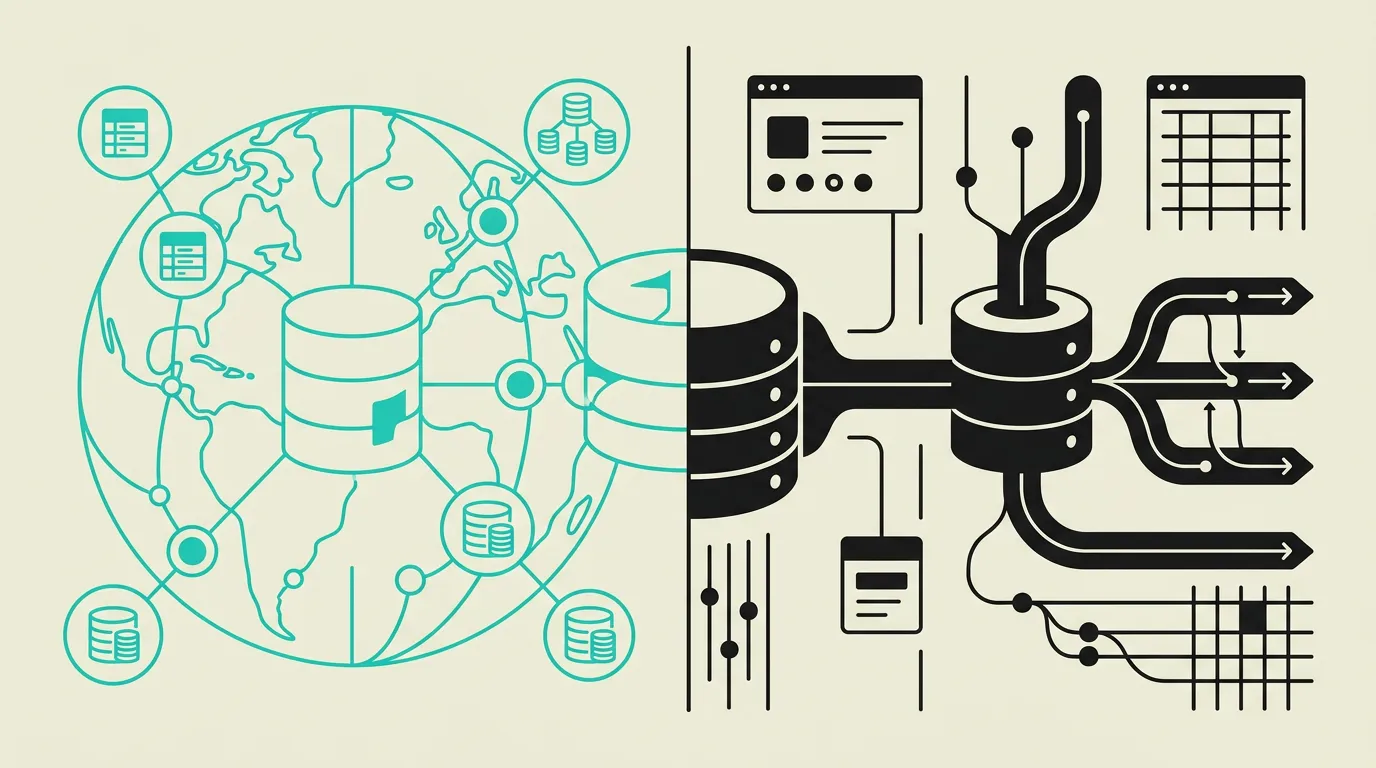
Background
The edge database market is one of the fastest-growing segments in cloud infrastructure. Traditional databases run in a single region, meaning users on the other side of the world experience tens to hundreds of milliseconds of latency on every query. Turso and PlanetScale address this scaling challenge through radically different architectures. Turso brings the database to the edge via distributed SQLite replicas, handling reads locally with minimal latency. PlanetScale scales MySQL horizontally through Vitess with centralized regions and connection pooling. Both platforms invest heavily in developer experience with CLI tooling, database branching and serverless compatibility, but the underlying architecture, cost model and target audience differ fundamentally.
Turso
An edge database built on libSQL, an open-source fork of SQLite that adds server-side write capabilities, vector search support and replication primitives. Turso distributes SQLite databases across more than 35 edge locations worldwide, delivering local reads with single-digit millisecond latency. With embedded replicas, applications read directly from an in-process SQLite copy without any network overhead. Turso combines SQLite's legendary reliability and zero-configuration simplicity with the scalability of a globally distributed system, offering SDKs for JavaScript, Python, Go and Rust.
PlanetScale
A MySQL-compatible serverless database platform built on Vitess, the battle-tested horizontal sharding framework originally developed for YouTube and later adopted by Slack and GitHub. PlanetScale provides non-blocking schema changes that alter table structures without downtime, database branching for safe development workflows and automated horizontal sharding for virtually unlimited growth. Since 2024, the platform has shifted its focus to enterprise customers, removing the free tier and concentrating on teams that need MySQL protocol compatibility combined with enterprise-grade scalability and zero-downtime deployments.
What are the key differences between Turso and PlanetScale?
| Feature | Turso | PlanetScale |
|---|---|---|
| Database engine | libSQL, a SQLite fork that is lightweight and embeddable with added server-side capabilities and replication | MySQL-compatible via Vitess, the horizontal sharding framework proven at YouTube and large-scale SaaS platforms |
| Edge performance | Edge-optimized with local SQLite replicas distributed across more than 35 global locations for minimal latency | Centralized regions with connection pooling, but not specifically optimized for edge-latency use cases |
| Embedded replicas | In-process SQLite replica enabling zero-latency reads directly from your application without any network hop | Not available as a feature; every query requires a network connection to the centralized database cluster |
| Schema branching | Database branching for development and testing with simple CLI commands and point-in-time snapshots | Advanced schema branching with non-blocking schema changes, deploy requests and automatic rollback capabilities |
| Free tier | Generous with 9 GB storage, 500 databases, 25 billion rows read per month and unlimited API requests | No free tier available since 2024; Scaler Pro starts at 39 dollars per month for production workloads |
| Multi-tenancy | Native multi-database architecture allowing each tenant to receive their own isolated SQLite database at the edge | Sharding via Vitess for logical separation, but no native per-tenant database isolation at the engine level |
| Vector search | Experimental vector search support through libSQL extensions for AI embeddings and similarity queries | No native vector search capability; requires an external service like Pinecone or a separate vector database |
| Query analytics | Basic monitoring through the Turso dashboard with query statistics and per-database storage usage metrics | PlanetScale Insights provides comprehensive query analytics, slow query detection and performance recommendations |
When to choose which?
Choose Turso when...
Choose Turso when your application runs on edge platforms like Cloudflare Workers, Vercel Edge Functions or Deno Deploy and requires ultra-fast local reads without network latency. Embedded replicas are ideal for read-heavy applications serving a global audience where every millisecond of response time matters. The per-tenant database model works exceptionally well for multi-tenant SaaS applications where data isolation per customer is important. The generous free tier with 9 GB storage and 500 databases makes Turso particularly attractive for startups, side projects and prototypes that want to experiment quickly without financial risk or credit card requirements.
Choose PlanetScale when...
Choose PlanetScale when your organization needs a proven MySQL platform that scales horizontally without rewriting application code. The Vitess architecture has been battle-tested at the world's largest websites, including YouTube and Slack, and delivers reliable sharding for terabyte-scale datasets. Non-blocking schema changes make it safe to modify table structures in production without downtime or table locks. PlanetScale Insights provides valuable query analytics for performance optimization and identifying slow queries. This platform is the logical choice for enterprise teams with existing MySQL expertise who want to scale to the next level without abandoning their familiar tooling.
What is the verdict on Turso vs PlanetScale?
Turso and PlanetScale embody two fundamentally different visions for the future of cloud databases. Turso innovates by bringing SQLite to the edge, placing databases physically closer to users for reads with single-digit millisecond latency. Embedded replicas are a unique capability that eliminates network overhead entirely for read operations, and the per-tenant database model makes Turso particularly well-suited for multi-tenant SaaS architectures. PlanetScale delivers enterprise-grade MySQL scaling through the proven Vitess framework, with excellent schema management tools and deep query analytics via Insights. The tradeoff is the removal of the free tier and higher entry costs starting at 39 dollars per month. Your choice depends on architecture and budget: edge-first with minimal latency and a generous free tier with Turso, or MySQL enterprise scaling with advanced branching, analytics and battle-tested sharding with PlanetScale.
Which option does MG Software recommend?
At MG Software, we closely follow the rise of edge databases, but for our primary production workloads we choose PostgreSQL via Supabase. The combination of Row Level Security, real-time subscriptions and the PostgreSQL extension ecosystem integrates seamlessly with our Next.js and TypeScript stack on Vercel. Turso is an excellent choice for specific edge use cases where sub-millisecond read latency is critical, for example personalization logic in Vercel Edge Functions or per-tenant data serving in a multi-tenant SaaS. The generous free tier makes it ideal for experimentation and prototypes. We recommend PlanetScale specifically for clients with an established MySQL ecosystem who need enterprise-grade horizontal scaling without rewriting their application layer. The edge database market is evolving rapidly, and we expect Turso's approach of distributed SQLite to become increasingly relevant as more application logic moves to the edge.
Migrating: what to consider?
Switching between Turso and PlanetScale means a complete database engine change. Turso uses libSQL, which is SQLite-compatible, while PlanetScale runs MySQL via Vitess. SQL dialects, data types and query patterns differ significantly. SQLite lacks native DATE or DATETIME types and does not support stored procedures. MySQL has no ROWID concept and uses different locking mechanisms. Evaluate the complexity of your queries and any dependencies on engine-specific features before starting a migration. Using an ORM like Drizzle or Prisma can simplify the database abstraction layer and make future migrations between platforms considerably easier to manage.
Frequently asked questions
What is an edge database?
An edge database distributes data across multiple locations worldwide so that read operations are handled by the nearest location to the user. This minimizes latency because data does not need to travel across the globe for every query. Turso places SQLite replicas at more than 35 edge locations, enabling local reads with single-digit millisecond latency instead of the tens or hundreds of milliseconds required for a round-trip to a centralized server in a single region.
Can Turso replace PlanetScale?
Not as a direct drop-in replacement, because they run on fundamentally different database engines. Turso uses libSQL, a SQLite fork, while PlanetScale runs MySQL through Vitess. SQL dialects, data types and query patterns differ considerably. If your application relies on MySQL-specific features like stored procedures or complex cross-shard joins, migrating to Turso requires significant refactoring. Turso is best suited for new projects that prioritize edge performance and global read latency over MySQL protocol compatibility.
What are embedded replicas in Turso?
Embedded replicas are SQLite databases that run directly inside your application process, for example within a Cloudflare Worker or Vercel Edge Function. Instead of opening a network connection to an external database server, your code reads from a local SQLite copy with zero network latency. Write operations are sent to the primary Turso database and then automatically synchronized to all replicas within milliseconds, ensuring eventual consistency across the global edge network.
Why did PlanetScale remove its free tier?
PlanetScale removed the free tier in April 2024 as part of a strategic shift toward enterprise customers. The company stated that the cost of maintaining free databases was not sustainable and that focusing on paying enterprise clients enables better support and feature development. The most affordable plan, Scaler Pro, starts at 39 dollars per month. For developers looking for a free database option, Turso offers a generous alternative with 9 GB storage and 500 databases at no cost.
Which is better for serverless applications?
Turso generally performs better in serverless environments because embedded replicas eliminate network latency and the libSQL client has a minimal footprint. With PlanetScale, every query requires a network connection, which adds extra latency during cold starts of serverless functions. Turso's SDK integrates smoothly with Cloudflare Workers, Vercel Edge Functions and other serverless platforms. PlanetScale offers connection pooling through their serverless driver, but lacks the edge distribution that Turso provides by default.
Can I use Turso with an ORM like Prisma or Drizzle?
Turso has official support for Drizzle ORM via the @libsql/client driver, which is a popular combination in the TypeScript ecosystem. Prisma supports Turso through a dedicated adapter for libSQL. Both ORMs abstract away SQL dialect differences, simplifying potential future migrations between database platforms. Drizzle is often the preferred choice due to its lighter footprint and better edge runtime compatibility. Always verify that your specific query patterns work correctly within the SQLite dialect limitations of libSQL.
How does Turso compare to Supabase or Neon?
Turso, Supabase and Neon target different use cases. Supabase and Neon are PostgreSQL-based platforms offering a full backend-as-a-service with authentication, file storage and real-time capabilities. Turso focuses specifically on edge distribution of SQLite for ultra-fast reads with minimal latency. At MG Software, we use Supabase for our primary databases because of Row Level Security and the PostgreSQL extension ecosystem. Turso serves as a complementary tool for specific edge scenarios where sub-millisecond read latency is essential.
We build production software with this stack
Our developers work with these tools daily for clients across Europe. Price estimate within 24 hours.
 Discuss your project