
Vite vs Webpack: Native ES Modules or Established Bundling?
Vite starts in milliseconds, Webpack offers a decade of plugin support. Speed versus maturity - which bundler fits your development workflow?
Vite has fundamentally changed the frontend build landscape since its introduction. The blazing-fast development server that starts in milliseconds, the minimal configuration, and the excellent developer experience make it the superior choice for virtually any new project. Webpack remains relevant for existing codebases with complex configurations, projects requiring Module Federation, and edge cases that Vite does not yet fully cover. The trend is irreversible: most frameworks have adopted Vite as their default build tool. Vue, Svelte, SolidJS, and Astro all use Vite as their core, and even Angular is considering future integration. For new projects in 2026, there is little reason to choose Webpack unless specific Webpack plugins or Module Federation are indispensable to your architecture.
Background
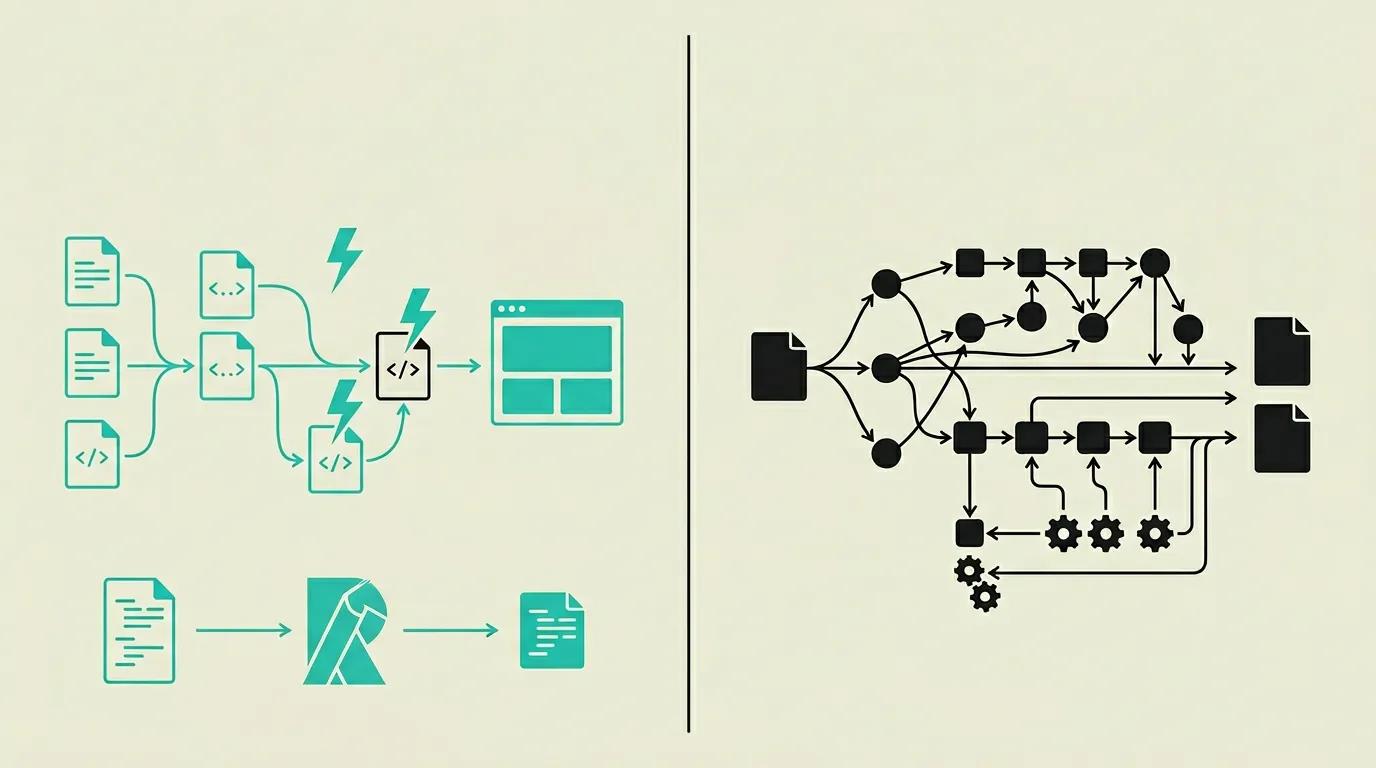
The JavaScript build tool landscape has undergone a decisive shift toward Vite. Where Webpack was the undisputed standard for years, Vite introduced a fundamentally different approach using native ES modules that radically improves the development experience. New projects overwhelmingly choose Vite for its instant dev server and simple configuration. Webpack continues to dominate in existing enterprise applications with complex build pipelines built up over years. The migration trend from Webpack to Vite continues to accelerate as the Vite plugin ecosystem grows and tools like Rolldown promise to make production builds even faster and more consistent.
Vite
Vite is a next-generation build tool built on native ES modules for blazing-fast development server startup times. Created by Evan You, the maker of Vue, Vite uses esbuild for dependency pre-bundling and Rollup (with a future migration to Rolldown) for optimized production builds. In 2026, Vite is the default build tool for Vue, Svelte, SolidJS, and an increasing number of React projects outside the Next.js ecosystem. With Vite 6, the environment API and improved server-side rendering support were added, and Rollup plugin compatibility makes the ecosystem remarkably extensive.
Webpack
Webpack is the most mature and widely used JavaScript bundler with over ten years of active development. It offers the largest plugin ecosystem in the frontend landscape, advanced code-splitting strategies, Module Federation for micro-frontends, and deep configuration capabilities. Webpack is used by millions of projects worldwide and serves as the underlying bundler in Create React App, older Angular versions, and many enterprise applications. Webpack 5 added Module Federation, improved caching, and better tree-shaking, but configuration complexity remains a recurring pain point for development teams.
What are the key differences between Vite and Webpack?
| Feature | Vite | Webpack |
|---|---|---|
| Dev server startup time | Milliseconds thanks to native ESM that serves modules on demand without pre-bundling anything | Seconds to minutes because the entire dependency graph must be bundled before serving |
| Hot Module Replacement | Instant and consistent regardless of project size thanks to ESM-based module replacement | Gets progressively slower as the project grows due to the expanding dependency graph |
| Configuration complexity | Minimal with sensible defaults, works out of the box for most common project types | Complex and verbose, requiring detailed configuration for loaders, plugins, and optimizations |
| Plugin ecosystem | Rapidly growing ecosystem, fully compatible with Rollup plugins and dedicated Vite-specific plugins | The largest ecosystem with thousands of plugins, loaders, and community contributions over a decade |
| Production builds | Rollup-based with efficient tree-shaking, code-splitting, and optimized chunking strategy | Powerful with advanced optimizations, dynamic imports, and configurable code-splitting strategies |
| Legacy browser support | Via @vitejs/plugin-legacy with automatic polyfills and syntax transformation for older browsers | Extensive with fine-grained control over browser targets via Babel and browserslist configuration |
| Module Federation | Supported via vite-plugin-federation, but less mature than Webpack's native implementation | Native Module Federation 2.0 for micro-frontends with runtime code-sharing between applications |
| CSS processing | Built-in support for CSS Modules, PostCSS, Sass, and Tailwind without additional configuration | Requires specific loaders such as css-loader, style-loader, and postcss-loader for each CSS variant |
When to choose which?
Choose Vite when...
Choose Vite when you want the fastest development experience with instant hot module replacement and a dev server that starts in milliseconds regardless of project size. Vite is the default choice for new projects with React, Vue, Svelte, SolidJS, or vanilla TypeScript. The minimal configuration saves setup time and Rollup compatibility provides access to a large plugin ecosystem. Vite's library mode is also ideal for building and publishing npm packages with optimal tree-shaking support and multiple output formats.
Choose Webpack when...
Choose Webpack when you are working with an existing project that has complex Webpack configuration not easily migrated, or when you need specific Webpack loaders for which no Vite equivalent exists yet. Webpack is also the right choice for projects using Module Federation for micro-frontend architectures with runtime code-sharing between applications. Teams with deep Webpack expertise and a working build pipeline do not need to migrate if there are no concrete pain points in their development workflow.
What is the verdict on Vite vs Webpack?
Vite has fundamentally changed the frontend build landscape since its introduction. The blazing-fast development server that starts in milliseconds, the minimal configuration, and the excellent developer experience make it the superior choice for virtually any new project. Webpack remains relevant for existing codebases with complex configurations, projects requiring Module Federation, and edge cases that Vite does not yet fully cover. The trend is irreversible: most frameworks have adopted Vite as their default build tool. Vue, Svelte, SolidJS, and Astro all use Vite as their core, and even Angular is considering future integration. For new projects in 2026, there is little reason to choose Webpack unless specific Webpack plugins or Module Federation are indispensable to your architecture.
Which option does MG Software recommend?
At MG Software, we use Vite as our default build tool for all new projects outside the Next.js ecosystem. The speed of the development server and simple configuration significantly improve our productivity. Next.js has its own compiler (Turbopack), but for standalone React projects, Vue projects, library development, and prototyping, we consistently choose Vite. We actively migrate existing Webpack projects to Vite when the opportunity arises, because the improvement in developer experience and build speed is immediately measurable. The investment in migration typically pays for itself within a few weeks through increased development velocity and reduced frustration in day-to-day work.
Migrating: what to consider?
When migrating from Webpack to Vite, replace webpack.config.js with vite.config.ts. Most Webpack loaders have Vite equivalents as plugins, for example sass-loader becomes native Sass support or a dedicated Vite plugin. Note that import.meta.env replaces the DefinePlugin for environment variables, and require() is not available in ESM mode. Reconfigure path aliases via resolve.alias in the Vite config. Start in a feature branch, test thoroughly for production build compatibility, and plan 1 to 4 weeks depending on the complexity of the existing Webpack configuration.
Frequently asked questions
Is Vite really faster than Webpack?
Yes, the difference is substantial. Vite starts the development server in milliseconds regardless of project size, while Webpack takes seconds to minutes. This is because Vite uses native ES modules and only transforms the modules that the browser actually requests on demand, instead of pre-bundling everything upfront. For hot module replacement, Vite is equally faster since only the changed module and its direct dependents are updated.
Can I migrate from Webpack to Vite?
Yes, migration is possible and becomes easier as the Vite ecosystem grows. Most popular Webpack loaders and plugins have Vite equivalents. Pay specific attention to require() statements that must be rewritten as ESM imports, environment variables that move from process.env to import.meta.env, and custom Webpack loaders that may require a Vite plugin. Migration guides are available for React, Vue, and Angular projects.
Does Next.js use Vite or Webpack?
Next.js uses Webpack as its default bundler, but Vercel is developing Turbopack as a replacement. Turbopack is a Rust-based bundler specifically designed for Next.js that offers speed advantages similar to Vite. Vite is not officially supported within Next.js, but can be used with other React frameworks like Remix and Astro, or with standalone React projects outside the Next.js ecosystem.
What is the difference between dev server and production build in Vite?
Vite uses two different systems: the development server runs on native ES modules and esbuild for fast transformation, while production builds use Rollup for optimized bundling with tree-shaking and code-splitting. This dual system provides the fastest development experience alongside optimized production output, but requires testing both environments to rule out subtle behavioral differences between them.
What is Module Federation and does Vite support it?
Module Federation is a Webpack 5 feature that enables runtime code-sharing between independently deployed applications, essential for micro-frontend architectures. Vite supports Module Federation through community plugins like vite-plugin-federation, but the implementation is less mature than Webpack's native version. If Module Federation is a core requirement for your architecture, Webpack currently still has an advantage in this area.
Is Vite suitable for large enterprise projects?
Yes, Vite is suitable for large enterprise projects and is widely adopted in enterprise environments in 2026. The dev server scales excellently with project size thanks to the on-demand nature of native ES modules. Production builds via Rollup are optimized and reliable. The only caveat is that very complex Webpack configurations with custom loaders and plugins may require additional migration effort to find equivalent solutions.
What is Rolldown and how does it affect Vite?
Rolldown is a Rust-based bundler being developed as a future replacement for Rollup in Vite's production builds. The goal is to combine the speed of esbuild with the full feature set of Rollup. When Rolldown is fully integrated, Vite production builds will become significantly faster, and the gap between the dev server and production bundler will disappear, improving the consistency of the overall build pipeline.
We build production software with this stack
Our developers work with these tools daily for clients across Europe. Price estimate within 24 hours.
 Discuss your project