
What is the Model Context Protocol? - Explanation & Meaning
Anthropic's Model Context Protocol standardizes how AI agents connect to external tools and data sources. It is the universal connector for AI integrations.
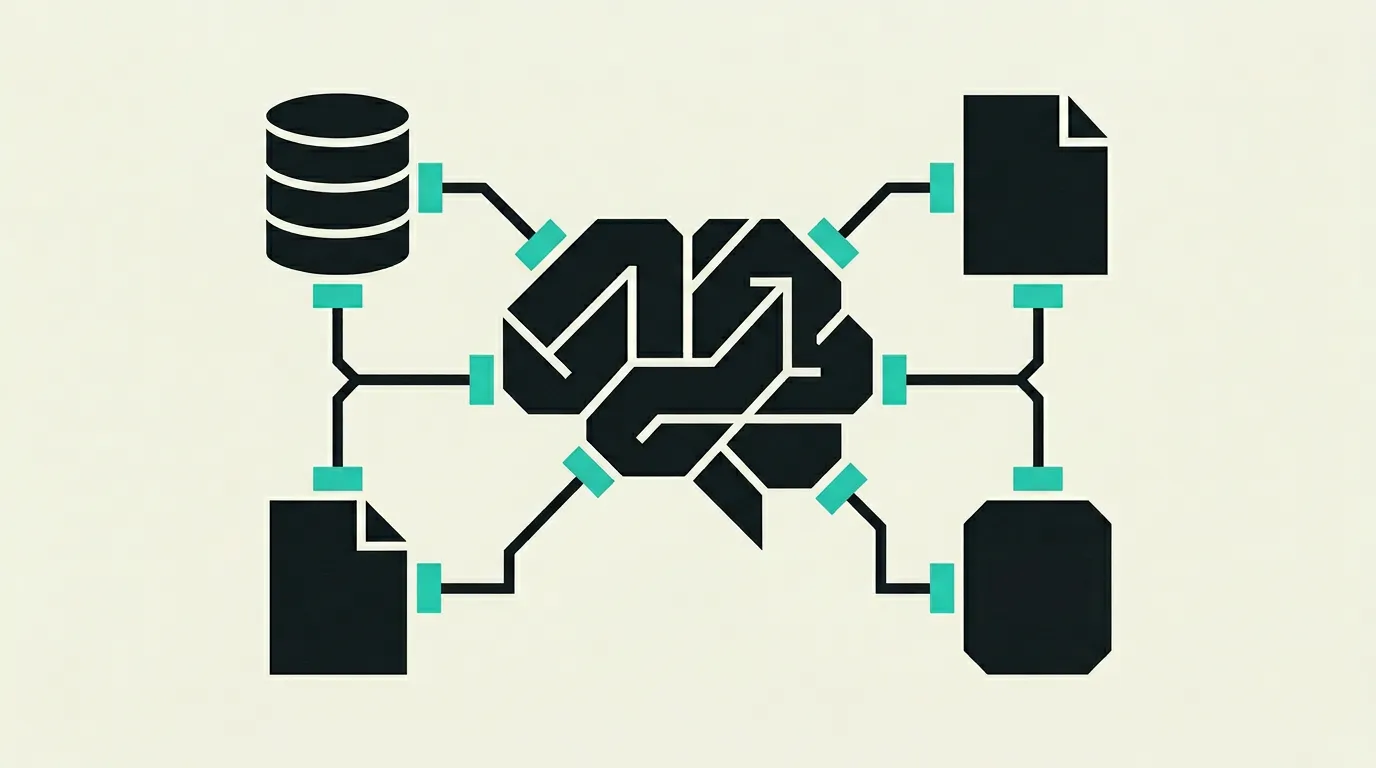
The Model Context Protocol (MCP) is an open standard, developed by Anthropic, that defines a universal interface through which AI models and agents can securely connect to external data sources, tools, and services. MCP serves as the standardized communication layer between AI systems and the outside world, comparable to the role HTTP plays for the web. Thanks to MCP, each AI system no longer needs to build separate, custom-built integrations for every external service it wants to communicate with.
What is Model Context Protocol?
The Model Context Protocol (MCP) is an open standard, developed by Anthropic, that defines a universal interface through which AI models and agents can securely connect to external data sources, tools, and services. MCP serves as the standardized communication layer between AI systems and the outside world, comparable to the role HTTP plays for the web. Thanks to MCP, each AI system no longer needs to build separate, custom-built integrations for every external service it wants to communicate with.
How does Model Context Protocol work technically?
MCP standardizes communication between AI agents and external systems via a client-server architecture based on JSON-RPC 2.0. An MCP server exposes three types of capabilities: tools (functions that perform actions such as querying customer data or creating a Jira ticket), resources (readable data sources such as documents, database tables, or API endpoints), and prompts (reusable instruction sets that guide agent behavior). MCP clients, such as AI agents in a chat interface or IDE extensions, discover available capabilities through capability negotiation during connection setup and invoke them via a type-safe interface with validated parameters. The protocol supports multiple transport layers: stdio for local inter-process communication, HTTP with Server-Sent Events (SSE) for remote connections, and WebSocket for bidirectional real-time communication in latency-sensitive scenarios. In 2026, MCP has become the de facto standard for AI tool usage. Major platform vendors including OpenAI, Google, and Microsoft have integrated MCP support into their AI products. The open-source ecosystem provides ready-made MCP servers for databases (PostgreSQL, MySQL, Supabase), cloud services (AWS, GCP, Azure), development tools (GitHub, GitLab, Jira, Linear), CRM systems (Salesforce, HubSpot), and dozens of other services. Security is built into the protocol through OAuth 2.0 authentication, fine-grained permission models that determine per tool and per client which actions are allowed, and audit logging of all tool invocations. The protocol also specifies how sensitive operations can require a human approval step (human-in-the-loop), which is essential for enterprise scenarios where AI agents perform actions with real consequences such as modifying customer records or approving orders. The modular design of MCP enables servers to be developed, tested, and deployed independently, significantly improving the maintainability of AI integrations across the organization.
How does MG Software apply Model Context Protocol in practice?
MG Software uses MCP as the standard protocol for every AI agent we build. We develop custom MCP servers that expose business-specific tools and data sources: from CRM systems and databases to internal applications and document management systems. Because each MCP server provides a standardized interface, we can compose agents from reusable components in a modular fashion. A new agent that needs CRM access does not require building another integration; it simply connects to the existing MCP server. We implement fine-grained permissions per agent, ensuring that a customer service agent has read-only access to client records while an order management agent also has write permissions. Audit logging gives our clients full visibility into which actions agents have performed, which is essential for compliance and trust.
Why does Model Context Protocol matter?
MCP standardizes how AI agents communicate with external systems, comparable to the way HTTP standardized communication on the web. Without MCP, every AI system must build and maintain a separate integration for each external service, creating an exponentially growing web of connections as the number of tools and agents increases. With ten agents and fifteen tools, that means 150 custom integrations to build and maintain. MCP reduces this complexity to an N+M problem: each service builds one MCP server and each agent implements one MCP client, bringing those 150 integrations down to just 25 components. By adopting MCP, you make your systems AI-ready so that future AI applications can connect immediately without developing new integrations from scratch. The protocol also enforces a security-first approach through built-in authentication, permission models, and audit logging, which means security is part of the architecture rather than an afterthought bolted on later. For development teams, MCP significantly reduces the time required to ship new AI features because the foundational connectivity layer is already in place and tested. Organizations that invest in MCP servers for their core processes now are building a foundation that is reusable for every subsequent AI agent or application they deploy, creating compounding returns on that initial investment as the number of AI use cases within the organization grows.
Common mistakes with Model Context Protocol
Implementing MCP servers without adequate authentication and authorization, giving AI agents unrestricted access to sensitive data and operations. Not distinguishing between read and write actions in the permission model, so an agent that only needs to query information can also make modifications. Skipping rate limiting, allowing an agent stuck in an error loop to generate thousands of API calls within minutes. Not implementing audit logging, making it impossible to reconstruct which actions an agent performed and why. Bundling all capabilities into a single large MCP server instead of building functionally separated servers, which makes it harder to manage permissions granularly and update servers independently. Finally, omitting human-in-the-loop for destructive or financially sensitive actions, which poses a real risk when deploying AI agents in production environments.
What are some examples of Model Context Protocol?
- A company building an MCP server for their Salesforce CRM, enabling AI agents to look up customer information, review interaction history, and create follow-up tasks through a standardized secured interface. The sales team can now ask the AI agent questions about client relationships in natural language without navigating the CRM directly.
- A development team using an AI coding assistant in their IDE that connects via MCP to their GitHub repository, Linear project board, and Confluence documentation site. The assistant reads existing code, creates issues based on detected bugs, and keeps technical documentation automatically up to date as the codebase evolves.
- A data analytics platform implementing MCP servers for their PostgreSQL databases and Metabase dashboards, allowing an AI agent to run ad-hoc analyses, generate SQL queries, build visualizations, and compile reports based on natural language questions from non-technical business users.
- A customer service organization building an MCP server for their ticketing system and knowledge base. The AI agent classifies incoming questions, retrieves relevant articles, drafts response suggestions, and for complex cases automatically escalates to a human agent with all necessary context attached to the ticket.
- A financial institution implementing MCP servers with strict human-in-the-loop approval for sensitive operations. The AI agent can query transaction data and perform analyses freely, but for actions like blocking an account or approving a payment, explicit human authorization is always required before execution.
Related terms
Frequently asked questions
We work with this every day
The same expertise you are reading about, we put to work for clients across Europe.
See what we doRelated articles
What are AI Agents? - Explanation & Meaning
AI agents act autonomously by planning tasks, invoking tools, and making decisions. It represents the next evolution in applied AI technology for enterprises.
What Is an API? How Application Programming Interfaces Power Modern Software
APIs enable software applications to communicate through standardized protocols and endpoints, powering everything from payment processing and CRM integrations to real-time data exchange between microservices.
What Is SaaS? Software as a Service Explained for Business Leaders and Teams
SaaS (Software as a Service) delivers applications through the cloud on a subscription basis. No installations, automatic updates, elastic scalability, and secure access from any device make it the dominant software delivery model for modern organizations.
Qwik Alternatives That Ship Production Apps Today
Resumability is promising but the ecosystem is small. Five frameworks that already deliver what Qwik promises for your next production project.