
Product Configurator Examples Built for Real Businesses
Explore three real-world examples of custom product configurators built by MG Software for manufacturers and suppliers across different sectors. From an interactive 3D kitchen configuration tool and an online window frame configurator to a hardware configurator for IT suppliers, each example demonstrates how visual configuration combined with automated quoting accelerates the sales process and measurably increases conversion rates.
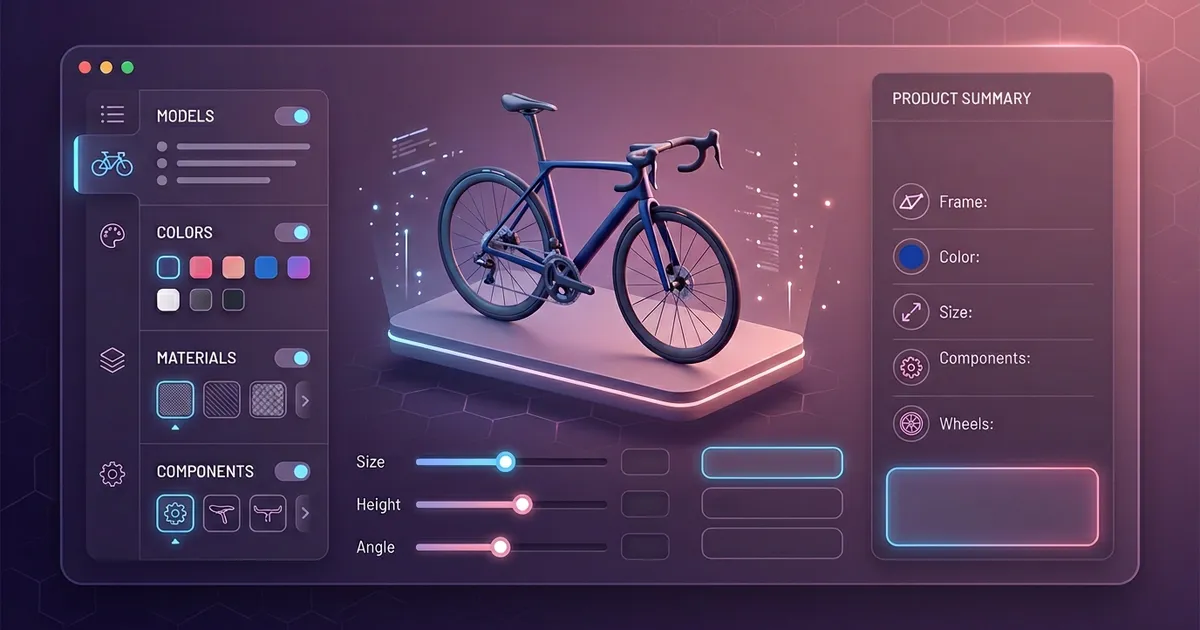
Companies that offer made-to-order products often struggle with the same problem: customers want to see what they are buying beforehand, but the variety of options, materials, and dimensions makes it impossible to create an image or brochure for every combination. The result is a slow quoting process that depends on technical staff, a high risk of configuration errors, and customers who drop off because they lack confidence in their selection. A product configurator allows customers to build their product step by step, with real-time visualisation that immediately shows what the end result looks like and an accurate price calculation that updates with every selection. The technical challenge in building a configurator lies in correctly modelling all product rules, dependencies, and exclusions, so that only valid configurations are possible while the user experience remains intuitive. MG Software builds product configurators for manufacturers, retailers, and B2B companies selling complex products. Below we share three examples with different product categories and configuration complexity that demonstrate how a custom configurator transforms the sales process.
3D kitchen configuration tool for a kitchen manufacturer
A kitchen manufacturer with a dealer network of 45 showrooms wanted to give customers a realistic impression of their kitchen already in the showroom, so they could make a purchasing decision on the spot. The existing process required a designer to manually create a 3D drawing in specialised CAD software, which took two to three working days. In the meantime, many potential customers lost their enthusiasm or visited a competitor. We built a configuration tool where dealers and customers together compose a kitchen layout in an interactive 3D environment that runs directly in the browser. The tool shows available cabinets, worktops, appliances, and finishes with photorealistic material rendering and calculates the price in real-time based on selected components. A rules engine continuously checks the validity of the configuration: invalid combinations are automatically blocked, for example a dishwasher next to a corner unit that offers insufficient space, and the system actively suggests alternatives. After configuration, the system automatically generates a detailed quote with per-component specifications and a production order that can be forwarded directly to the factory.
- Interactive 3D environment where customers visually compose their kitchen layout
- Real-time price calculation based on selected cabinets, worktops, and appliances
- Rules engine that automatically blocks invalid product combinations and suggests alternatives
- Automatic generation of quote and production order directly from the configuration
- Result: quoting time dropped from 3 days to 30 minutes, showroom conversion increased by 40%
- Built with Three.js for 3D visualisation and a React interface for the configuration panel
Quote configurator for custom window frames
A window frame manufacturer received dozens of daily quote requests for custom windows and doors via email and phone. Each request required a technical staff member to manually combine dimensions, materials, glass types, and hardware into a price, taking into account hundreds of product rules and dependencies. This took an average of 45 minutes per quote and during peak periods the wait time for quotes extended to over a week. We developed an online configurator where both consumers and dealers compose window frames by entering dimensions, choosing materials (PVC, aluminium, or wood), selecting glass types, and configuring hardware. The configurator contains all the manufacturer's product rules and automatically blocks combinations that are technically impossible, such as oversized glass surfaces for certain profile types. At each step, the system instantly calculates the price and displays a technical drawing of the frame with dimension annotations. For complex configurations that fall outside standard rules, a manual review is automatically scheduled with a technical specialist. Customers can save their configuration and return later to finalise it, which significantly increases conversion for more expensive projects.
- Step-by-step configuration process for dimensions, material, glass, and hardware
- Instant price calculation with technical drawing based on selected specifications
- Automatic detection of non-standard configurations with routing to manual review
- Save and resume capability for customers who need more consideration time
- Result: quoting time dropped from 45 minutes to 5 minutes, 70% of quotes fully automated
- Integration with the ERP system for production orders and with the website for lead generation
Server hardware configurator for an IT supplier
An IT supplier offered custom servers and workstations, but the configuration process happened via phone or email, with technical consultants manually checking component compatibility against product specifications from dozens of vendors. With over 200 configuration requests per month, this was no longer scalable and compatibility errors occurred with increasing frequency. We built an online configurator that guides customers through the selection process: processor, memory, storage, network, and chassis. A compatibility engine checks in real-time whether selected components work together and warns about conflicts, for example insufficient power supply for the chosen GPU, memory slots incompatible with the motherboard, or a chassis that provides inadequate cooling for the selected processor class. For each conflict, the system shows a clear explanation and suggests compatible alternatives. The configurator displays power consumption, performance scores based on common benchmarks, and lead times per configuration, so customers can make an informed choice. For business customers, the configuration is automatically converted into a quote with volume discounts, with the ability to compare multiple configurations side by side before placing the order.
- Step-by-step component selection with real-time compatibility checking across all parts
- Automatic warnings for conflicts such as insufficient power supply or incompatible memory types
- Performance scores and power consumption calculation per configuration for comparison
- Automatic quote generation with volume discounts for business customers
- Result: 60% fewer technical consultation calls and 35% higher average order value
- Integration with supplier APIs for real-time availability and lead times per component
Key takeaways
- Product configurators shorten the quoting process from days to minutes and increase conversion because customers immediately see a concrete result. The psychological barrier to making a purchase decreases when customers have assembled their own product and the price is transparently calculated. This effect is measurable in higher conversion rates and higher average order values.
- A rules engine that blocks invalid combinations prevents configuration errors that would otherwise only surface during production or delivery. By modelling all dependencies and exclusions upfront, you save not only technical staff checking hours but also prevent costly returns and customer dissatisfaction from incorrect deliveries.
- Visual 3D configuration significantly increases customer confidence because they see exactly what they are buying beforehand, including materials, colours, and dimensions. This is particularly valuable for high-value products where customers want more certainty before committing. The investment in 3D visualisation pays for itself through higher conversion and fewer returns.
- Automatic quote generation from the configuration eliminates manual price calculations and accelerates the sales process from days to minutes. The quote contains all selected components, specifications, and prices and can be immediately sent or converted into an order. This shortens the sales cycle and reduces the chance of calculation errors in complex quotes.
- Complex non-standard configurations must be able to flow through to manual review without blocking the automated process. By making a clear separation between standard configurations that run fully automatically and exceptions that require human assessment, you maintain the speed of the automated process while still being able to serve custom requests.
- Integration with ERP and production systems ensures that an approved configuration is immediately production-ready without manual re-entry. Specifications, bills of materials, and production orders are automatically created in your ERP system. This prevents translation errors between sales and production and shortens lead time from order to delivery.
How MG Software can help
MG Software designs and builds product configurators that let your customers independently assemble products with real-time visualisation and accurate price calculation. Our approach begins with a thorough analysis of your product range, configuration rules, dependencies, and pricing structure. We model all valid combinations and exclusions in a rules engine that guarantees customers can only create configurations that are technically and commercially correct. From 3D kitchen configuration with interactive material switching to technical hardware selection with compatibility checks: we translate your product knowledge into an intuitive tool that works smoothly on both desktop and mobile. Every configurator integrates with your existing systems for quotes, production orders, and inventory management, so an approved configuration flows directly to production without manual re-entry. We also build the admin dashboard where your team can independently update products, prices, and rules. After delivery, we train your sales team and provide support for continued development. The timeline ranges from eight to sixteen weeks, depending on visual complexity and the number of product variants.
Frequently asked questions
What does a custom product configurator cost?
A basic configurator with step-by-step selection and price calculation starts from approximately 12,000 euros. Configurators with 3D visualisation, complex rules engines, and ERP integration range between 25,000 and 60,000 euros. The investment depends on the number of product variables, visual requirements such as 3D models and material rendering, the number of integrations with ERP and production systems, and the scope of the rules engine that models all product dependencies.
Can the configurator work on mobile devices?
Yes, all configurators we build are fully responsive and optimised for tablets and smartphones. 3D configurators are technically built to run smoothly on less powerful mobile devices through dynamic quality adjustment, with an intelligent fallback to 2D display when the hardware lacks sufficient graphical capability. The configuration process itself works identically across all devices so customers can switch seamlessly.
How are product rules and prices managed?
We build an admin dashboard where your team can independently manage products, options, compatibility rules, and prices without technical knowledge. Changes to the assortment or price list are immediately available in the configurator as soon as they are saved. For complex rule changes that affect product dependencies or the rules engine, we provide support via a maintenance contract with direct availability.
Can the configurator integrate with our ERP system?
Yes, ERP integration is a core part of our configurator projects. Approved configurations are automatically converted into production orders, bills of materials, or quotes in your ERP system without manual re-entry. We integrate with systems such as SAP, Exact Online, and Microsoft Dynamics via their APIs or standard data exchange formats, so the complete configuration including specifications and prices flows through seamlessly.
Do you support 3D visualisation?
Yes, we build interactive 3D configuration environments with Three.js and React Three Fiber. Customers can view the product from all angles, swap materials and colours, and add options with immediate visual feedback. The 3D models are optimised for web performance using techniques such as level-of-detail and texture compression, ensuring the configurator loads quickly and runs smoothly even on less powerful devices.
How long does it take to build a configurator?
A configurator with step-by-step selection and price calculation is ready in eight to ten weeks. Configurators with 3D visualisation and extensive rules engines take twelve to sixteen weeks. The timeline also depends on the availability of structured product data, 3D models, and the complexity of the product rules that need to be modelled in the rules engine. We deliver interim demos so you can test and provide feedback early.
Can customers save their configuration and return later?
Yes, we implement save-and-resume functionality so customers can store their configuration and complete it at a later time. This can work via a customer account system for returning users or via a unique link sent by email for one-time visitors. This is particularly valuable for products with a higher order value and longer consideration period, and increases conversion because customers do not need to start over from scratch.
Want to build something like this?
From concept to launch. We deliver custom software that works for your customers and team.
 Discuss your project