
Retail Analytics Dashboards That Drive Revenue
Unify POS, inventory, and e-commerce data into a single retail dashboard that reveals what sells, what sits, and where to invest next.
Retail businesses generate data at every touchpoint: point-of-sale transactions, e-commerce orders, inventory movements, customer loyalty programs, and marketing campaigns. Yet most retailers analyze these data streams in isolation, if they analyze them at all. A store manager might know today's revenue but not which products are losing margin. An e-commerce manager sees online conversion rates but cannot compare them against in-store performance for the same SKUs. Category managers rely on gut feeling and supplier reports rather than real-time sell-through data. This fragmentation means that decisions about pricing, promotions, stock replenishment, and staff scheduling are made with incomplete information. In a market where consumer preferences shift rapidly and margins are under constant pressure, the retailers who thrive are those who see the full picture and act on it quickly.
Industry challenges
Revenue data siloed across POS, e-commerce, and marketplace channels
No real-time visibility into which products are underperforming or overstocked
Manual spreadsheet-based reporting that is outdated by the time it is compiled
Inability to measure the true ROI of promotions across all channels
Staff scheduling disconnected from actual foot traffic and sales patterns
Our solution
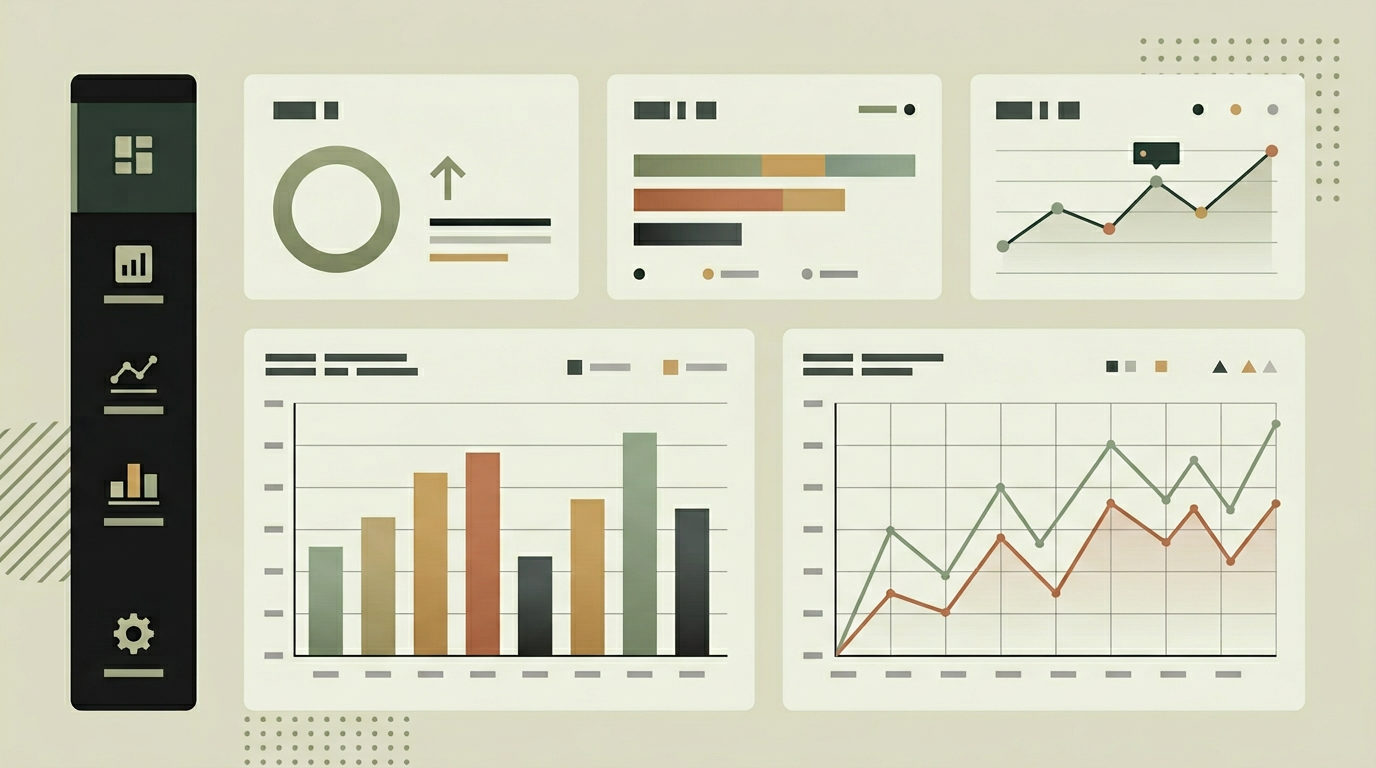
Our retail dashboard consolidates data from your POS system, e-commerce platform, marketplace integrations, and inventory management into a single, real-time view of your business. At the top level, executives see total revenue, margin, and year-over-year growth across all channels. Store managers drill down into location-specific performance, comparing daily revenue, basket size, and conversion against targets and historical benchmarks. Category views reveal sell-through rates, stock cover days, and margin contribution by product group, enabling data-driven assortment decisions. Promotion performance panels measure uplift, cannibalization, and post-promotion dip in a single view, replacing post-campaign guesswork with real numbers. Inventory alerts flag products approaching out-of-stock at any location, or highlight slow movers ripe for markdown. Foot traffic data, when available from sensors, correlates with conversion rates to highlight staffing optimization opportunities. The dashboard is built for speed: pages load in under two seconds even with millions of transaction records, thanks to an optimized data pipeline that pre-aggregates common queries. Every chart and table can be filtered by date range, channel, location, and category, giving each stakeholder the view they need without information overload.
Key features
Omnichannel Revenue View
Unified revenue and margin metrics across physical stores, webshop, and marketplace channels in real time.
Product Performance Matrix
SKU-level sell-through, margin, and stock cover analysis to identify winners, slow movers, and markdown candidates.
Promotion Impact Analysis
Automated uplift calculation comparing promo periods against control periods to measure true incremental revenue.
Inventory Alert System
Real-time stock level monitoring with configurable thresholds that trigger replenishment alerts before stockouts occur.
Store Comparison Benchmarks
Side-by-side performance comparison between locations on revenue, conversion, basket size, and labor efficiency.
Trend Forecasting
Historical pattern recognition that projects demand for the coming weeks, supporting proactive buying and staffing decisions.
Benefits
Faster Merchandising Decisions
Real-time sell-through data means category managers can react to trends within days instead of waiting for monthly reports.
Reduced Stockouts and Overstock
Inventory alerts and demand forecasting keep stock levels aligned with actual demand, protecting both revenue and margin.
Measurable Promotion ROI
Knowing the true uplift of each promotion prevents repeating campaigns that destroy margin without driving incremental sales.
Optimized Store Operations
Traffic-to-conversion analysis highlights when stores need more staff on the floor, reducing missed sales opportunities.
Approach & timeline
We begin by connecting to your POS and e-commerce APIs to build a unified data warehouse. The dashboard layout is co-designed with store managers, buyers, and executives in a series of focused workshops. We deliver a first working version within six weeks, then iterate based on user feedback and data quality findings.
Integrations
Practical scenario
A fashion retailer with 12 physical stores and an online shop used to compile weekly revenue reports in Excel, taking one employee an entire Monday morning. Their custom dashboard automated this entirely and added real-time inventory visibility. Within two months, the buying team identified three product categories consistently overstocked across all stores and adjusted future orders, recovering tens of thousands of euros in tied-up capital.
Success metrics
- Time savings on report compilation
- Stockout frequency reduction
- Markdown rate reduction through earlier identification of slow movers
- Revenue per square meter improvement
Frequently asked questions
Want this solution built for you?
We develop custom software tailored to your industry, processes, and growth plans.
Request a price estimateRelated articles
Real-Time Logistics Dashboards for Smarter Operations
Gain instant visibility into fleet performance, delivery status, and warehouse throughput with a custom logistics dashboard built around your KPIs.
Manufacturing Dashboards: From Shop Floor Data to Decisions
Monitor production output, machine uptime, and quality metrics in a single manufacturing dashboard connected to your OT and ERP systems.
Performance Dashboards for Sports and Fitness Organizations
Track member engagement, class occupancy, and revenue trends in a custom dashboard built for gyms, sports clubs, and fitness franchises.
Your own dashboards with advanced reporting
Combine interactive dashboards with scheduled and ad-hoc reporting. Export polished PDFs, automate weekly digests, and let data speak for itself.