
Customer Feedback System Examples for Businesses
Explore three real-world examples of custom customer feedback systems built by MG Software for businesses across industries. From an NPS measurement platform for a retail chain to in-app feedback for SaaS and multi-channel review aggregation, each example showcases concrete improvements and measurable results that demonstrate how tailored feedback software helps organisations translate customer insights into targeted improvement actions.
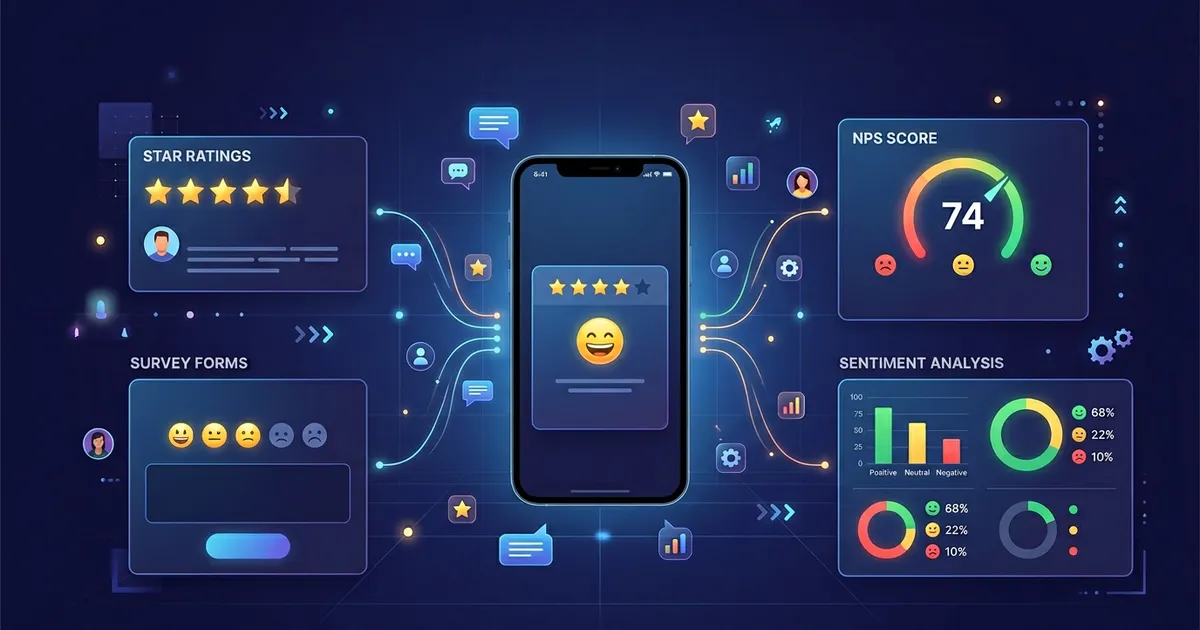
Customer feedback is one of the most valuable data sources for businesses looking to improve their products and services, but collecting, analysing, and turning feedback into action is more complex than it seems. Many organisations rely on standard survey tools that measure satisfaction scores but lack the context to understand why customers give a particular rating. Feedback that exists in isolation from transaction data, user behaviour, and customer history provides only a superficial picture of the actual customer experience. The challenge lies not just in collecting responses, but in linking those responses to relevant customer data, recognising recurring patterns across channels, and converting insights into prioritised improvement actions that genuinely impact customer satisfaction and retention. A custom feedback system integrates feedback collection into your existing processes, combines quantitative scores with qualitative analysis through natural language processing, and makes it straightforward for every team to take targeted action based on real-time data. MG Software has built feedback systems for retail, SaaS, and hospitality businesses that go far beyond a simple NPS score and deliver genuine, actionable insights. Below we present three examples from our practice that demonstrate how custom feedback software works in daily business operations.
NPS and customer satisfaction platform for a retail chain
A retail chain with 28 stores wanted to measure and compare customer satisfaction per location, but the manual surveys they used yielded a response rate of only 3%. There was no insight into which locations performed well and which fell behind, making it impossible to deploy improvement initiatives in a targeted manner. We built a feedback platform that sends customers a short survey directly after their purchase via email and SMS, linked to their transaction data from the POS system. The survey contains an NPS question, two to three contextual questions that vary by product category, and an open field for comments. Because the platform is connected to the POS system, it knows which products the customer purchased, making the questions relevant and specific. The platform analyses results per location, product category, and time of day and displays trends in a management dashboard with month-over-month comparisons. Store managers receive a weekly summary with their top three improvement points and a ranking relative to other locations. When an NPS score falls below 6, a follow-up action is automatically created for the regional manager, including the context of the feedback moment and previous scores for that location.
- Automated survey delivery after purchase via email and SMS linked to transaction data
- Contextual questions that vary by product category for more relevant insights per department
- Management dashboard with NPS trends per location, product category, and time of day
- Automatic follow-up action for low NPS scores with notification to the responsible manager
- Result: response rate rose from 3% to 22% and NPS improved from 31 to 48 in six months
- Integration with the POS system for transaction linking and the CRM for customer history
In-app feedback system for a SaaS product
A SaaS company offering project management software wanted to collect feedback at the moment users are actually using the software, rather than via separate surveys sent weeks later that reached only a fraction of the user base. The existing quarterly survey yielded too few responses to draw reliable conclusions about specific features. We built an in-app feedback widget that appears at strategic moments in the user experience: after completing a project, upon first use of a new feature, and when a user leaves a page without completing the intended action. The widget adapts based on context: for a new feature it asks about usability and expectations, for an abandoned page it asks about the reason with predefined options and an optional open field. A smart frequency limit prevents the same user from being surveyed too often, which would cause survey fatigue. All feedback is automatically categorised by theme and linked to the user account, including metadata such as plan type, usage duration, browser, and which features the user utilised during that session. The product team receives a weekly digest with the most important feedback themes, ranked by frequency and impact.
- Context-sensitive feedback widget appearing at strategic moments in the user experience
- Automatic feedback categorisation by theme with linking to user account data
- Metadata enrichment with plan type, usage duration, browser, and feature usage per feedback item
- Weekly digest for the product team with the most important feedback trends and themes
- Result: 340% more feedback responses compared to the previous quarterly survey
- New feature adoption increased by 25% thanks to targeted improvements based on feedback
Multi-channel review aggregation platform
A hospitality chain with 12 restaurants received reviews on Google, TripAdvisor, delivery platforms, and social media, but had no central overview of what customers were saying about the various locations. Negative reviews sometimes went unanswered for days because nobody was responsible for monitoring, and positive feedback was not systematically leveraged for marketing or staff motivation. We built an aggregation platform that collects reviews from all channels via API connections and web scraping, normalises them into a uniform format, and presents them in a central dashboard. The system analyses sentiment per location and per theme (food, service, atmosphere, price) using a natural language processing model trained on Dutch and English hospitality reviews. When a negative review appears, the location manager receives an immediate notification with a draft response generated based on the specific complaint theme, which can be adjusted and published from within the platform without navigating to the external review channel. Positive reviews are automatically nominated for use on the website and in social media campaigns, with the system selecting the most impactful quotes based on specificity and positive sentiment.
- Aggregation of reviews from Google, TripAdvisor, delivery platforms, and social media in a central dashboard
- Sentiment analysis per location and per theme using natural language processing
- Immediate notification for negative reviews with draft response for quick response
- Automatic nomination of positive reviews for website and social media campaigns
- Result: average response time to negative reviews dropped from 3 days to 4 hours
- Average Google rating increased from 3.8 to 4.3 stars within four months
Key takeaways
- Collecting feedback at the right moment is critical for the quality of insights you obtain. Surveys sent directly after a purchase, service contact, or product interaction yield significantly higher response rates because the experience is fresh in memory. The responses are also more specific and actionable because the customer knows exactly which interaction is being referenced.
- Linking feedback to transaction and user data is what distinguishes custom feedback systems from standard survey tools. By combining an NPS score with purchase data, usage frequency, and customer value, you can recognise patterns that standalone surveys miss, such as the finding that your most valuable customers are dissatisfied on specific points.
- Automatic categorisation and sentiment analysis through natural language processing save your team hours of manually reviewing open-ended responses. Instead of reading hundreds of individual replies, you immediately see which themes recur most frequently, which sentiment dominates per theme, and how trends develop over time across your customer base.
- Quick response to negative feedback limits reputation damage and shows customers their opinion is taken seriously. Customers who receive a fast, personal reaction to a complaint often remain more loyal than those who never experienced a problem at all. An automated notification system with draft responses makes rapid response scalable, even at high volumes.
- Contextual questions that vary per situation, product category, or usage moment deliver significantly more specific insights than generic satisfaction surveys. A customer who just configured a complex product has different feedback needs than someone making a routine repeat purchase. Adapting questions to context increases both response rates and the usefulness of the answers.
- Positive feedback is a valuable but often underutilised marketing resource. When positive reviews and testimonials are systematically collected, categorised, and made available for website, social media, and sales materials, they strengthen the credibility of your brand. A feedback system that automates this process ensures no positive customer experience goes to waste.
How MG Software can help
MG Software builds customer feedback systems that collect, analyse, and convert feedback into concrete improvement actions that directly impact customer satisfaction and retention. Our process begins with an analysis of your customer touchpoints to determine where and when feedback yields the most value. We then design a feedback architecture that fits your situation: NPS measurements after transactions, in-app feedback widgets at strategic moments, review aggregation from multiple channels, or a combination of these approaches. Every system integrates with your existing CRM, POS system, or product platform so feedback is directly linked to customer profiles and transaction history. We deliver not only the technology but also dashboards with automatic trend detection, configurable alerts for negative feedback, and periodic reports that help your team make data-driven decisions. After delivery, we support your team in interpreting the initial results and optimising the feedback strategy. The timeline for a feedback project ranges from six to twelve weeks, depending on the number of channels and integration complexity.
Frequently asked questions
What does a custom feedback system cost?
A basic feedback system with surveys and a dashboard starts from approximately 8,000 euros. More extensive platforms with in-app widgets, multi-channel aggregation, and sentiment analysis range between 15,000 and 35,000 euros depending on desired functionality. The investment is determined by the number of feedback channels, the complexity of the desired analyses, the number of integrations with existing systems, and whether visual or interactive components are required. We always provide a detailed cost estimate after an exploratory conversation.
How is the feedback data analysed?
We implement both quantitative analysis with NPS scores, trends, and comparative benchmarks as well as qualitative analysis via natural language processing that automatically categorises open responses by theme and sentiment. The dashboard presents these insights in clear charts and tables with drill-down capabilities, so you can zoom from an overall trend down to specific feedback items. Periodic reports summarise the most important shifts and are automatically sent to the relevant teams.
Can the system collect feedback from multiple channels?
Yes, we integrate with review platforms such as Google Business, TripAdvisor, and Trustpilot, social media channels including Facebook and Instagram, email surveys, and in-app widgets. All feedback is normalised into a uniform format and presented in a central dashboard so you have a complete overview across all channels. The system also detects duplicate reviews from the same customer across multiple channels and merges them into a single customer profile.
How are customers motivated to give feedback?
Timing and convenience are the most important factors for achieving a high response rate. We send surveys directly after a relevant interaction when the experience is fresh in memory, keep them short with a maximum of three to four targeted questions, and provide mobile-optimised forms that can be completed in under a minute. Optionally, we can integrate incentives such as discount codes, loyalty points, or entry into a monthly prize draw.
Is the system GDPR compliant?
Yes, all feedback systems we build fully comply with GDPR. Customer data is pseudonymised where possible and explicit consent is requested for processing feedback through a clear consent mechanism. Customers have the right to view, correct, or delete their data via the rights portal. We also advise on retention periods for feedback data and implement automatic deletion when the retention period expires, ensuring ongoing compliance without manual intervention.
Can we link feedback to individual customer profiles?
Yes, through integration with your CRM or customer database, we link feedback to individual customer profiles. This makes it possible to recognise feedback patterns per customer segment, region, or product category and to immediately access the full customer history when addressing a complaint, including previous purchases, contact moments, and prior feedback responses. This enables your team to place a complaint in the right context and respond in a personalised manner.
How quickly can we respond to negative feedback?
The system sends an immediate notification for negative feedback via email or mobile push notification, including all context and a draft response tailored to the type of complaint. Your team can respond to reviews and survey responses from the dashboard without navigating to external platforms. The average response time for our clients typically drops to less than four hours, which is a significant improvement over the days that manual monitoring usually requires.
Want to build something like this?
From concept to launch. We deliver custom software that works for your customers and team.
 Discuss your project