
Employee Portal Examples Built for Real Organisations
Three custom employee portal examples: from HR self-service with leave management and expense claims to digital onboarding and automated shift scheduling. With measurable results showing how much time HR departments save.
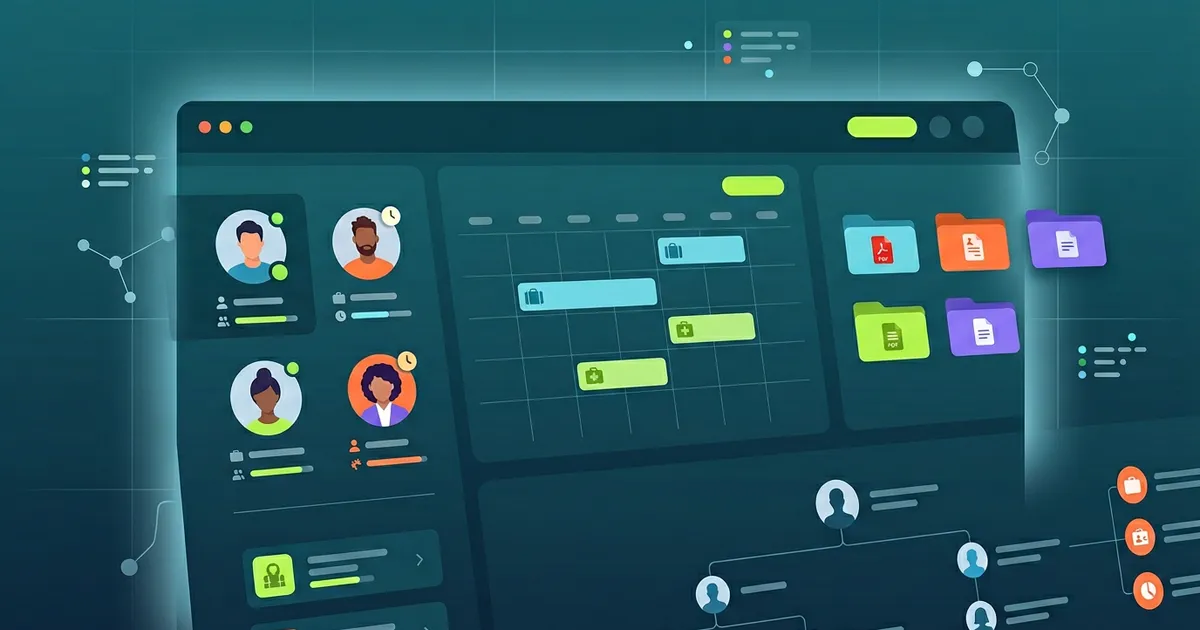
HR departments spend a significant portion of their time handling routine employee requests: leave applications, payslip enquiries, expense claims, and address changes. Research shows that HR staff spend an average of 30 to 40 percent of their working hours on administrative tasks that add little strategic value. An employee portal centralises all these processes in a single digital environment and enables employees to handle matters themselves, at any time and from any device, without HR involvement. This not only saves time for the HR department but also increases employee satisfaction because information is always accessible and requests are processed more quickly. Furthermore, a well-designed portal offers capabilities beyond basic self-service: think of digital onboarding for new hires, automated shift scheduling, and internal communication channels. The key to a successful employee portal is that it integrates seamlessly with your existing processes and systems, rather than being a standalone system that employees need to learn separately. MG Software builds employee portals that go beyond a digital noticeboard and deliver real process automation. Below we share three examples from our practice with diverse HR challenges, organisation types, and concrete results that demonstrate how much impact a well-built portal makes.
HR self-service portal for a mid-size company
An accounting firm with 180 employees across five locations had an HR department of three people handling dozens of routine questions daily. Leave requests went via email, expense claims via paper forms that regularly got lost, and payslips were sent by post. HR staff spent an estimated 60 percent of their time on these repetitive tasks, leaving almost no room for strategic HR work such as employee development and absence prevention. We built a self-service portal where employees can request leave, submit expense claims with photo attachments via their smartphone, and download their payslips and annual statements in a secured personal file. Supervisors approve requests via the portal and receive push notifications for new submissions, ensuring approval happens within hours rather than days. The system automatically calculates the remaining leave balance based on contract hours and collective agreement rules, and blocks requests that exceed the balance. Approved expense claims are automatically forwarded to the accounting department. All HR documents are digitally available, which not only saves time but also improves GDPR compliance by eliminating postal delivery of sensitive documents.
- Digital leave requests with automatic balance calculation and approval workflow
- Expense claim submission with photo attachment via smartphone and automatic forwarding to accounting
- Digital payslips and annual statements available in a secured personal file
- Notifications for supervisors on new requests and for employees on status changes
- Result: HR department saves 15 hours per week on routine questions and administrative tasks
- Integration with AFAS for employee data and payroll processing
Onboarding platform for a fast-growing tech startup
A tech startup hiring five to eight new employees per month had no structured onboarding process and noticed it took weeks before new colleagues were fully productive. New hires received information via scattered emails and Slack messages, causing important steps to be regularly missed: laptops not configured on time, access rights missing, and compliance trainings only completed weeks later. This led to a poor first impression and in some cases early departure of new talent. We developed an onboarding portal with a personalised step-by-step plan per new employee, depending on role, department, and office location. The platform contains checklists for IT setup and access rights, compliance trainings with video and assessments, a team introduction with profiles and contact details, and an onboarding meeting scheduler that automatically books meetings with relevant stakeholders. Each step has a deadline and the system sends automatic reminders to the responsible person when progress falls behind. Managers can monitor the progress of their new team members through a central dashboard that clearly displays all active onboarding processes. Average time-to-productivity decreased from six to three weeks after implementation.
- Personalised onboarding step plan based on role, department, and office location
- Automated checklists for IT setup, access rights, and compliance trainings
- Onboarding meeting scheduler that automatically books meetings with relevant team members and stakeholders
- Progress dashboard for managers with overview of all active onboarding processes
- Result: average time-to-productivity decreased from six to three weeks
- Integration with Slack for notifications and Google Workspace for calendar management
Shift planning and availability portal for a retail chain
A retail chain with 14 stores and 220 part-time employees spent over twelve hours weekly manually assembling schedules in Excel. Employees communicated their availability via WhatsApp groups, which regularly led to miscommunication, understaffing during busy periods, and overstaffing during quiet times. The planner had no overview of contract hours and skills, resulting in some employees consistently working too many or too few hours. When a sick leave was reported, finding replacements meant a manual search through individual phone calls. We built a portal where employees submit their weekly availability via a mobile interface, send swap requests, and view their schedule. The planning system automatically generates a draft schedule based on availability, contract hours, skills, and expected footfall per time slot, which the planner can adjust before publishing. Employees receive a notification as soon as their schedule is available. When a sick leave is reported, the system immediately shows which available employees can cover the shift based on skills and remaining contract hours, and sends them a notification. Scheduling time dropped from twelve to two hours per week and understaffing was reduced by 80 percent.
- Digital availability input by employees with weekly deadline and reminders
- Automatic schedule generation based on availability, contract hours, and skills
- Shift swap requests between employees with planner approval in the system
- Sick leave workflow that immediately shows and notifies available replacements
- Result: scheduling time reduced from 12 to 2 hours per week, understaffing decreased by 80%
- Mobile-first design so store employees use the portal on their phone
Key takeaways
- A self-service portal takes over routine HR tasks and gives employees direct control over their own information.
- Structured onboarding via a digital platform accelerates time-to-productivity for new employees.
- Automatic schedule generation based on availability and skills saves planners hours every week.
- Integration with existing HR systems like AFAS and Personio prevents duplicate administration.
- Mobile access is essential for employee portals, as many employees do not have a fixed workstation.
- Approval workflows with notifications ensure fast handling without anything slipping through the cracks.
How MG Software can help
MG Software builds employee portals that relieve your HR department and give employees a pleasant digital experience. We start by identifying the processes that consume the most time and cause the greatest frustration, both for HR and for employees themselves. Based on this, we prioritise the modules that deliver the most impact and build a portal that provides immediate value. From leave management with automatic balance calculation and expense claims with photo attachments to complete onboarding journeys and automated shift scheduling: we analyse your processes and build a portal that seamlessly aligns with your workflow. Every solution integrates bidirectionally with your existing HR systems such as AFAS, Personio, or SAP SuccessFactors, ensuring data is always synchronised. The portal is delivered with an intuitive interface that employees can use without training, including a fully responsive mobile experience. The timeline for an employee portal project ranges from six to ten weeks. After delivery, we offer maintenance and continued development, so the portal can grow with your organisation.
Frequently asked questions
What does a custom employee portal cost?
A basic employee portal with leave management, expense claims, and document access starts from approximately 8,000 euros. More extensive portals with digital onboarding, automated shift scheduling, multiple integrations, and advanced reporting range between 15,000 and 35,000 euros. The exact investment depends on the number of modules and the complexity of integrations with your existing HR systems. We always provide a no-obligation quote after an intake that maps your specific requirements.
Can the portal integrate with our current HR system?
Yes, we build integrations with common HR systems such as AFAS, Personio, Nmbrs, and SAP SuccessFactors. Employee data is automatically synchronised so no double entry is needed. The integration works bidirectionally: changes in the portal are pushed to the HR system and vice versa.
Can the portal be used on a phone?
All employee portals we build are fully responsive and optimised for mobile use. For organisations where employees primarily work via their phone, we can develop a Progressive Web App that provides a native app experience without requiring installation from an app store.
How is employee data privacy protected?
We implement role-based access control so employees only see their own data and managers only see data for their team. All communication is encrypted and personal data is stored in compliance with GDPR. We conduct a DPIA when the portal processes sensitive data.
Can employees update their own information?
Yes, employees can update their contact details, bank account, and emergency contacts via the portal. Depending on your policy, changes are processed immediately or first submitted for HR approval. All changes are logged in an audit trail for full traceability. Changes are automatically synchronised with your HR system so no manual reconciliation is needed.
How long does it take to build an employee portal?
A standard employee portal with the most commonly used modules is operational in six to eight weeks. More complex projects with multiple integrations, custom workflows, and extensive reporting take ten to fourteen weeks. We deliver working versions along the way so you can test early.
Can we add extra modules later?
Absolutely, our portals are built with a modular architecture specifically designed for extensibility. New modules such as an internal job board, course platform, satisfaction surveys, or an internal communication channel can be added at any time without disrupting the existing portal. The modular design ensures that new functionality can be implemented quickly and cost-effectively.
Want to build something like this?
From concept to launch. We deliver custom software that works for your customers and team.
 Discuss your project